
A question from life
Enlarge image
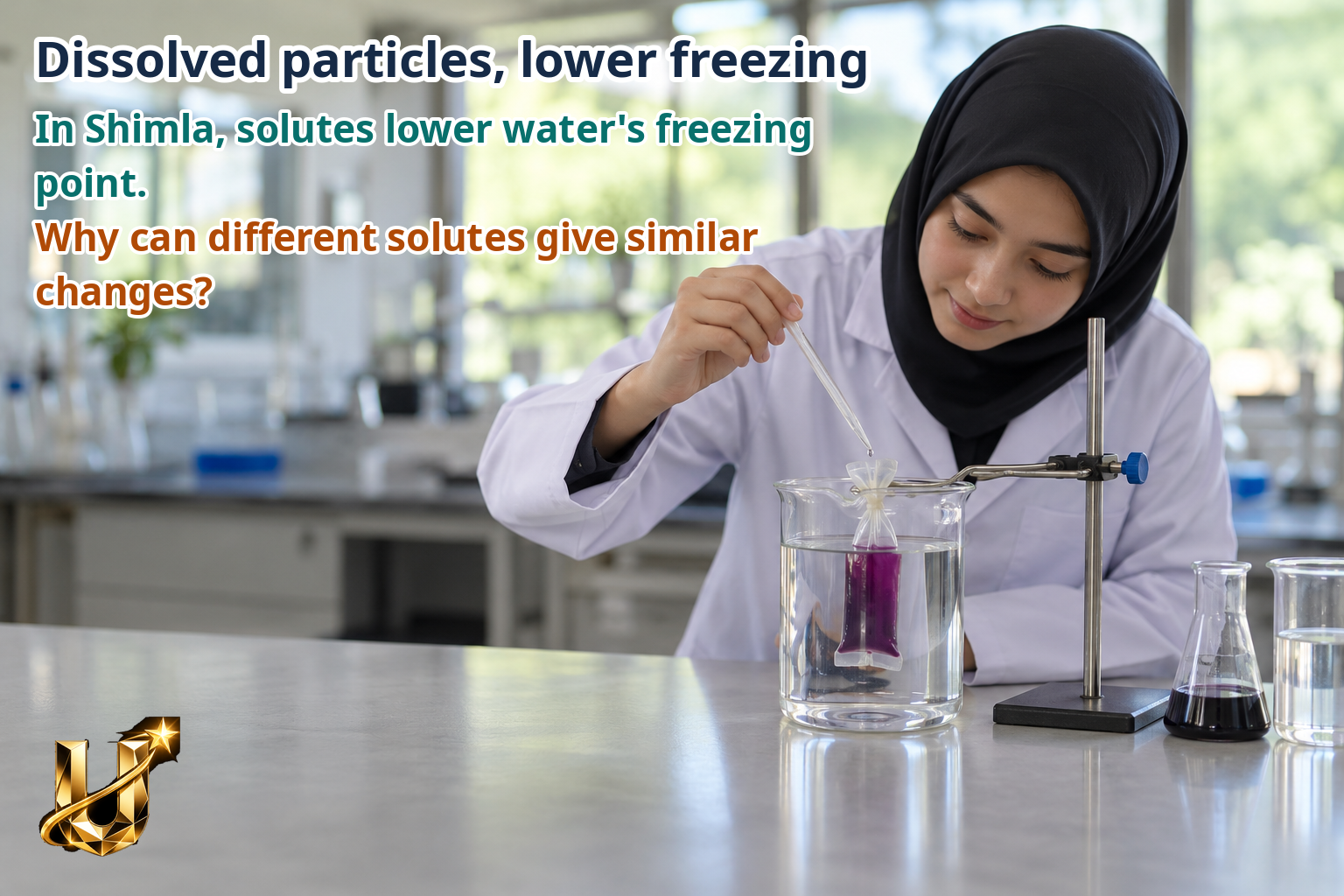
In a Shimla classroom model, dissolved particles lower water's freezing point. Why can different solutes give similar changes when their effective particle concentrations match?
Working review group 1; official unit label pending
In a Shimla classroom model, dissolved particles lower water's freezing point. Why can different solutes give similar changes when their effective particle concentrations match?
The change in Gibbs energy per added amount of a component under specified conditions.
Review lesson not available yet.
In a Shimla classroom model, dissolved particles lower water's freezing point. Why can different solutes give similar changes when their effective particle concentrations match?
For dilute ideal solutions of a nonvolatile solute, colligative properties mainly depend on effective solute particle concentration. Boiling elevationΔTb=iKbm and freezing depressionΔTf=iKfm use molality. Add/subtract these changes from the pure solvent's transition temperature at the same external pressure;100°C and0°C are not universal solvent references.
36.0g glucose of molar mass180g/mol is dissolved in0.500kg water. Use Kf=1.86Kkg/mol andi=1.
Freezing-point depression uses which concentration?
Osmosis is net solvent transfer through a membrane selective for solvent, towards lower solvent chemical potential. For the usual equal-pressure dilute comparison, this is towards the more concentrated solution. Osmotic pressureπ=i cRT is the extra pressure needed to stop net solvent transfer in the ideal dilute model. Use absolute temperature and consistent R units. Reverse osmosis applies sufficient pressure on the solution side to reverse solvent flow.
A dilute nonelectrolyte hasc=0.0100mol/L, T=300K, R=0.0821Latm mol^-1K^-1.
Ideal full dissociation of oneCaCl2 unit produces how many particles?
The van't Hoff factori compares observed colligative effect with the expected nonelectrolyte value. Dissociation tends toi>1 and association toi<1; an ideal fully dissociated NaCl limit isi≈2, but ion interactions cause departures. To find molar mass fromπV=(w/M)RT fori=1, rearrangeM=wRT/(πV). Incorrect particle assumptions give abnormal apparent molar masses.
A model polymer solution has1.00g in1.00L at300K andπ=0.00246atm; assumei=1.
Compare prepared solutions with the same formula-unit concentration but different declaredi. Predict freezing/osmotic rankings and identify all dilute-solution assumptions. Discuss membrane drawings rather than making concentrated solutions or treating biological tissue.
Colligative formulae require dilute-model conditions, consistent concentration and correct particle factor. Osmotic pressure uses Kelvin. Molar-mass inference fails if association or dissociation is ignored.