
A question from life
Enlarge image
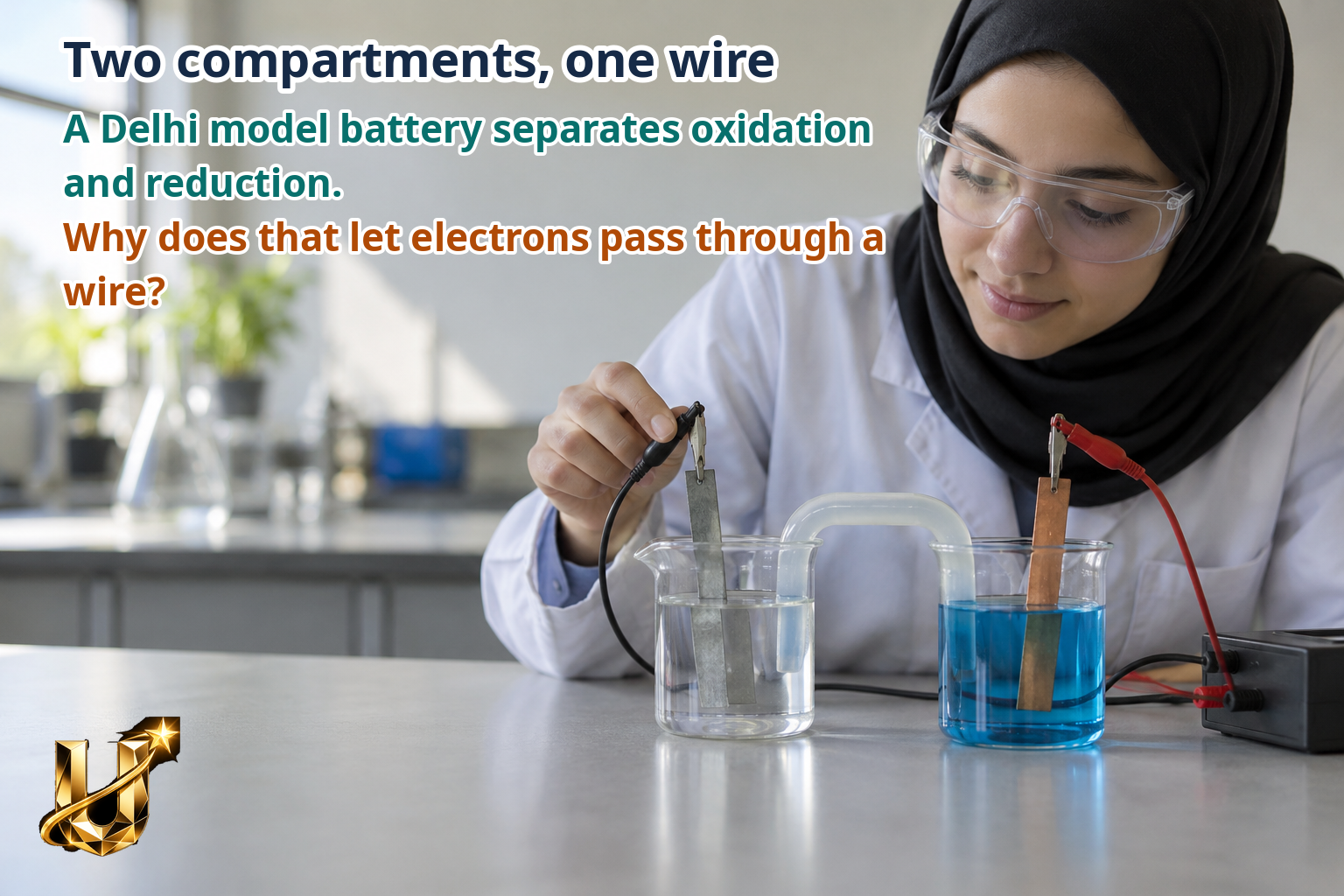
A Delhi model battery separates oxidation and reduction into two compartments. Why does separating them allow electrons to pass through an external wire?
Working review group 1; official unit label pending
A Delhi model battery separates oxidation and reduction into two compartments. Why does separating them allow electrons to pass through an external wire?
A potential measured relative to a reference that describes an electrode’s redox tendency under stated conditions.
Review lesson not available yet.
A Delhi model battery separates oxidation and reduction into two compartments. Why does separating them allow electrons to pass through an external wire?
A galvanic cell converts chemical free energy to electrical work through a spontaneous redox reaction. Oxidation occurs at the anode and reduction at the cathode in every electrochemical cell. In a discharging galvanic cell the anode is negative and cathode positive. Electrons travel through the external wire anode to cathode; ions through electrolyte/salt bridge maintain charge balance. Salt bridges do not carry electrons.
Write the Zn/Cu cell reaction.
Oxidation occurs at which electrode?
A reduction potential is measured relative to a reference such as the standard hydrogen electrode. E°cell=E°cathode−E°anode using both as reduction potentials. Potentials are intensive: do not multiply them by balanced-reaction coefficients. Standard state uses unit activities, gas pressure1bar and stated temperature, often298K; it is not a claim of identical potential at every concentration.
Use E°(Cu²⁺/Cu)=+0.34V and E°(Zn²⁺/Zn)=−0.76V.
Electrons in the external discharging-cell wire flow?
For the written reaction, E=E°−(RT/nF)lnQ. At298K, E≈E°−(0.05916V/n)log10Q. n is transferred electrons per balanced reaction andQ uses activities; dilute concentration ratios approximate them. ΔG=−nFE. At equilibrium E=0, Q=K, and ln K=nFE°/(RT).
At298K take the Daniell cellE°=1.10V, n=2 and ideal activity ratio a Zn²⁺/aCu²⁺=100.
Use half-reaction and electron-arrow cards to build a Daniell-cell diagram. Calculate voltage from supplied reduction potentials and compare activity ratios in the Nernst expression. Use records only; do not assemble metal-salt cells.
Oxidation/anode and reduction/cathode definitions are universal. Cell signs depend on operation. Voltage uses potential differences and composition-dependent Nernst terms;ΔG=−nFE connects spontaneity.