A pretend animal game
Open It is Fun in your student book with an adult. First use this reading explanation and application. The later original examples practise language separately. Separate original practice context: In a classroom in Bhopal, children name animal actions. A fish swims. A bird flies. Which word helps us talk about an ability?
Read the book: It is Fun
The poem invites a child to pretend to move like different animals: a lamb leaping, a cat climbing, a frog hopping and other animals in motion. Acting like them is imaginative play, not becoming an animal. Leap means jump; trot describes a horse’s steady moving gait. The repeated opening idea helps hold the animal actions together.
Practise with the book
Explain the difference between pretending and a literal claim.
- A child can act out a bird’s movement.
- That does not mean the child can grow wings or fly unaided.
- Naming or imagining the action is also a way to join the language activity.
Use can
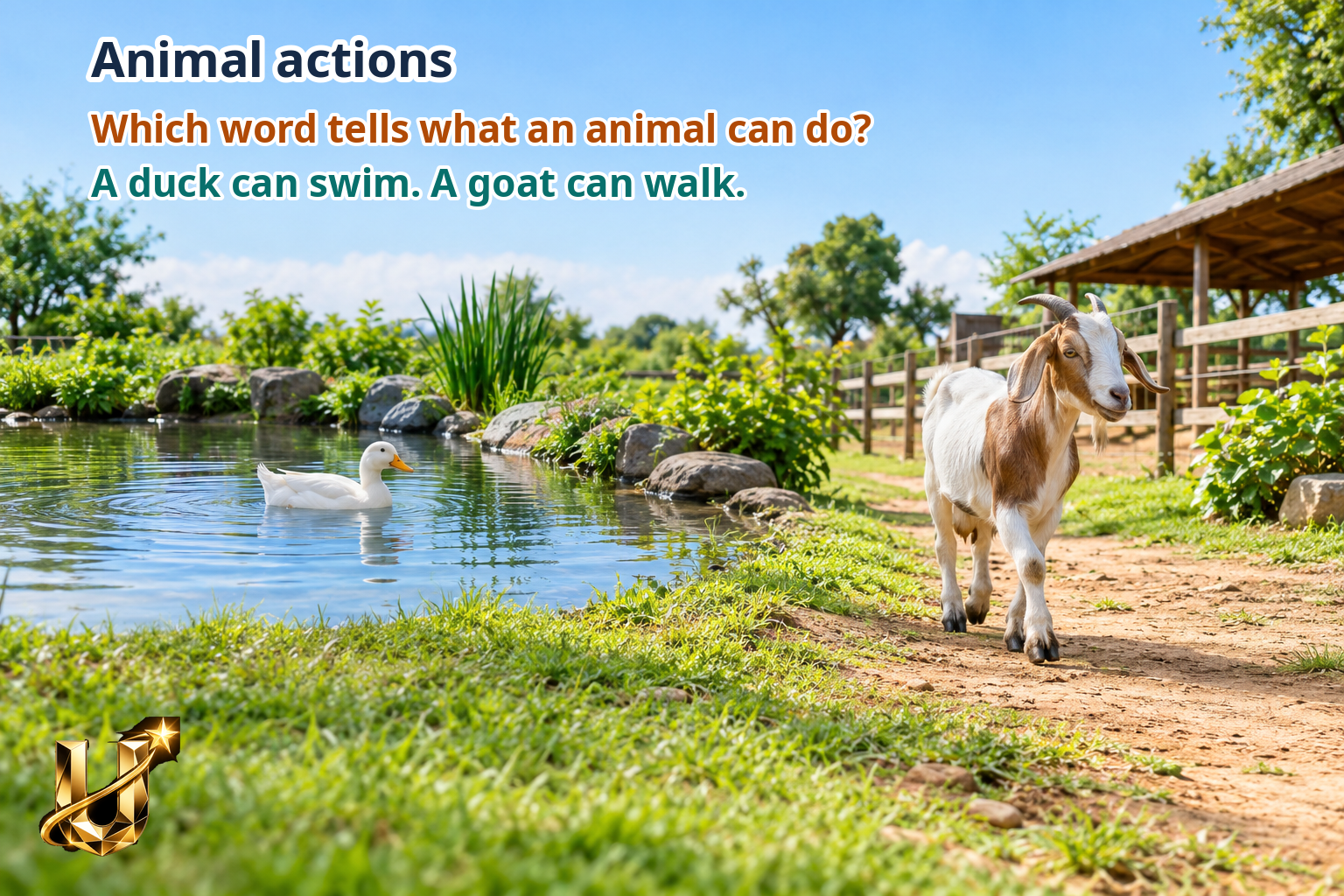
Can tells an ability: A fish can swim. A goat can walk. Use the simple action word after can: can swim, can walk. Do not add s to the action after can. A comparison can use like: I can hop like a rabbit. In I can move like an elephant, an goes before the vowel sound in elephant. Name an action rather than performing it if preferred.
Example 1: Say an ability
A duck moves across a pond.
- Name the duck.
- Choose the action swim.
- Say: A duck can swim.
Use cannot
Cannot tells that an ability is not present in the situation: A fish cannot ride a bicycle. A person may use tools or support to do activities. In pretend games, name actions without expecting everyone to move the same way.
Example 2: Choose the verb form
A goat can walk or walks?
- Can is already in the sentence.
- Use the simple form walk.