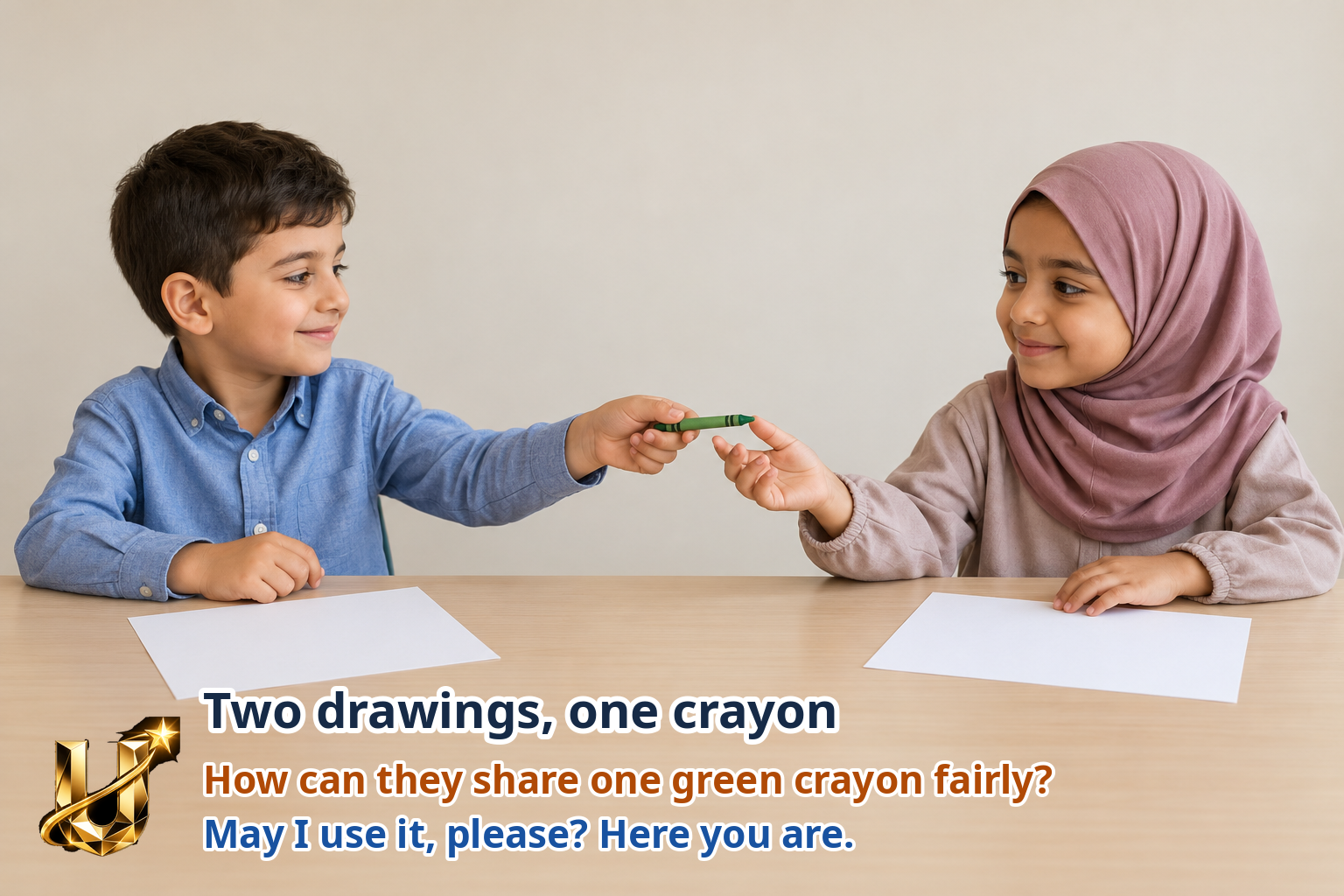
Two drawings, one green crayon
Open Colours in your student book with an adult. First use this reading explanation and application. The later original examples practise language separately. Separate original practice context: In a Jaipur classroom, Meera and Aarav both want a green crayon. There is only one. What could they say to share it fairly? This is an original practice scene.
Read the book: Colours
Two speakers have different crayons and need colours held by the other. Sharing gives them a fuller set for drawing. The poem uses I and you to make cooperation a conversation. A pack is a set kept together. This is the poem’s crayon problem, while our later Meera example practises a new conversation.
Practise with the book
Explain why sharing helps both speakers.
- One needs the other’s red crayon.
- The other needs black.
- Exchanging access gives both more usable colours without requiring either to grab the other’s things.
Name things and actions
Crayon, paper and friend are naming words. Draw, share and wait are action words. A sentence can show both: Meera shares a crayon. Find who, then find what that person does.
Example 1: Find the action
Meera shares a crayon.
- Who? Meera.
- Does what? Shares.
- Shares is the action word.
Make a kind request
May I use the green crayon, please? Yes, after my turn. Thank you. Sharing does not mean grabbing; speakers listen and agree on turns. More beginning blends are heard in crab, drum and print. In green, crab, drum and print, both beginning consonant sounds are heard together. An adult models them without adding an extra vowel.
Example 2: Ask and reply
Aarav wants the same crayon.
- Ask: May I use the green crayon, please?
- Reply: Yes, after my turn.
- Thank the person and wait for the agreed turn.