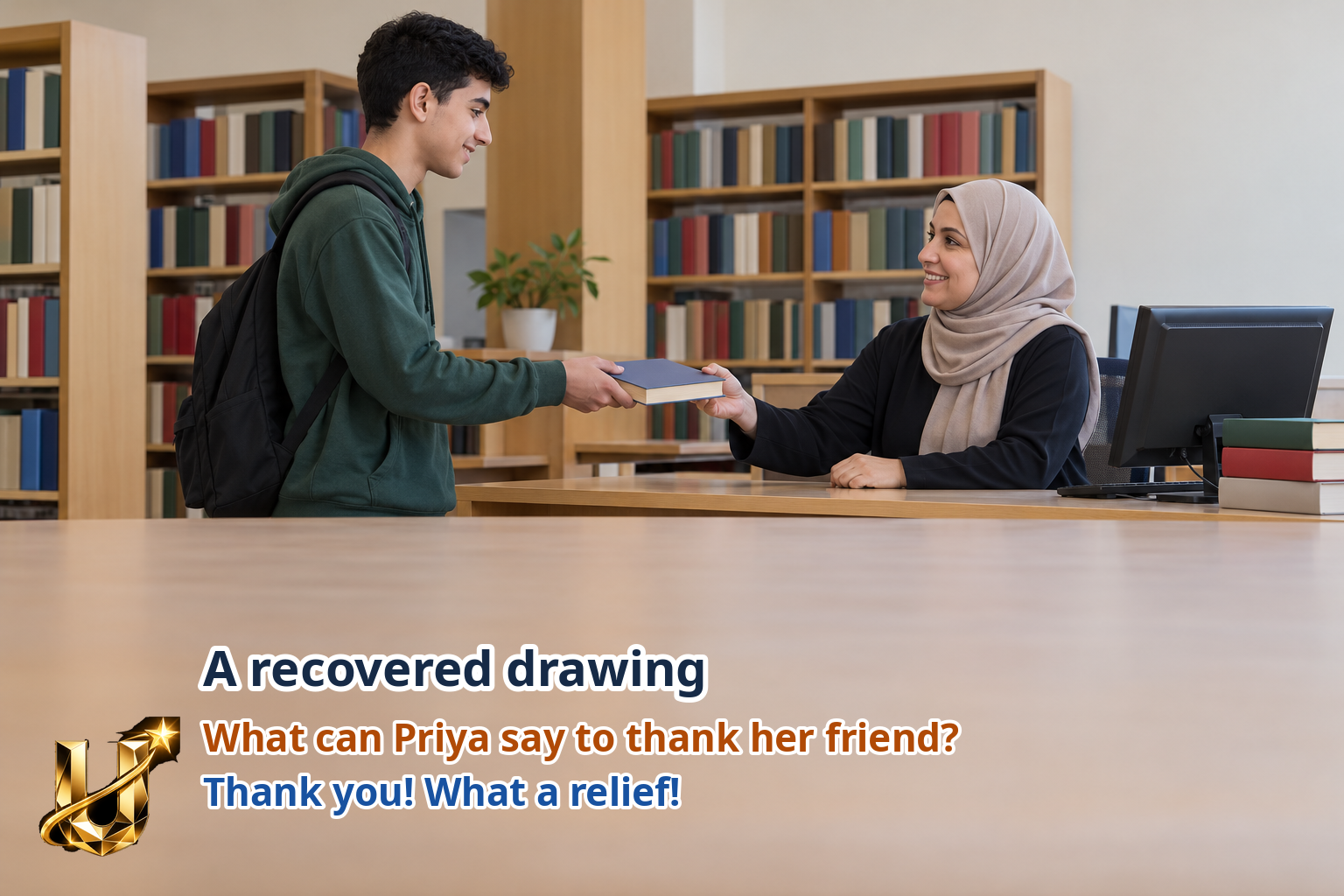
A recovered drawing
Open Thank God! in your student book with an adult. First use this reading explanation and application. The later original examples practise language separately. Separate original practice context: In our new practice scene, Priya thinks her drawing is lost. A friend finds it safely in a folder. Priya feels relieved. What can she say to thank the friend? This scene is separate from the textbook story.
Read the book: Thank God!
A farmer chooses grapes rather than heavy watermelons as a gift for the king. The king throws grapes at him, and the farmer responds with thanks. His surprising explanation imagines how much worse being hit by watermelons would have been. Royal means related to a ruler; wise describes good judgement. The tale uses a comparison for humour without making the king’s behaviour respectful.
Practise with the book
Why does the farmer’s reply surprise the king?
- Being struck would normally suggest a complaint.
- The farmer instead compares it with the worse imagined alternative.
- His thanks refer to having brought the lighter fruit, not to a literal claim that grapes cannot hurt.
Say thanks and tell a feeling
Thank you for finding my drawing. I feel relieved. Relief is a feeling when a worry ends or becomes less. A reason makes thanks clear: Thank you for helping me.
Example 1: Make thanks specific
A friend finds Priya's drawing.
- Start: Thank you.
- Add the reason: for finding my drawing.
- Say the complete thanks kindly.
Use sentence marks
A full stop ends a statement: My drawing is here. A question mark ends a direct question: Where is my drawing? An exclamation mark can show a strong feeling: What a relief! Use it where the feeling fits. A farmer grows food. Farmers grow food. Use is for one farmer in The farmer is busy; use are for more than one in The farmers are busy. Thick and thin are opposites; long and short are another opposite pair.
Example 2: Choose a question mark