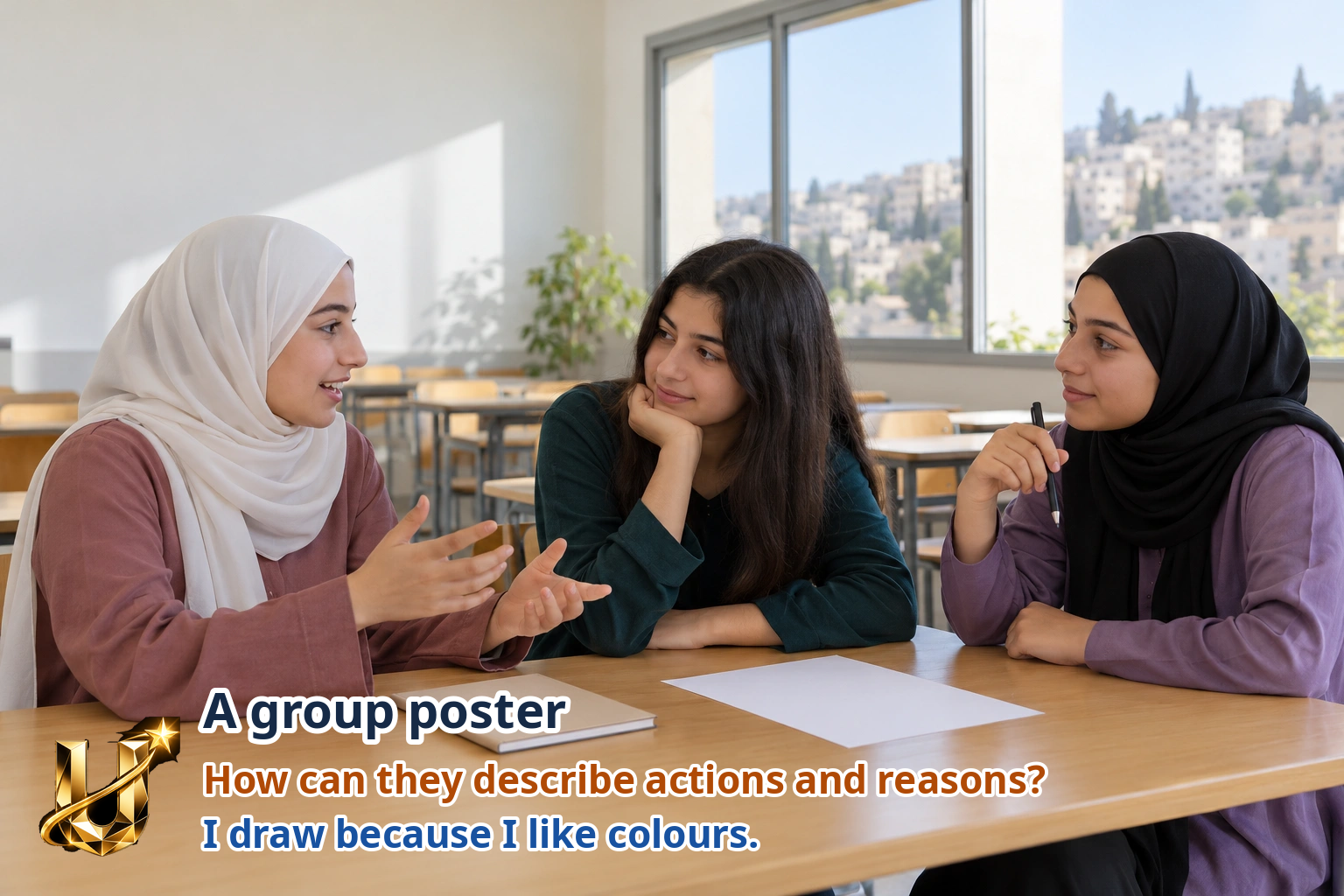
A group poster
Open Together We Can in your student book with an adult. First use this reading explanation and application. The later original examples practise language separately. Separate original practice context: In a Jaipur classroom, four children plan an original poster about books. One draws, one chooses colours, and two organise ideas. How can they describe both their actions and their reasons?
Read the book: Together We Can
The poem celebrates a team’s trust, shared effort and encouragement through winning or losing. Repeated we makes the group its speaking voice. Bond means a close connection; cheer expresses encouragement or joy. Its confident claim about teamwork is poetic encouragement, not evidence that any team can overcome every possible obstacle. The following dialogue connects shared belonging with different foods, languages and celebrations.
Practise with the book
What keeps the team together beyond a result?
- The poem describes sharing in defeat as well as victory.
- Trust and mutual help therefore matter beyond a score.
- Explain the repeated group voice rather than claiming that cooperation guarantees winning.
And adds; but contrasts
And joins related ideas: Aisha draws and Aarav writes. But introduces a contrast: The task is difficult, but we can share it. Use a conjunction to make the relationship clear.
Example 1: Add two actions
Meera draws. Imran writes a heading.
- Both actions belong to the project.
- Join with and.
- Meera draws and Imran writes a heading.
Because gives a reason
We share the task because working together helps us. The words after because explain why. Choose a reason that actually supports the first idea, not an unrelated fact. A collective noun names a group, as in a team of players or a flock of birds. Place words can locate the group: near the gate, behind the bench, in front of the tree, or between two posts. Name the reference points clearly.
Example 2: Show a contrast