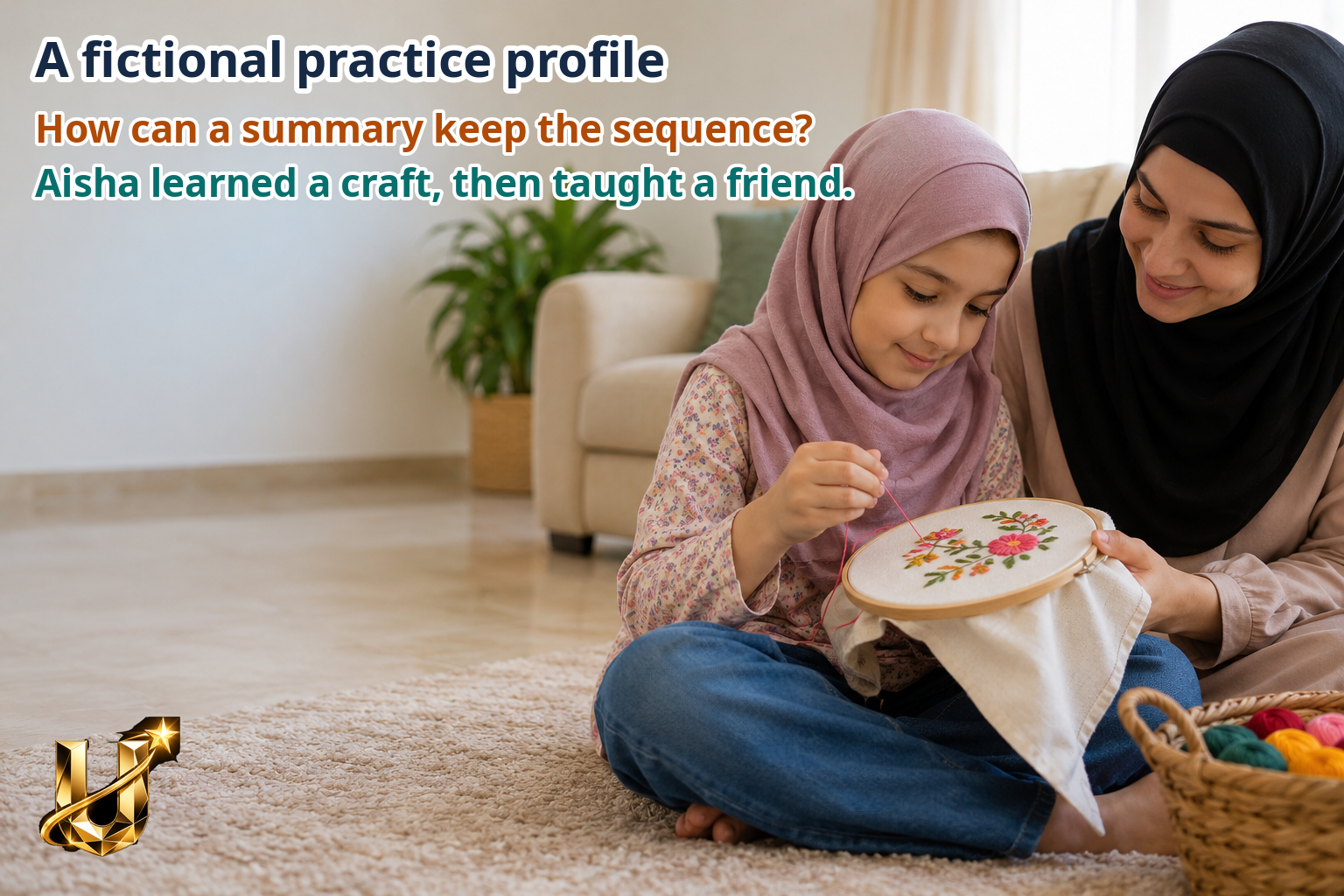
A fictional practice profile
Open Ila Sachani: Embroidering Dreams with her Feet in your student book with an adult. First use this reading explanation and application. The later original examples practise language separately. Separate original practice context: A new profile of an invented learner, Aisha, says she began learning a craft at ten, displayed a piece at fourteen, and later taught a friend. How can a summary preserve the sequence without inventing a birth date? This is not Ila Sachani's biography.
Read the book: Ila Sachani: Embroidering Dreams with her Feet
Ila learns embroidery using her feet, supported by relatives. Exhibitions bring recognition, income and independence. The account connects skilled practice with support and opportunity. Embroidery decorates fabric with stitches; awestruck means deeply impressed.
Practise with the book
What contributes besides determination?
- Relatives teach and encourage her.
- Exhibitions connect her work with buyers.
Biography uses sourced life events
A biography concerns a real person's life and needs accurate sources. Our fictional profile is only practice for arranging events. Never transfer its ages or milestones to the real person named in a textbook title.
Example 1: Order the profile
Learning at ten precedes displaying at fourteen.
- Use the given ages as sequence evidence.
- Later teaching comes after the displayed work.
- Keep all three events in order.
Summarise achievements precisely
Keep the order and stated achievements. Do not invent feelings, limits or dates. Discuss a person's work and choices respectfully, without reducing their whole identity to one physical characteristic. Many threads uses a plural countable noun; much patience uses an uncountable noun in this meaning. A lot of can accompany both. Skill and ability can be near-synonyms in a suitable context; patient and impatient contrast. Much and many are quantity words, not themselves nouns.
Example 2: Handle missing dates