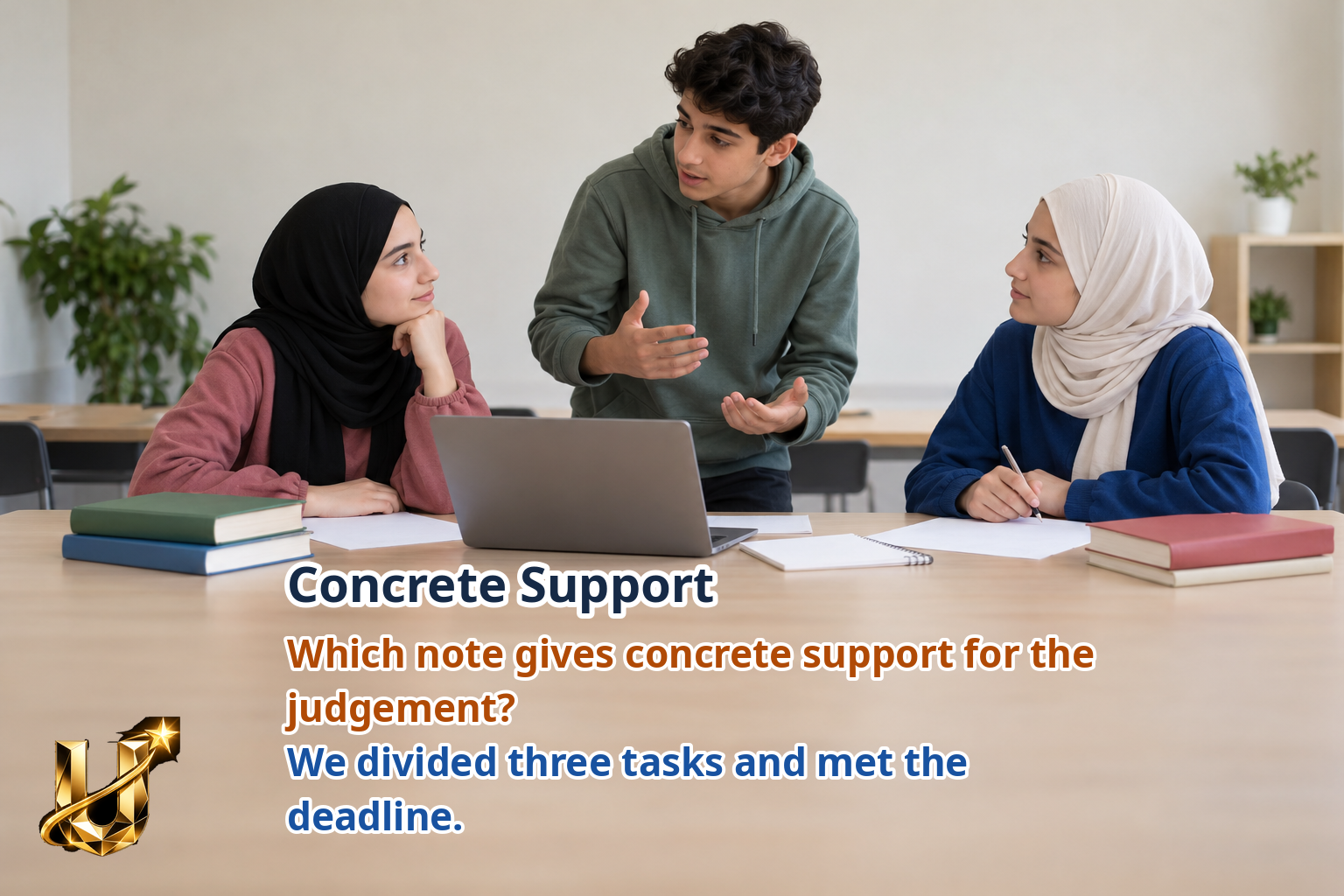
Two descriptions
Open A Concrete Example in your student book with an adult. First use this reading explanation and application. The later original examples practise language separately. Separate original practice context: An original project note says, Our group worked well. A second says, We divided three tasks, met the deadline and checked each other's work. Which gives concrete support for the judgement?
Read the book: A Concrete Example
Mrs. Jones cherishes tiny plants among garden stones. The speaker overlooks a flower while standing on it. Repeated description and the final reply create a comic reversal. Concrete suggests both solid material and something specific; delicate means easily damaged.
Practise with the book
Why does the ending surprise?
- The flower is present throughout the conversation.
- The speaker's search overlooks their own position.
Abstract judgement and specific detail
Worked well is a broad evaluation. Concrete details name observable actions or particulars. They help readers understand what the judgement is based on, without automatically proving every possible meaning of well.
Example 1: Find the judgement
Our group worked well.
- Identify the evaluative phrase.
- Ask what specific behaviour supports it.
- Do not treat the judgement as its own evidence.
Choose relevant examples
Evidence must match the point. Dividing tasks and meeting a deadline support organisation. A blue poster may describe colour, but it does not by itself support good cooperation. Explain the relevance of the example. A concrete noun names something perceived through the senses, such as a stone; an abstract noun names an idea or quality, such as patience. Concrete can also mean specific, as in concrete evidence. A pun plays on word meanings or sounds. A refrain repeats a line or phrase; a rhyme scheme records ending-sound patterns.
Example 2: Find concrete support
We divided three tasks.