
A question from everyday life
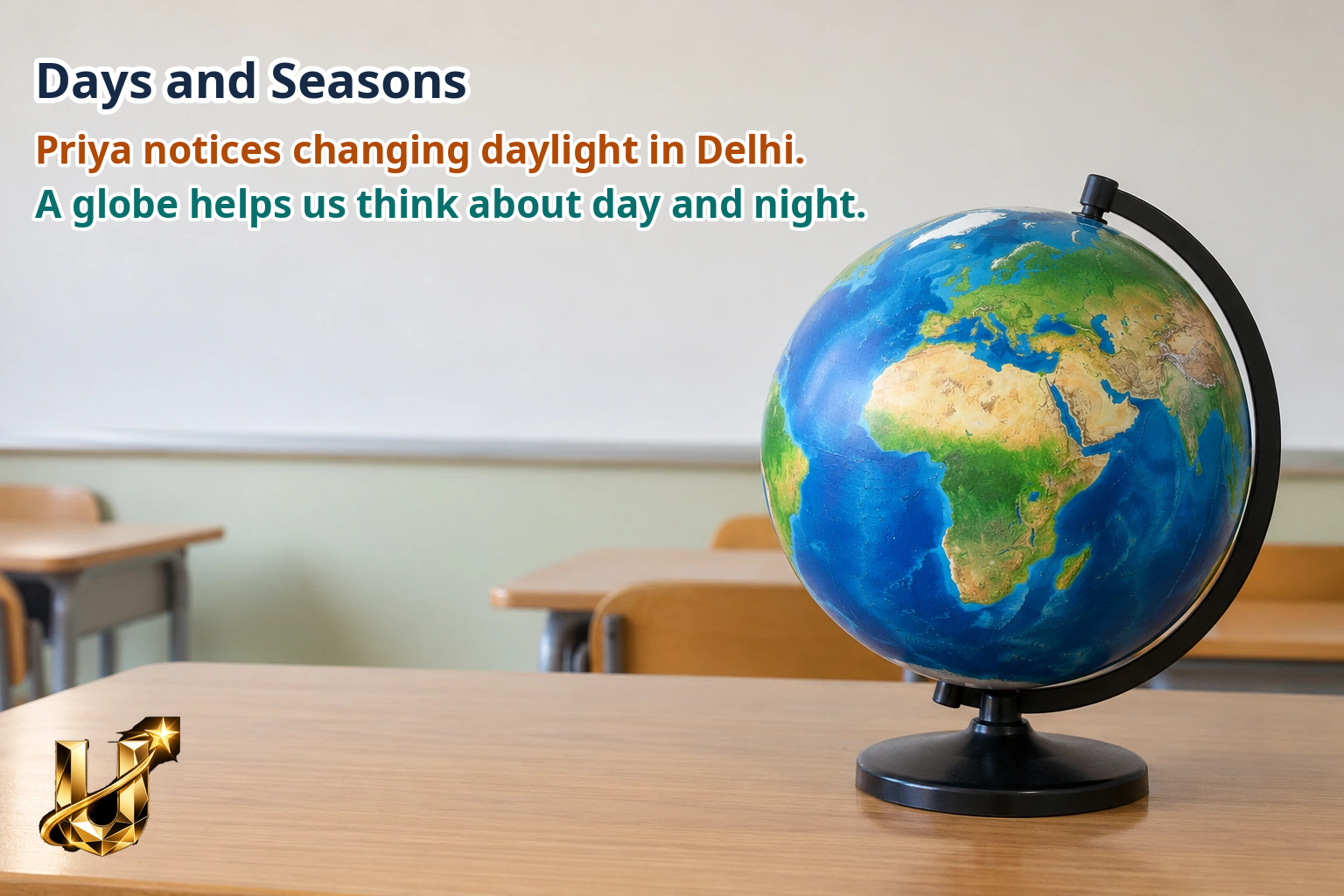
Enlarge image

Enlarge image
In Delhi, Priya notices changing daylight and different plant activity over the year. Why do some natural changes repeat without happening identically everywhere?
Unit 5: Our Amazing Planet
In Delhi, Priya notices changing daylight and different plant activity over the year. Why do some natural changes repeat without happening identically everywhere?
Atmospheric conditions at a particular place and time.
Review lesson not available yet.
In Delhi, Priya notices changing daylight and different plant activity over the year. Why do some natural changes repeat without happening identically everywhere?
Earth's rotation changes which side faces the Sun, producing day and night. Plants and animals may show patterns of activity linked to light and darkness. Not every animal is active at the same time.
An adult turns a globe beside a safe room light. A marked place enters the dark side. What is represented?
Day and night mainly result from:
Earth travels around the Sun with a tilted axis. Changing sunlight angle and day length help explain seasons. Seasons are not mainly caused by Earth moving closer to the Sun. Local rain and temperature patterns also vary.
Aarav says winter happens because the Sun switches off. Is that the seasonal explanation?
The main seasonal explanation involves:
Some plants flower, fruit or shed leaves at particular times. Some animals migrate or change activity as conditions change. Species differ, so one plant or bird does not establish a rule for all living things.
One tree has fewer leaves in a certain month. Can Meera say every plant loses leaves then?
Use fictional dated plant pictures or an approved globe model. Describe a repeated pattern and one reason not to generalise it to every species.
Daily rotation and seasonal sunlight changes help explain natural rhythms. Living things respond in varied ways.