
A question from life
Enlarge image
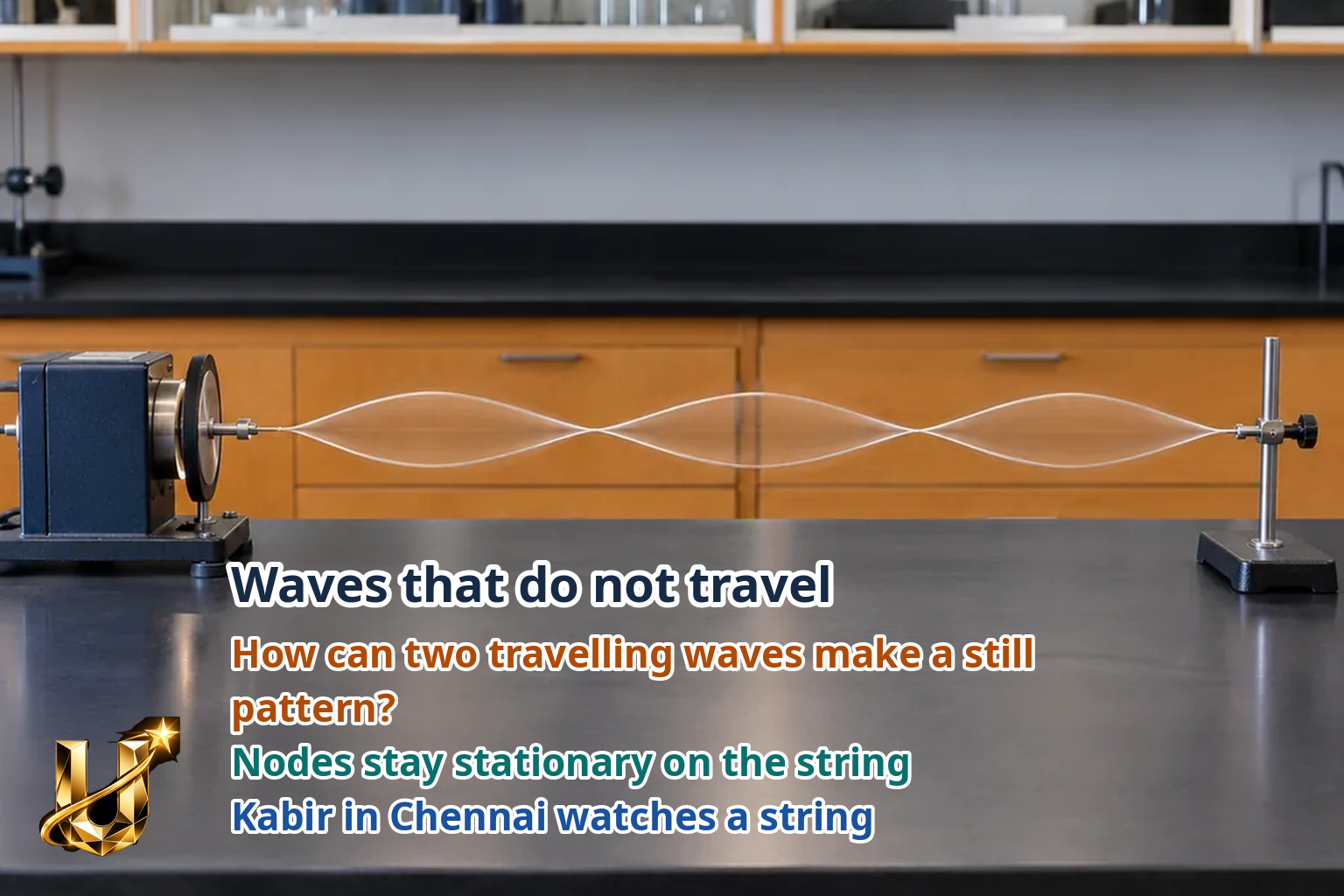
Kabir in Chennai sees a simulated string with stationary nodes. How can two travelling waves combine into a pattern that does not travel along the string?
Working review group 7; official unit label pending
Kabir in Chennai sees a simulated string with stationary nodes. How can two travelling waves combine into a pattern that does not travel along the string?
Addition of disturbances at a point in a linear wave model.
Review lesson not available yet.
Kabir in Chennai sees a simulated string with stationary nodes. How can two travelling waves combine into a pattern that does not travel along the string?
In a linear medium, overlapping disturbances add algebraically at each point. Constructive or destructive interference depends on phase. Destructive interference at a point does not mean energy is universally destroyed; energy distribution and boundary conditions must be considered.
A fixed-end string has L = 1 m and v = 100 m/s.
What is a standing-wave node?
Equal-frequency waves travelling oppositely can form a standing pattern with nodes and antinodes. For a string fixed at both ends, λn = 2L/n and fn = nv/(2L). In ideal air columns, open ends are displacement antinodes and closed ends displacement nodes; a one-closed-end pipe has odd harmonics in the simple model.
An ideal pipe of length 0.5 m is closed at one end; use v = 340 m/s.
For a fixed-end string L = 2 m and v = 120 m/s, what is f₁?
Two close frequencies can produce periodic amplitude variation with beat frequency |f₁−f₂|. Beat frequency differs from the rapid oscillation frequency. Standing-wave points do not all have equal amplitude; adjacent loops can oscillate in opposite phase.
Prepared low-volume tones have frequencies 256 Hz and 260 Hz.
Use standing-wave diagrams and recorded safe-volume beat traces. Identify boundaries before selecting modes; do not create loud resonance or hearing-limit tests.
Superposition explains interference, standing waves and beats. Boundary conditions select allowed modes, while beat frequency is the difference between close frequencies.