
A question from life
Enlarge image
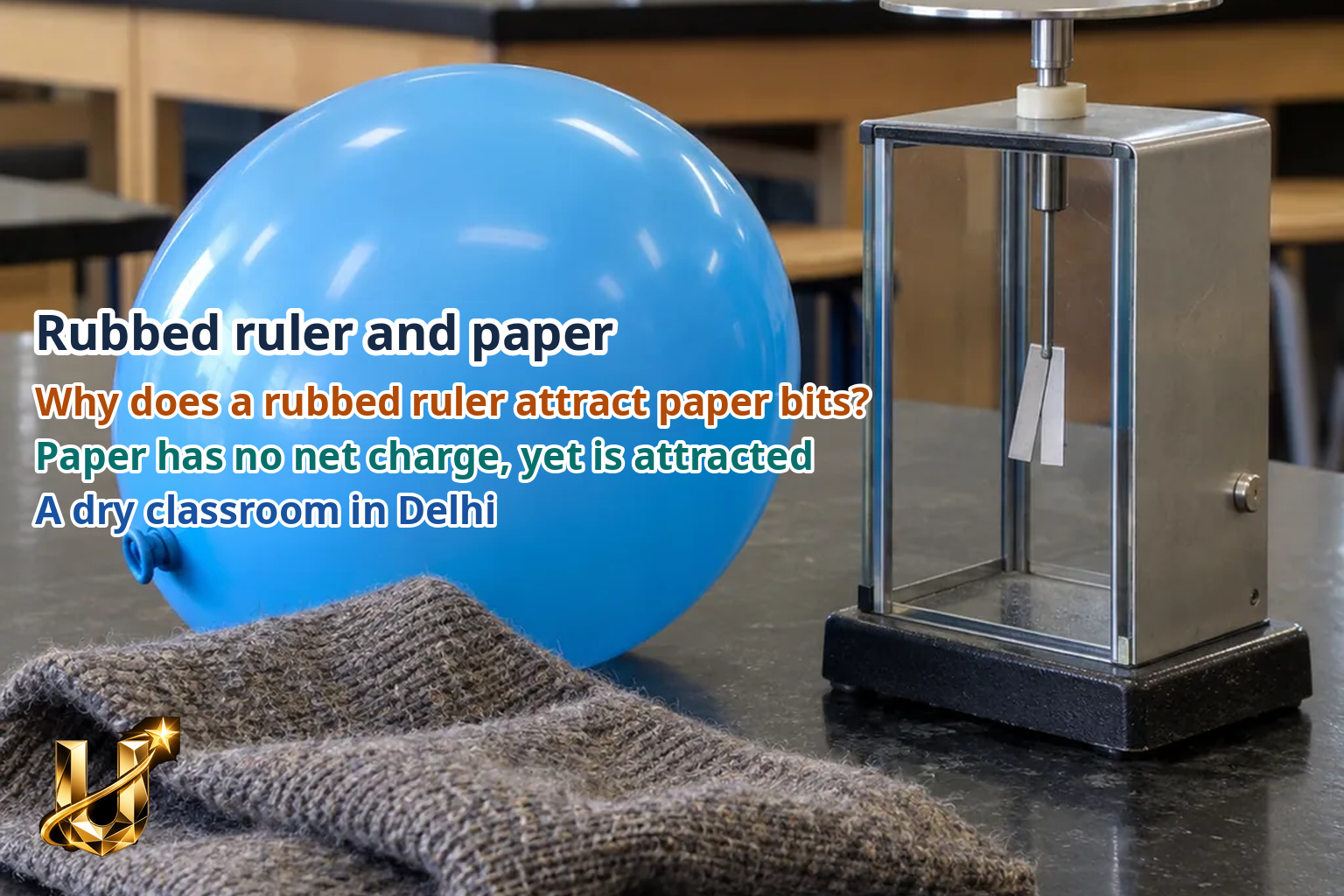
In a dry Delhi classroom, why can a rubbed plastic ruler attract tiny paper pieces even when the paper has no net charge?
Working review group 1; official unit label pending
In a dry Delhi classroom, why can a rubbed plastic ruler attract tiny paper pieces even when the paper has no net charge?
The vector sum of individual fields or forces in the applicable linear model.
Review lesson not available yet.
In a dry Delhi classroom, why can a rubbed plastic ruler attract tiny paper pieces even when the paper has no net charge?
Charge can be positive or negative. Like charges repel and unlike charges attract. Ordinary rubbing transfers electrons; it does not create net charge. A neutral object can be attracted through redistribution of its charges. Electrons move readily through a metal conductor but are less mobile in an insulator.
Asha's model shows a neutral bead gaining three electrons. What sign does it acquire?
Rubbing two initially neutral isolated objects changes their total net charge to what?
Total signed charge of an isolated system stays constant. Identical isolated metal spheres brought into contact share total charge equally after equilibrium, if leakage and external influences are negligible. Unequal objects do not generally share equally.
Identical metal spheres have +6 μC and −2 μC. They touch, then separate in isolation. Find each final charge.
Which object becomes positive?
A body's net charge is q = n e, where n is a signed integer and e = 1.60 × 10^-19 C. Losing electrons leaves positive charge; gaining electrons leaves negative charge. Charging by induction can charge a conductor without contact with the charged inducing object, using a correctly ordered earth connection.
A model object loses 2.0 × 10^10 electrons. Find its net charge from an initially neutral state.
Use signed charge cards, not electrical equipment. Move two negative cards between two paper circles and explain why each charge changes while their total does not. Then compare identical and unequal conducting-object claims aloud.
Charging redistributes charge. Conserve signed totals; use equal sharing only for the stated identical-sphere model. Net charge is an integer multiple of e, and electron loss produces positive charge.