
A question from life
Enlarge image
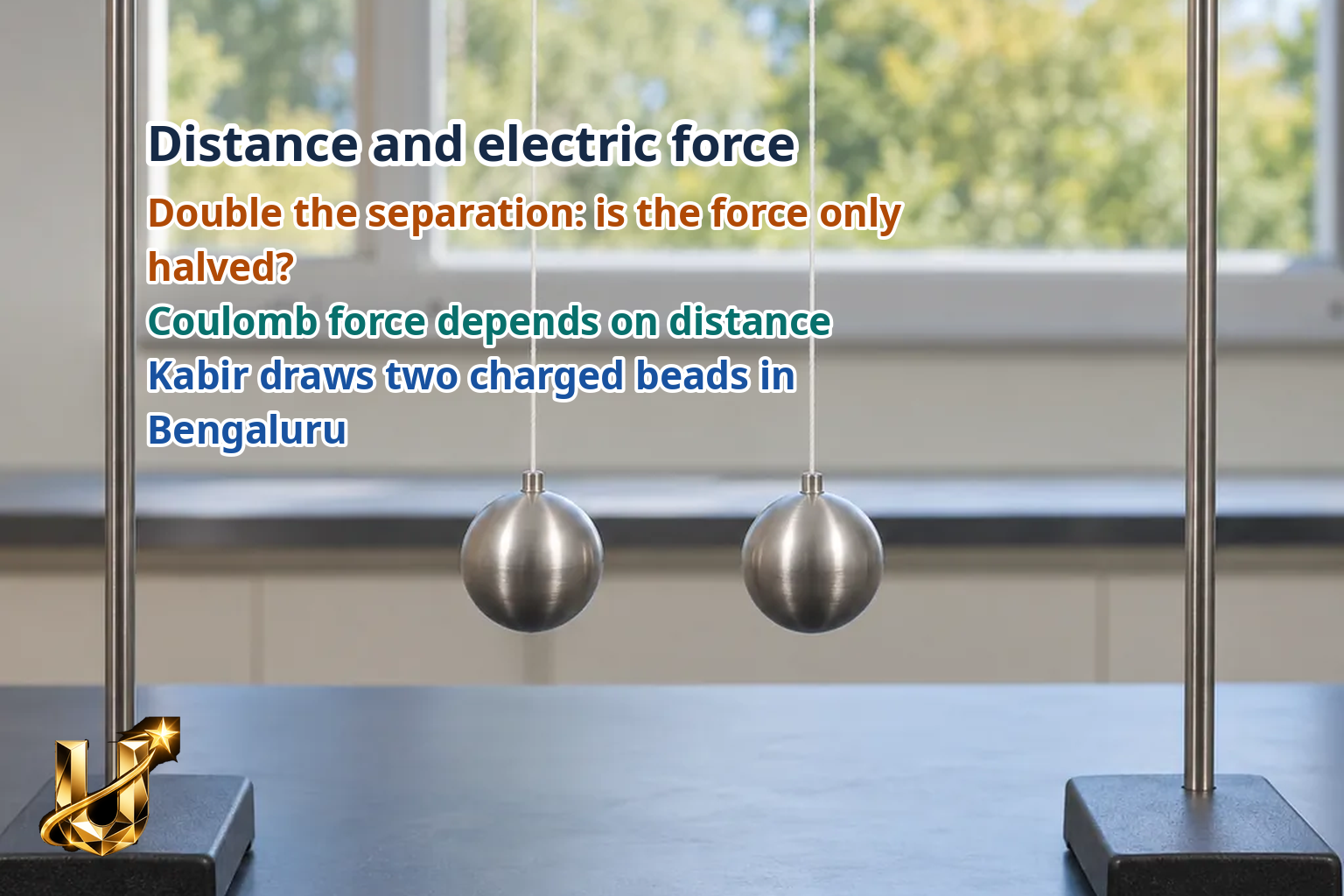
Kabir draws two charged beads on a Bengaluru science display. If he doubles their separation in the model, does their electric force merely halve?
Working review group 1; official unit label pending
Kabir draws two charged beads on a Bengaluru science display. If he doubles their separation in the model, does their electric force merely halve?
The vector sum of individual fields or forces in the applicable linear model.
Review lesson not available yet.
Kabir draws two charged beads on a Bengaluru science display. If he doubles their separation in the model, does their electric force merely halve?
For stationary point charges in vacuum, F = k |q1 q2| / r², with k ≈ 9.0 × 10^9 N m² C^-2. Separation r is in metres. The force acts along their joining line: like signs repel, unlike signs attract. This point-charge formula needs appropriate small-body or symmetric-body assumptions.
Two positive point charges, 2.0 μC and 3.0 μC, are 0.10 m apart in vacuum. Find the force.
If separation triples at fixed charges, force becomes what?
With charges fixed, multiplying separation by a factor s divides force magnitude by s². The forces on the two charges are equal in magnitude and opposite in direction, acting on different bodies; do not add them as a force on one body.
The pair is moved from 0.10 m to 0.20 m without changing charges.
Two negative charges interact how?
Find each force on the selected charge as if the others were absent, then add forces as vectors. In a line, choose a positive direction and use signed components. Electric field describes force per unit small positive test charge: E = F/q0; the test charge should not appreciably disturb the sources.
In a one-dimensional model, other charges exert 6 N right and 2 N left on a chosen bead. Find its net electric force.
Discuss a paper diagram of three stationary charges. Mark the forces on the central charge only, choose an axis and add components. Change one sign and explain which arrow reverses. Use the diagram rather than charged apparatus.
Use Coulomb's law with SI units and stated point-charge assumptions. Signs set attraction or repulsion. Changes in distance are squared, and several forces add as vectors on the chosen body.