
A question from life
Enlarge image
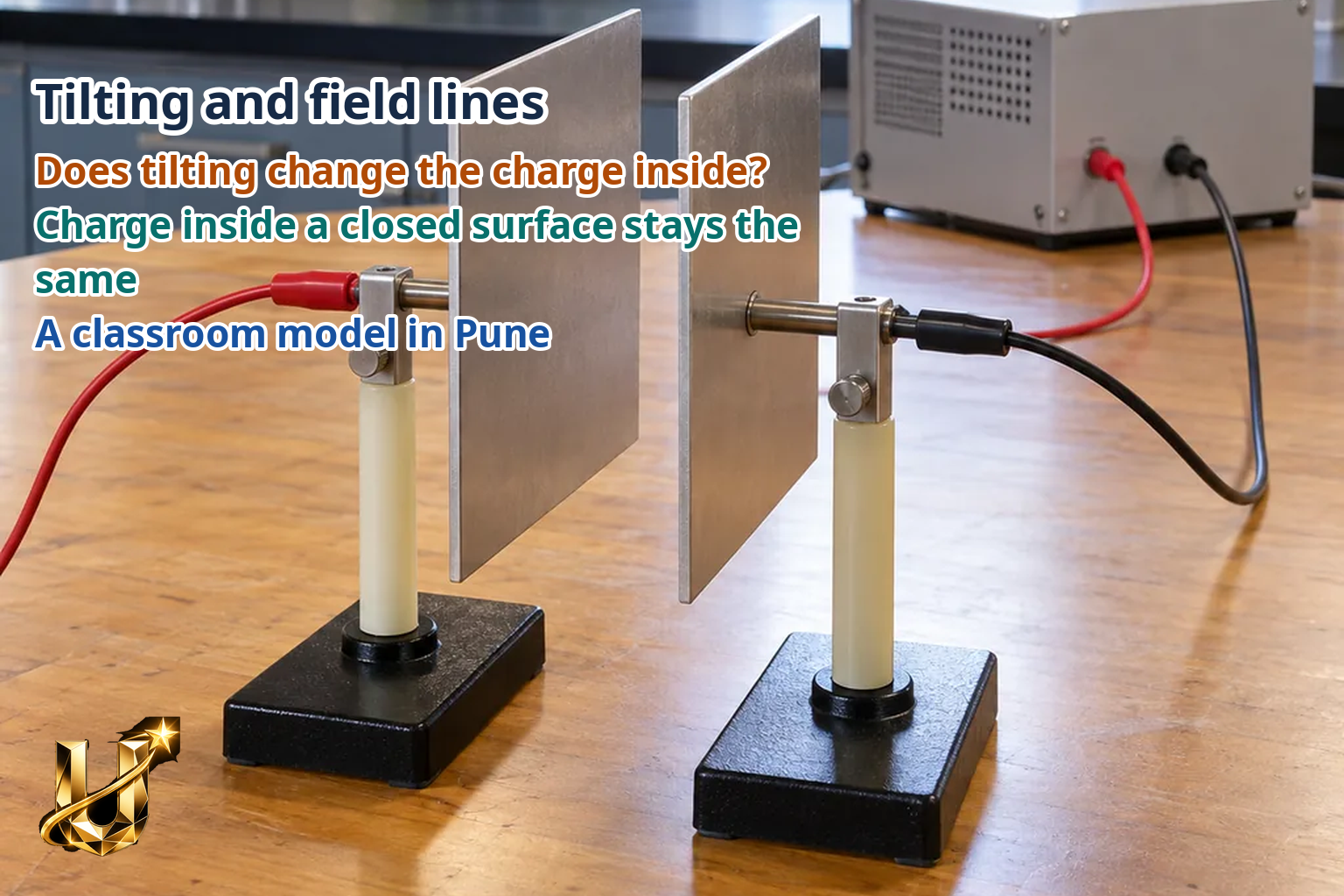
In a Pune classroom model, a tilted imaginary surface intercepts fewer field lines. Does tilting the drawing change the charge inside a closed surface?
Working review group 1; official unit label pending
In a Pune classroom model, a tilted imaginary surface intercepts fewer field lines. Does tilting the drawing change the charge inside a closed surface?
The vector sum of individual fields or forces in the applicable linear model.
Review lesson not available yet.
In a Pune classroom model, a tilted imaginary surface intercepts fewer field lines. Does tilting the drawing change the charge inside a closed surface?
The vector field is force per small positive test charge. Field lines point away from positive charges and towards negative charges; they never cross. For a dipole, p = q d points from −q to +q, where d is their separation. In a uniform field the net dipole force is zero, but torque has magnitude pE sinθ and tends to align the dipole.
A negative 2 μC charge sits in a uniform field 300 N/C east. Find its force.
Flux is EA cosθ when θ is measured from what?
For a uniform field through a flat surface, electric flux Φ = EA cosθ, where θ is measured from the chosen surface normal. Flux is signed and has units N m²/C. Curved or nonuniform cases require summing E·dA. For a closed surface the normal points outward.
A uniform field is 400 N/C, surface area 0.25 m² and angle to its normal 60°. Find flux.
Zero enclosed charge guarantees what?
For any closed surface in electrostatics, net outward flux ∮E·dA = Qenclosed/ε0. External charges affect the local field but contribute zero net closed-surface flux. Zero net flux does not mean zero field. Symmetry is needed to turn the law into a simple field calculation: an infinite line gives E = λ/(2πε0r), an infinite nonconducting sheet gives E = σ/(2ε0), and a uniformly charged thin spherical shell gives zero field inside and kQ/r² outside.
A closed surface encloses +8.85 μC. Use ε0 = 8.85 × 10^-12 C²/(N m²).
Use a drawn box in a uniform field. Mark inward and outward flux arrows on opposite faces and explain cancellation. Then place a positive charge inside the drawing. Discuss why Gauss's law gives net flux without necessarily giving the field at every point.
Fields are vectors; flux is a signed surface measure. A closed surface's net flux depends only on enclosed charge. Symmetry, not Gauss's law alone, permits a simple field formula.