
A question from life
Enlarge image
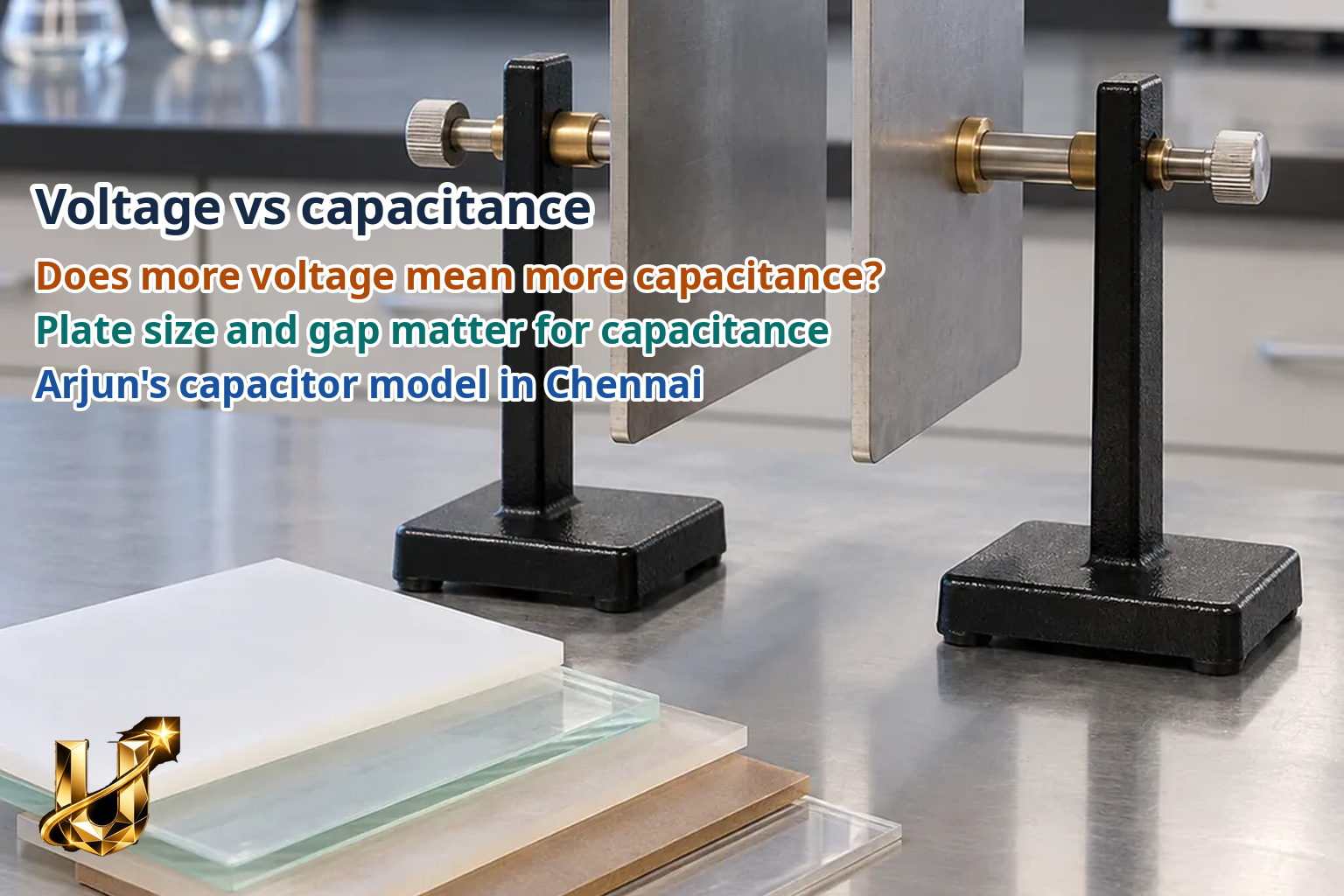
Arjun's Chennai model uses capacitors with different plate sizes. Why does a larger voltage not itself mean the capacitor has a larger capacitance?
Working review group 1; official unit label pending
Arjun's Chennai model uses capacitors with different plate sizes. Why does a larger voltage not itself mean the capacitor has a larger capacitance?
Change of electric potential energy per unit test charge.
Review lesson not available yet.
Arjun's Chennai model uses capacitors with different plate sizes. Why does a larger voltage not itself mean the capacitor has a larger capacitance?
A capacitor stores separated charges +Q and −Q. Its capacitance C=Q/V uses plate-charge magnitude and potential difference. For a linear ideal capacitor C depends on geometry and dielectric, not on Q alone. Parallel plates with negligible edges have C=ε0κA/d when the uniform dielectric fills the whole gap.
A=0.020 m², d=0.0010 m, κ=2.0. Use ε0=8.85 × 10^-12 F/m.
Doubling plate area at fixed gap and dielectric changes C how?
Parallel capacitors share voltage: Ceq=ΣCi and total supplied plate charge is CeqV. Initially uncharged series capacitors with neutral isolated joining conductors have equal charge magnitudes: 1/Ceq=Σ(1/Ci), and voltages add. Trace connections rather than judging from the drawing's shape.
Initially uncharged 2 μF and4 μF capacitors are connected in series across10 V.
For parallel capacitors, which quantity is shared?
Stored energy is U=½CV²=Q²/(2C)=½QV. Inserting a dielectric increases C. If disconnected with negligible leakage, Q stays fixed and V and U decrease. If kept across an ideal fixed-voltage source, V stays fixed and Q and stored U increase; energy exchange with the source must be included.
A 3 μF capacitor is at12 V. It is disconnected before a dielectric doubles its capacitance.
Use capacitor circuit cards and identify nodes aloud. Compare identical capacitors placed in series and in parallel. Then state whether Q or V stays fixed in disconnected and ideal-source-connected dielectric cases. Do not handle or open real charged capacitors.
Capacitance depends on geometry and material. Series and parallel rules differ. Stored energy contains a factor½, and dielectric predictions require stating whether Q or V is fixed.