
A question from life
Enlarge image
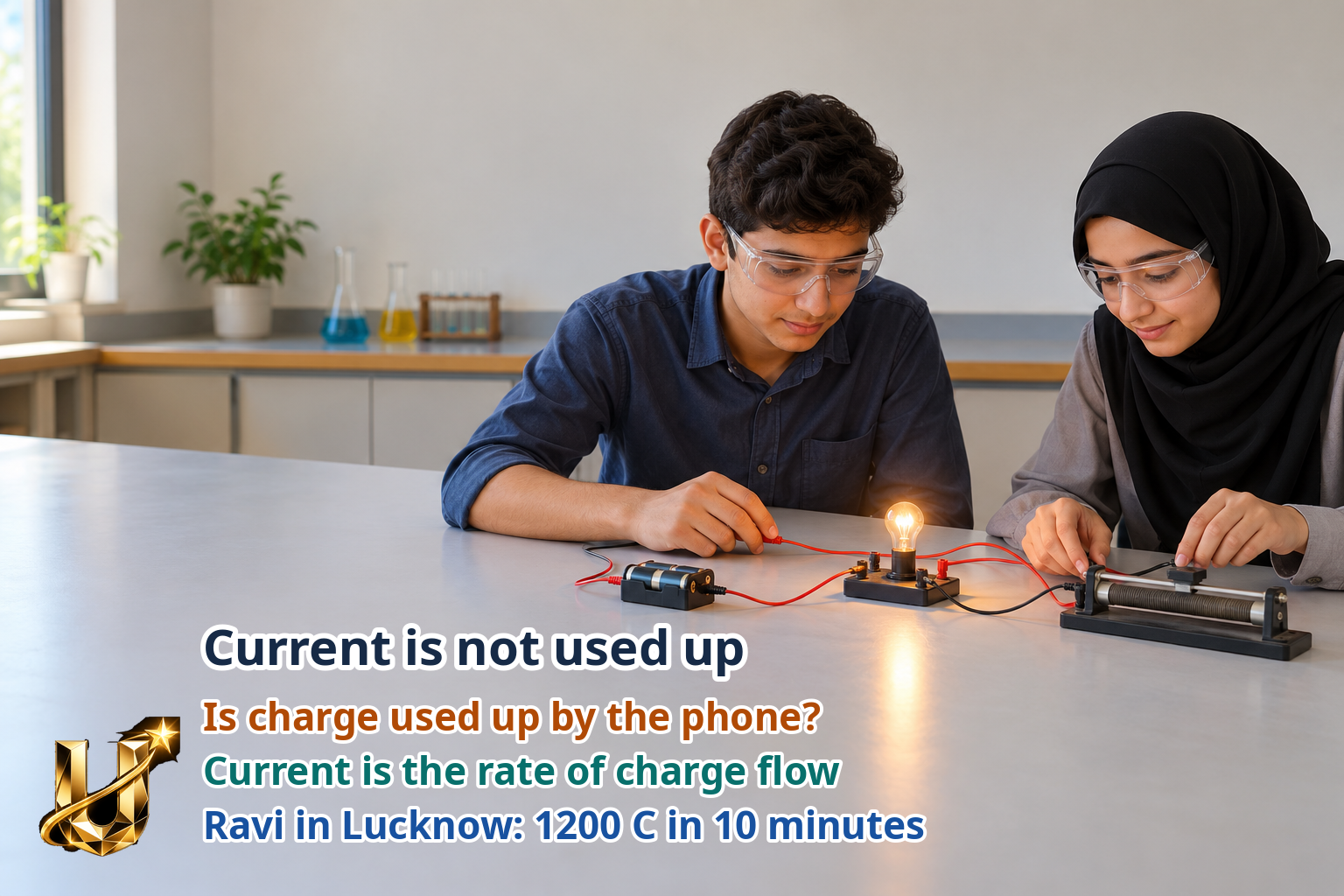
Ravi's Lucknow phone-charging record shows1200 C passing through a section in10 minutes. Does current count charge used up by the phone?
Working review group 2; official unit label pending
Ravi's Lucknow phone-charging record shows1200 C passing through a section in10 minutes. Does current count charge used up by the phone?
Energy supplied by a source per unit charge,measured in volts.
Review lesson not available yet.
Ravi's Lucknow phone-charging record shows1200 C passing through a section in10 minutes. Does current count charge used up by the phone?
Average current I=ΔQ/Δt; instantaneous current is dQ/dt. One ampere is one coulomb per second. Conventional current follows positive-charge flow; electron drift in a metal is opposite. Charge is conserved in steady circuits rather than consumed by a resistor.
1200 C passes through a charging lead section in10min.
The SI unit ampere equals what?
For one carrier type, current magnitude I=n e A vd, where n is carrier number density, A is cross-sectional area and vd is drift-speed magnitude. Random thermal motions alone give no net current. In a simple relaxation-time model, mobility μ=eτ/m and vd=μE. A small drift speed does not mean a circuit signal travels at that speed.
A uniform copper model wire hasρ=1.7 × 10^-8 Ωm, L=25m, A=2.5mm² at the stated temperature.
Electron drift in a metal points where relative to conventional current?
For an ohmic conductor at fixed physical conditions V=IR. A uniform wire has R=ρL/A, while conductivity σ=1/ρ. Resistivity is a material property at stated temperature; resistance also depends on dimensions. Over a limited range a metal may follow R≈R0[1+α(T−T0)]. Not all materials have positive α or linear V-I behaviour.
A straight V-vertical versus I-horizontal graph through the origin includes(0.40A,6.0V). Predict I at9.0V under unchanged conditions.
Discuss prepared current-time and V-I data cards. Convert minutes to seconds and identify the axes before calculating. Explain why an electron count is not a count of electrons destroyed. No household wiring measurements are required.
Current measures charge flow; electron drift opposes conventional current. R=ρL/A distinguishes dimensions from material resistivity. V=IR with constant R requires stated conditions.