
A question from life
Enlarge image
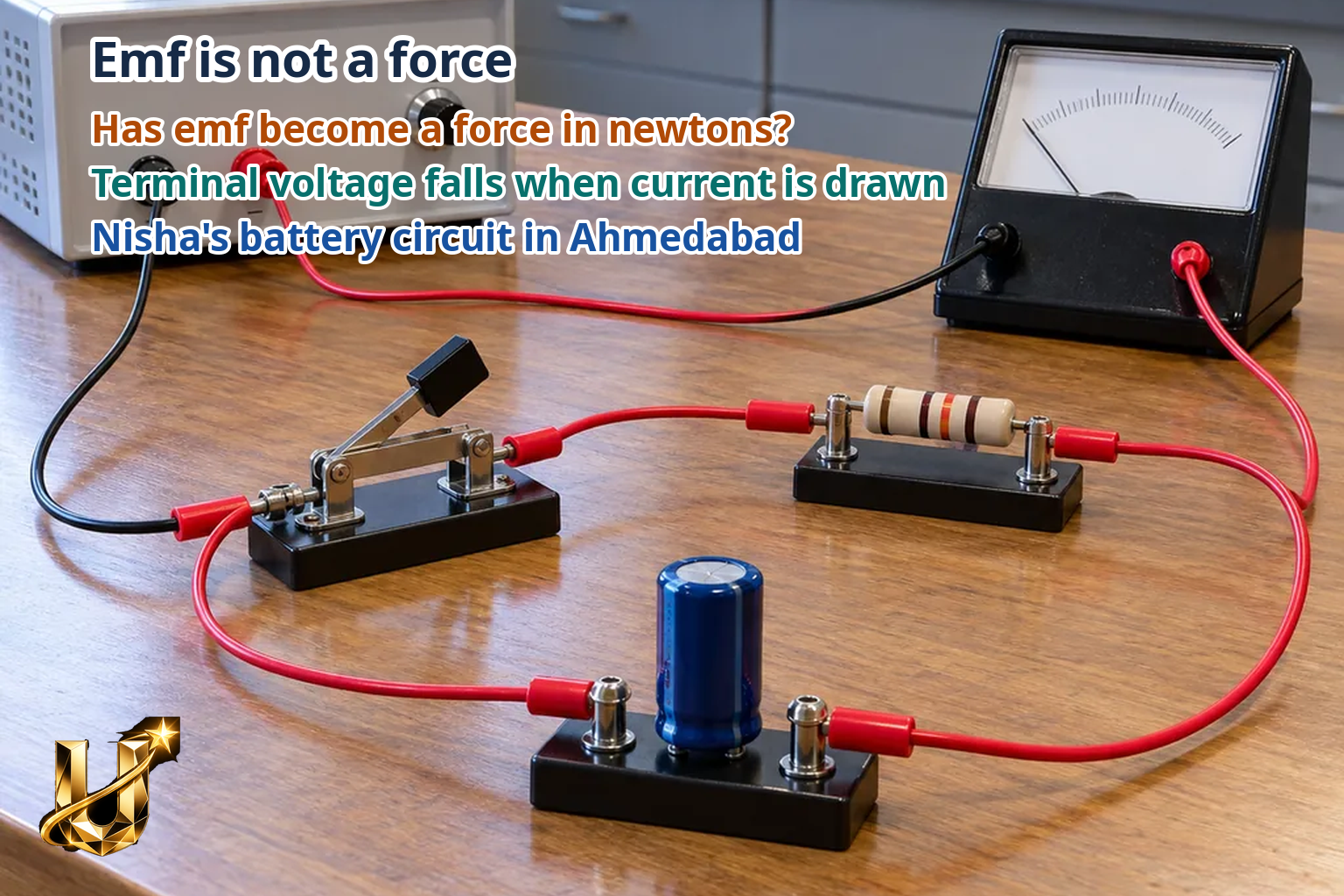
Nisha's Ahmedabad circuit model shows a battery's terminal voltage falling when it supplies current. Has its emf become a force measured in newtons?
Working review group 2; official unit label pending
Nisha's Ahmedabad circuit model shows a battery's terminal voltage falling when it supplies current. Has its emf become a force measured in newtons?
Energy supplied by a source per unit charge,measured in volts.
Review lesson not available yet.
Nisha's Ahmedabad circuit model shows a battery's terminal voltage falling when it supplies current. Has its emf become a force measured in newtons?
Emf ε is energy supplied per unit charge, measured in volts, not newtons. In a simple discharging cell model with internal resistance r and external R, I=ε/(R+r) and terminal V=ε−Ir. Identical cells in aiding series give εeq=Nε, req=Nr; identical equally polarised cells in parallel give εeq=ε, req=r/N. These are ideal models, not instructions to connect batteries.
A model cell has ε=4.5V, r=0.5Ω and external R=8.5Ω.
Emf is measured in what?
For steady currents, total current entering a junction equals total leaving. Around a closed loop the algebraic potential changes sum to zero: cross a resistor along assumed current as −IR and a cell from−to+ as+ε. A negative solved current means its real direction opposes the assumption. Series resistances add; parallel conductances add. At Wheatstone balance with top branches P, Q and bottom R, S in the same left-to-right order, P/Q=R/S and no current crosses the central detector.
Currents4A and1A enter a junction,7A leaves; assume a fourth I4 leaves.
A negative current solution indicates what?
A passive resistor dissipates power P=VI=I²R=V²/R under Ohm's law, and constant power transfers energy Pt. One kWh=3.6 × 10^6 J. Use the voltage actually across the load; internal resistance also dissipates I²r. Cell-supplied power εI balances external and internal power in the simple model.
For the first model cell, account for its power.
Use a drawn battery-and-resistor circuit. Choose loop and current arrows, read the potential rises and drops aloud, and check energy balance. Use paper data only; do not connect loose cells or attempt household electrical work.
Emf is energy per charge. Internal resistance lowers a discharging cell's terminal voltage. Junction and loop rules express conservation, while power accounting checks the result.