
A question from life
Enlarge image
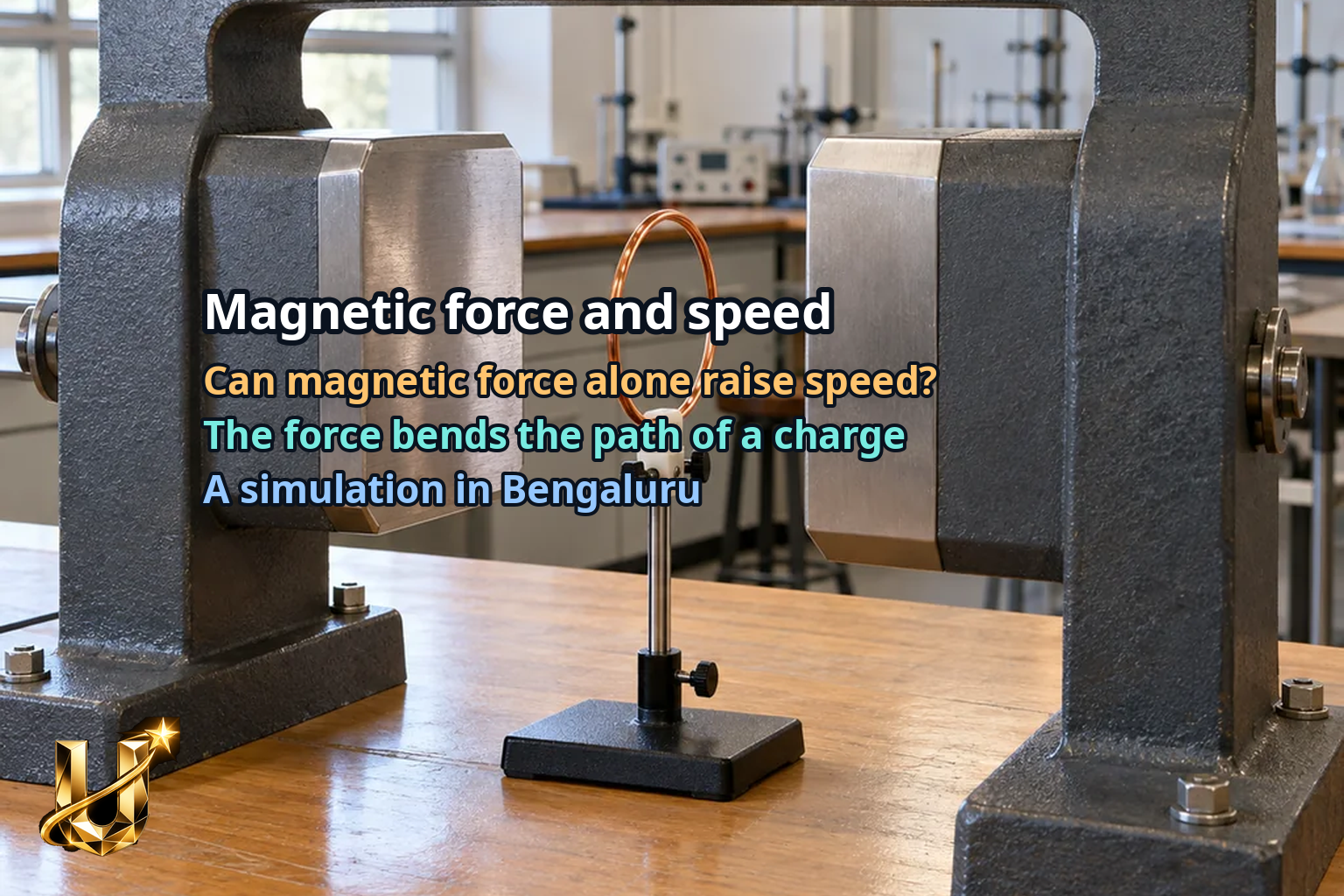
A Bengaluru simulation bends a charged particle's track in a magnetic field. Can that magnetic force alone increase the particle's speed?
Working review group 2; official unit label pending
A Bengaluru simulation bends a charged particle's track in a magnetic field. Can that magnetic force alone increase the particle's speed?
A vector operation whose direction is perpendicular to its input vectors and whose magnitude includes the sine of their angle.
Review lesson not available yet.
A Bengaluru simulation bends a charged particle's track in a magnetic field. Can that magnetic force alone increase the particle's speed?
A charge feels F=q(E+v×B). Magnetic magnitude is |q|vB sinθ with θ between velocity and B. Use the right-hand cross-product rule for positive charge, then reverse for negative charge. Parallel motion gives zero magnetic force. A stationary charge can feel electric force but no magnetic force.
q=+1.6 × 10^-19 C, v=3.0 × 10^5m/s, B=0.40T andθ=30°.
A stationary charge in a magnetic field alone feels what magnetic force?
Magnetic force is perpendicular to velocity and does no work on a point charge. With only a uniform magnetic field and initial velocity perpendicular to B, a nonrelativistic particle follows a circle: r=mv/(|q|B), period T=2πm/(|q|B). A parallel component remains constant and produces a helical path.
A nonrelativistic model particle has m=2.0 × 10^-26kg,|q|=1.0 × 10^-19C, v=1.0 × 10^5m/s perpendicular toB=0.20T.
Magnetic force alone changes which property in perpendicular circular motion?
A straight segment in uniform B has F=I L×B, where L follows conventional current. A closed planar loop in a uniform field has zero net force but torque τ=m×B, m=NIA n̂; magnitude NIAB sinθ with θ measured from the loop normal. It can rotate without a net translational force.
A50-turn loop,0.10m by0.060m, carries2.0A in0.40T parallel to its plane.
Use hand-rule drawings and a paper loop. Predict the force direction for a positive charge, then reverse charge sign. Rotate the loop's normal and compare zero and maximum torque. Use simulation data rather than beams or strong magnets.
Magnetic force is a signed cross product and does no point-charge work. Circular motion needs perpendicular velocity and the stated model. A uniform field can exert loop torque with zero net force.