
A question from life
Enlarge image
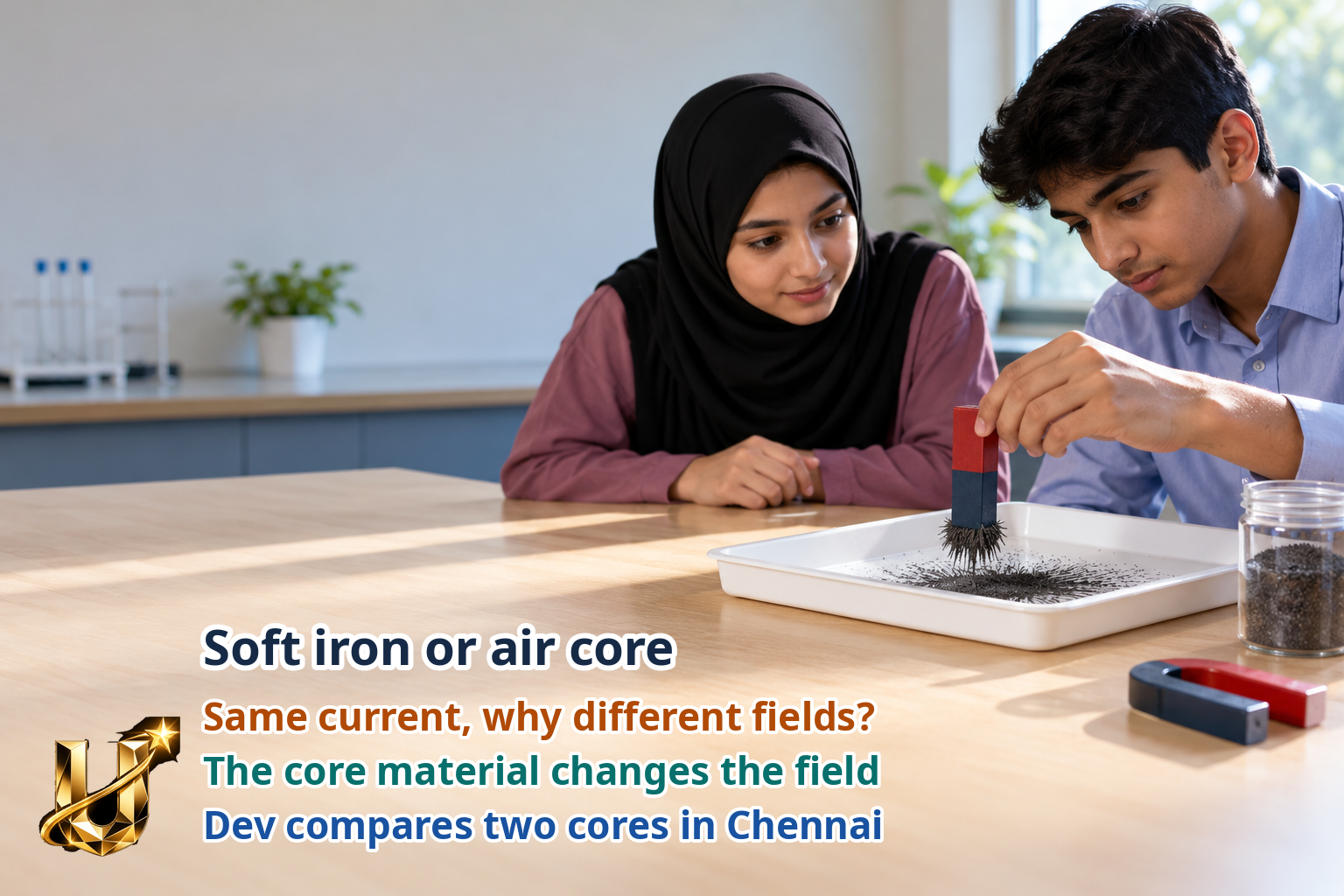
Dev compares a soft-iron core and an air core in a Chennai model solenoid. Why can the same current produce very different fields?
Working review group 3; official unit label pending
Dev compares a soft-iron core and an air core in a Chennai model solenoid. Why can the same current produce very different fields?
A vector describing the strength and orientation of a magnetic dipole.
Review lesson not available yet.
Dev compares a soft-iron core and an air core in a Chennai model solenoid. Why can the same current produce very different fields?
Magnetisation M is magnetic dipole moment per unit volume, measured in A/m. In SI, B=μ0(H+M). For a linear isotropic material under suitable conditions, M=χmH and μr=1+χm. Thus B=μ0μrH in that model. Ferromagnets often need nonlinear, history-dependent descriptions instead of one constant μr.
A prepared data card shows χm=−2.0 × 10^-5 in a weak-field linear response.
Small negative magnetic susceptibility indicates what?
Diamagnetic substances have a small negative susceptibility and weakly oppose an applied field; bismuth and copper are examples. Paramagnetic substances have small positive susceptibility and weakly align; aluminium is an example. Ferromagnets such as iron can align domains strongly and retain magnetisation. These are responses of materials, not labels for positive or negative electric charge.
A linear isotropic model hasχm=0.020 and H=1000A/m.
Which is a standard ferromagnetic material below its Curie temperature?
A ferromagnetic specimen may have little net magnetisation when domains point in many directions. Applied fields can change domain populations and alignment. Soft magnetic materials magnetise and demagnetise readily for electromagnet cores; hard magnetic materials can retain magnetisation for permanent magnets. Above a material's Curie temperature its ferromagnetic order is lost and it becomes paramagnetic. Do not heat magnets to test this at home.
For the same model use μ0≈4π × 10^-7Tm/A.
Sort prepared evidence cards by negative weak, positive weak and strong history-dependent magnetic response. Explain the difference between domain cancellation and absent moments. Compare soft-core and permanent-magnet uses without heating or dismantling equipment.
Magnetisation is moment per volume. Linear χm describes weak responses under stated conditions; ferromagnetic domains and history often require more than a constant permeability.