
A question from life
Enlarge image
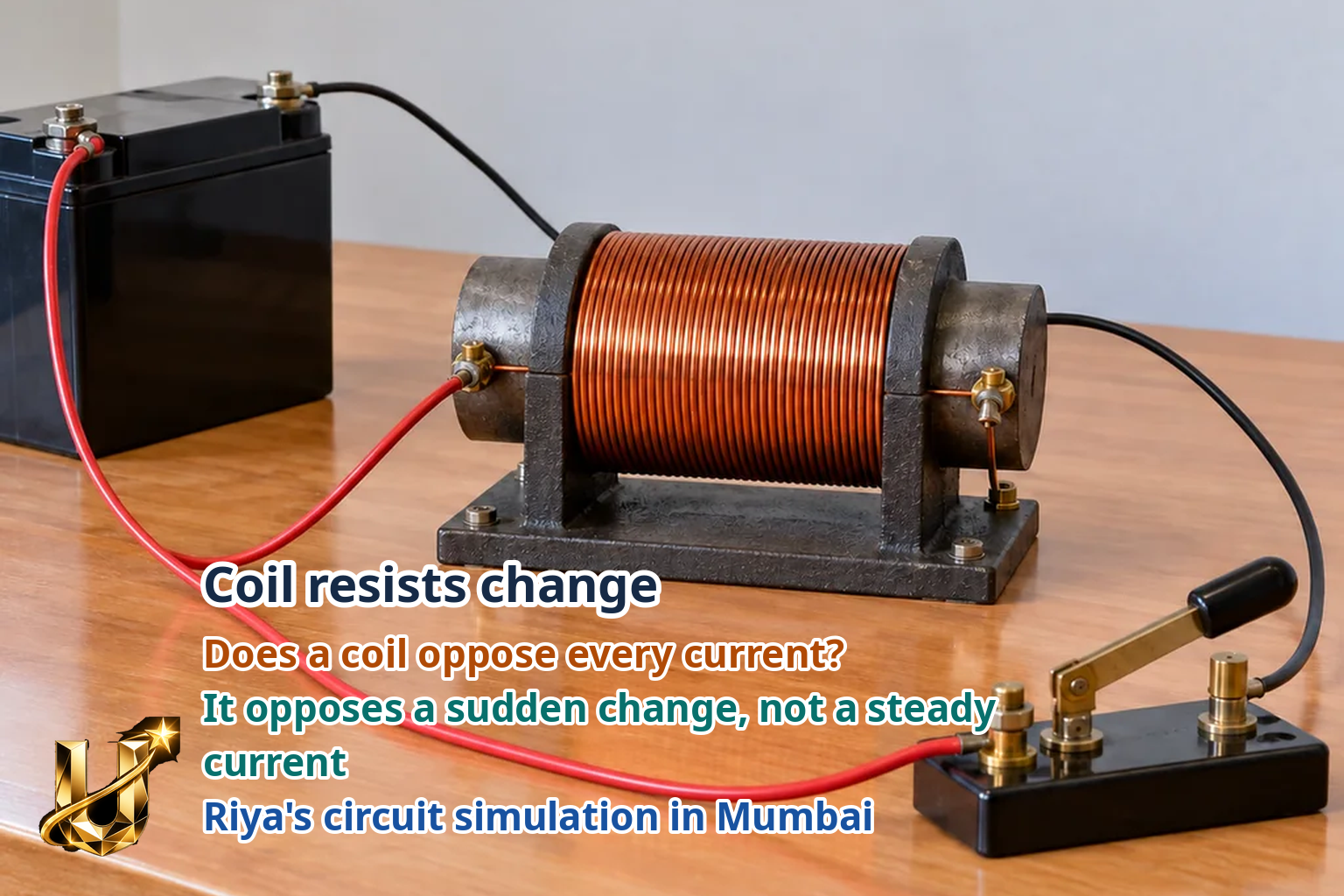
Riya's Mumbai circuit simulation shows a coil resisting a sudden change of current. Is it opposing every current, including a steady one?
Working review group 3; official unit label pending
Riya's Mumbai circuit simulation shows a coil resisting a sudden change of current. Is it opposing every current, including a steady one?
The sum of magnetic flux through the turns of a coil.
Review lesson not available yet.
Riya's Mumbai circuit simulation shows a coil resisting a sudden change of current. Is it opposing every current, including a steady one?
In a linear coil with fixed geometry, flux linkage NΦ=LI and induced emf εself=−L dI/dt. L is measured in henry:1H=1Vs/A. A coil opposes changes in current, not current itself. A real coil also has resistance, whereas an ideal inductor at steady DC has zero induced emf.
L=0.20H and current rises1.0A to3.0A in0.10s.
An ideal inductor with constant steady current has self-induced emf?
Building current against the induced emf transfers energy into the magnetic field. For constant L, U=½LI². Current in an ideal inductor cannot jump without unbounded voltage; rapid switching can create large voltages in real circuits. Energy is returned or dissipated when current decreases, depending on the circuit.
A linear0.40H inductor carries5.0A.
The henry is equivalent to?
Changing current in one coil can change flux linkage in another. For fixed linear geometry, ε2=−M dI1/dt with a consistent winding-polarity convention. M depends on geometry, separation, orientation and core material. The induced effect requires changing flux; constant DC in the first coil does not sustain a secondary emf after transients.
In a fixed linear two-coil model, M=0.050H and primary current falls from4.0A to1.0A in0.20s.
Read prepared current-time graphs and compare steep and shallow slopes for the same L. Rank induced-emf magnitudes, then compare stored energy at different currents. Discuss coupled-coil drawings without switching real coils or opening equipment.
Inductance links current to magnetic flux. Induced emf depends on change rate; stored energy depends on current squared. Mutual induction couples changing currents through shared magnetic flux.