
A question from life
Enlarge image
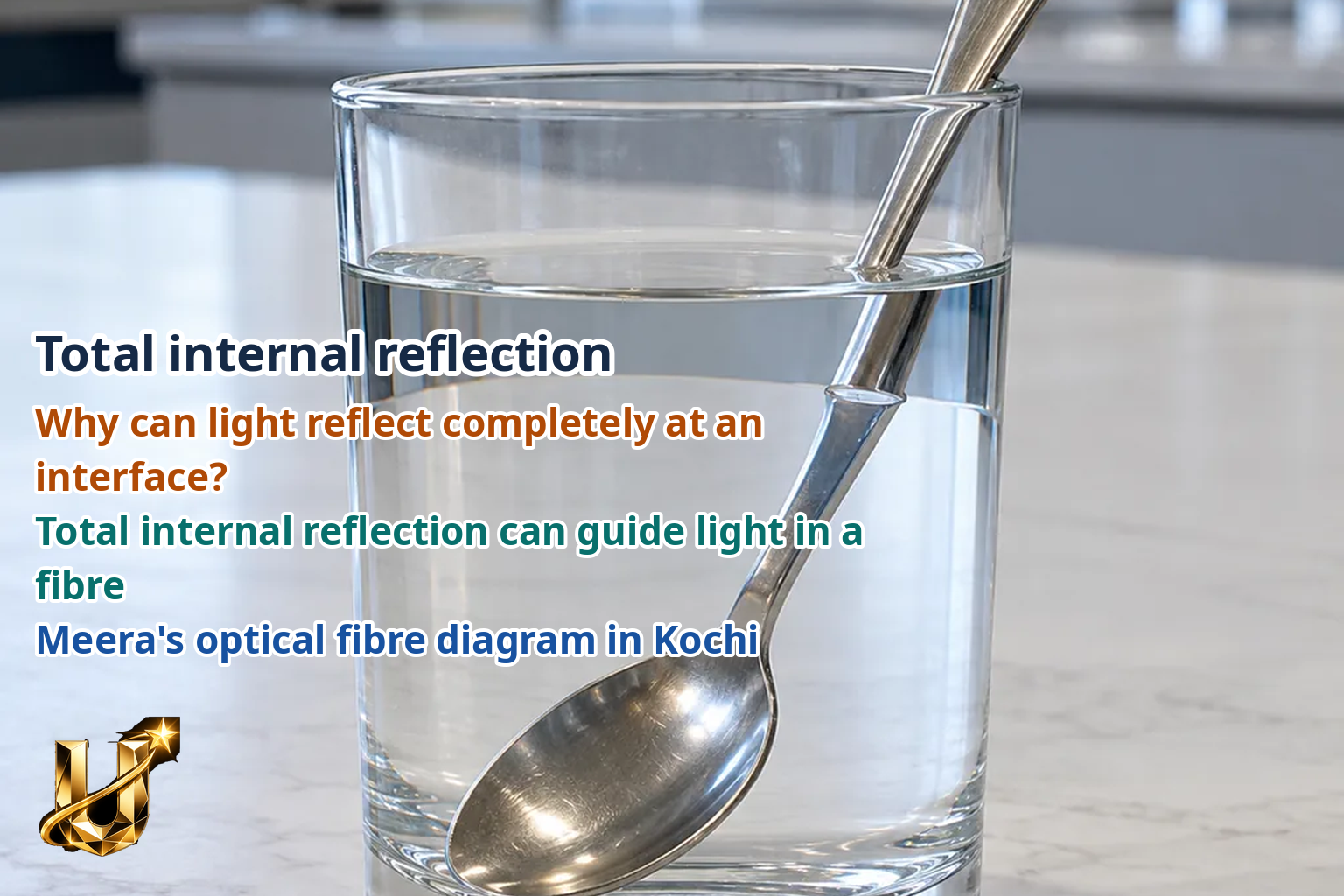
Meera's Kochi diagram shows light guided along an optical fibre. Why can light reflect completely at an interface that usually transmits some light?
Working review group 5; official unit label pending
Meera's Kochi diagram shows light guided along an optical fibre. Why can light reflect completely at an interface that usually transmits some light?
An optical model restricted to rays making small angles near the principal axis.
Review lesson not available yet.
Meera's Kochi diagram shows light guided along an optical fibre. Why can light reflect completely at an interface that usually transmits some light?
Incidence and reflection angles are measured from the normal and are equal. A plane mirror forms a virtual upright same-size image equally far behind the mirror. For paraxial spherical mirrors use Cartesian distances from the pole, positive in the incident-light direction:1/f=1/v+1/u and magnification m=−v/u. A concave mirror facing the object has negative f in this convention.
An object1.0m before a plane mirror moves0.10m towards it.
Reflection angles are measured from?
Refractive index n=c/v. At a stationary interface frequency remains unchanged, while speed and wavelength can change. Snell's law is n1 sin i=n2 sin r, with angles from the normal. Entering a higher-index medium bends an oblique ray towards the normal; normal incidence need not change direction.
Light travels from n1=1.50 ton2=1.00 withi=20°.
What remains unchanged at a stationary refracting boundary?
Total internal reflection requires travel from higher n1 to lower n2 and incidence above ic, where sin ic=n2/n1. At the critical angle the refracted ray is at90° to the normal. Optical fibres use a higher-index core and lower-index cladding. A prism deviates light; at minimum deviation for a prism angle A in air, n=sin[(A+δmin)/2]/sin(A/2). Dispersion occurs because index depends on wavelength.
For the same1.50-to1.00 interface, testi=50°.
Read ray diagrams and mark normals before angles. Compare a20° and50° glass-to-air case and explain why Snell's law cannot give a real transmitted angle in the latter ideal case. Never look at the Sun through optical equipment.
Use normals for angles and a declared sign convention for mirrors. Refraction preserves frequency; total internal reflection needs both higher-to-lower index and an above-critical angle.