
A question from life
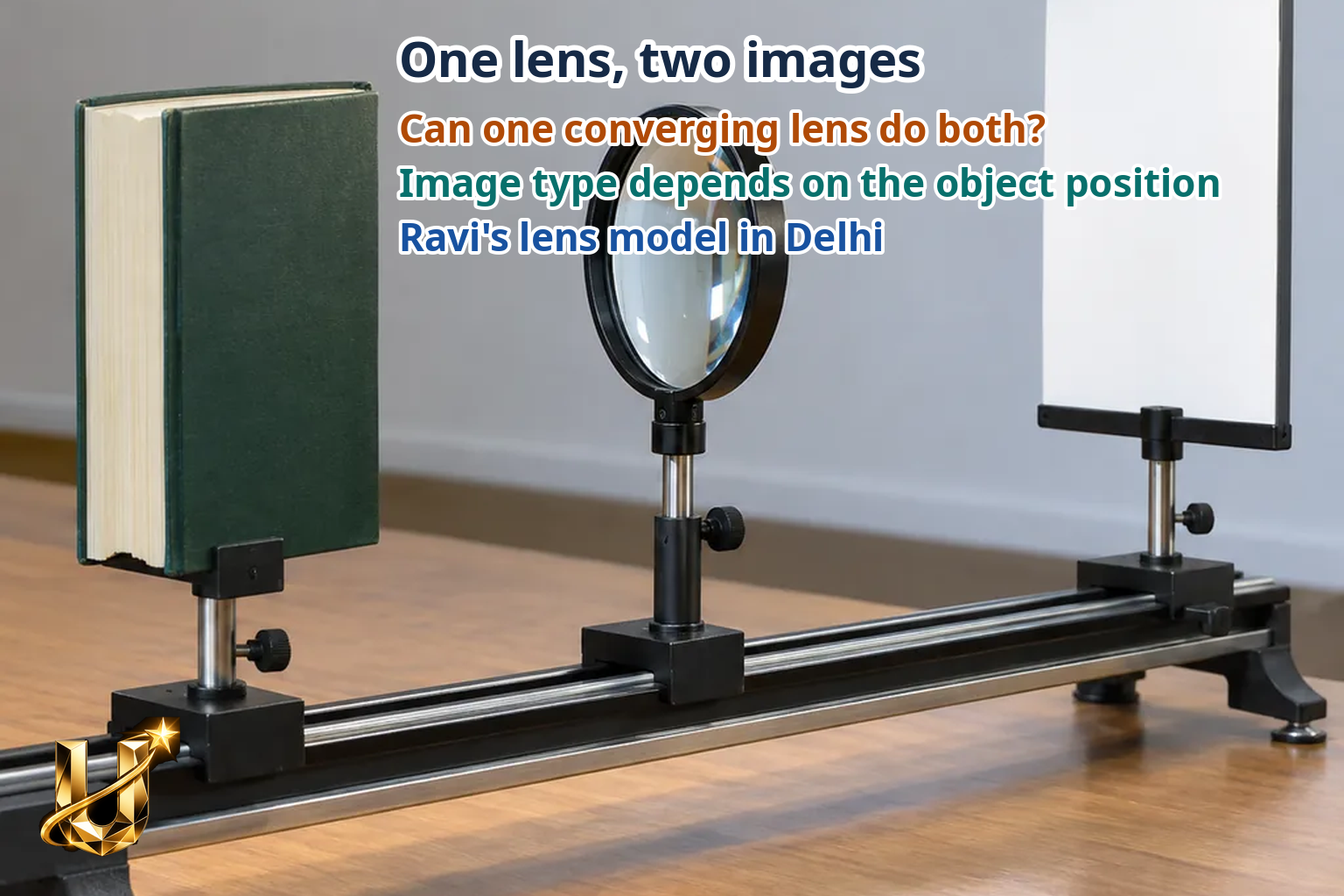
Enlarge image
Ravi's Delhi lens model gives a sharp screen image for one object position but an enlarged virtual image for another. Can the same converging lens do both?
Working review group 5; official unit label pending
Ravi's Delhi lens model gives a sharp screen image for one object position but an enlarged virtual image for another. Can the same converging lens do both?
An optical model restricted to rays making small angles near the principal axis.
Review lesson not available yet.
Ravi's Delhi lens model gives a sharp screen image for one object position but an enlarged virtual image for another. Can the same converging lens do both?
Use the optical centre as origin and incident light left to right as positive. A real object left of the lens hasu<0; a real image right hasv>0; a converging lens in air hasf>0. The paraxial thin-lens formula is1/f=1/v−1/u and transverse magnification m=v/u. Negative m means inverted.
A converging lens hasf=+10cm and a real objectu=−25cm.
For the stated axis, a real object left of a lens hasu?
For a thin lens in air,1/f=(n−1)(1/R1−1/R2) with signed radii under the same Cartesian axis. A spherical refracting interface obeys n2/v−n1/u=(n2−n1)/R in the paraxial approximation. Lens behaviour depends on relative index as well as shape; a thick-centred lens is not automatically converging in every surrounding medium.
The same lens hasu=−5.0cm.
The correct Cartesian thin-lens formula here is?
Lens power P=1/f withf in metres, unit dioptre(D). Converging power is positive and diverging negative in air for the usual lenses. Thin lenses in contact have Peq=P1+P2. A real image can be formed on a screen where rays converge; a virtual image is found by extending diverging rays backwards.
A+5D thin lens touches a−2D thin lens.
Draw the same converging lens with object outside and inside its focal distance. Marku, v andf signs, use two principal rays and explain whether a screen can catch the image. Use prepared diagrams; never focus sunlight.
Keep one Cartesian sign convention throughout. Lens power uses metres and adds for contact lenses. Image type depends on object position and the surrounding optical system.