
A question from life
Enlarge image
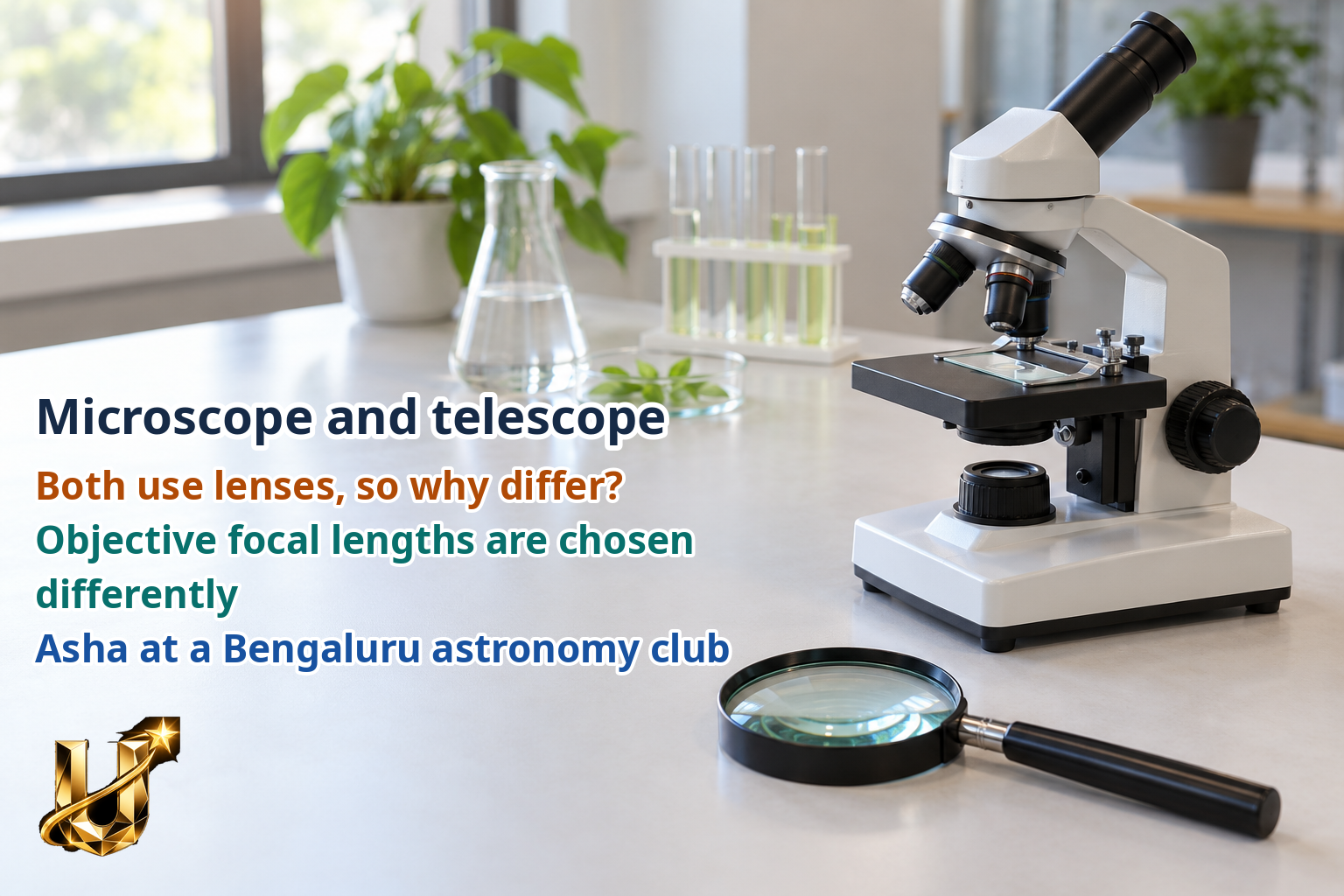
At a Bengaluru astronomy club, Asha compares a microscope and a telescope. Both use lenses, so why are their objective focal lengths chosen so differently?
Working review group 5; official unit label pending
At a Bengaluru astronomy club, Asha compares a microscope and a telescope. Both use lenses, so why are their objective focal lengths chosen so differently?
An optical model restricted to rays making small angles near the principal axis.
Review lesson not available yet.
At a Bengaluru astronomy club, Asha compares a microscope and a telescope. Both use lenses, so why are their objective focal lengths chosen so differently?
An instrument helps the eye by increasing the angle subtended by an object or its image. A simple magnifier uses a converging lens with the object at or within its focal distance. For a relaxed eye and final image at infinity, M=D/f, where D=25cm is a conventional least-distance reference. For a final image at that near point, M=1+D/f in the ideal thin-lens model.
A model magnifier hasf=5.0cm and D=25cm with a relaxed eye.
A relaxed-eye normal-adjustment image is located where?
A short-focal-length objective makes a real enlarged intermediate image. The eyepiece magnifies that image. For normal adjustment and the usual large tube-length approximation, magnitude M≈(L/fo)(D/fe), whereL is the approximate optical tube length; exact geometry uses actual object/image distances. The final image is inverted relative to the original.
TakeL=16cm, fo=1.0cm, fe=4.0cm, D=25cm under the stated approximation.
A simple magnifier uses what lens?
A distant object sends nearly parallel rays. A long-focal-length objective produces a real intermediate image at its focal plane, viewed by a shorter-focal-length eyepiece. In normal adjustment the final image is at infinity, separation≈fo+fe and angular magnification M=−fo/fe; the negative sign indicates inversion. Larger aperture aids light collection and resolution but focal-length ratio sets this ideal magnification.
fo=100cm and fe=5.0cm.
Arrange paper objective, intermediate-image and eyepiece cards for each instrument. State which lens first forms a real image and explain the chosen focal lengths. Use diagrams or safe indoor prepared images; never point optical instruments at the Sun.
Magnification compares viewing angles. Microscopes enlarge nearby objects through an intermediate real image; telescopes enlarge distant angular views. Normal adjustment places the final image at infinity.
A reflecting astronomical telescope uses a concave primary mirror to collect and focus light; an eyepiece views the intermediate image. It avoids chromatic aberration caused by refraction in a large objective lens,although other aberrations and alignment limits remain. The ideal normal-adjustment angular magnification magnitude follows objective focal length divided by eyepiece focal length. Larger aperture improves light collection and potential resolution,but does not alone set this focal-length ratio.
A reflecting telescope has objective focal length one thousand millimetres and eyepiece focal length twenty millimetres. Calculate ideal magnification magnitude.
A reflecting telescope’s primary collecting element is usually a: