
A question from life
Enlarge image
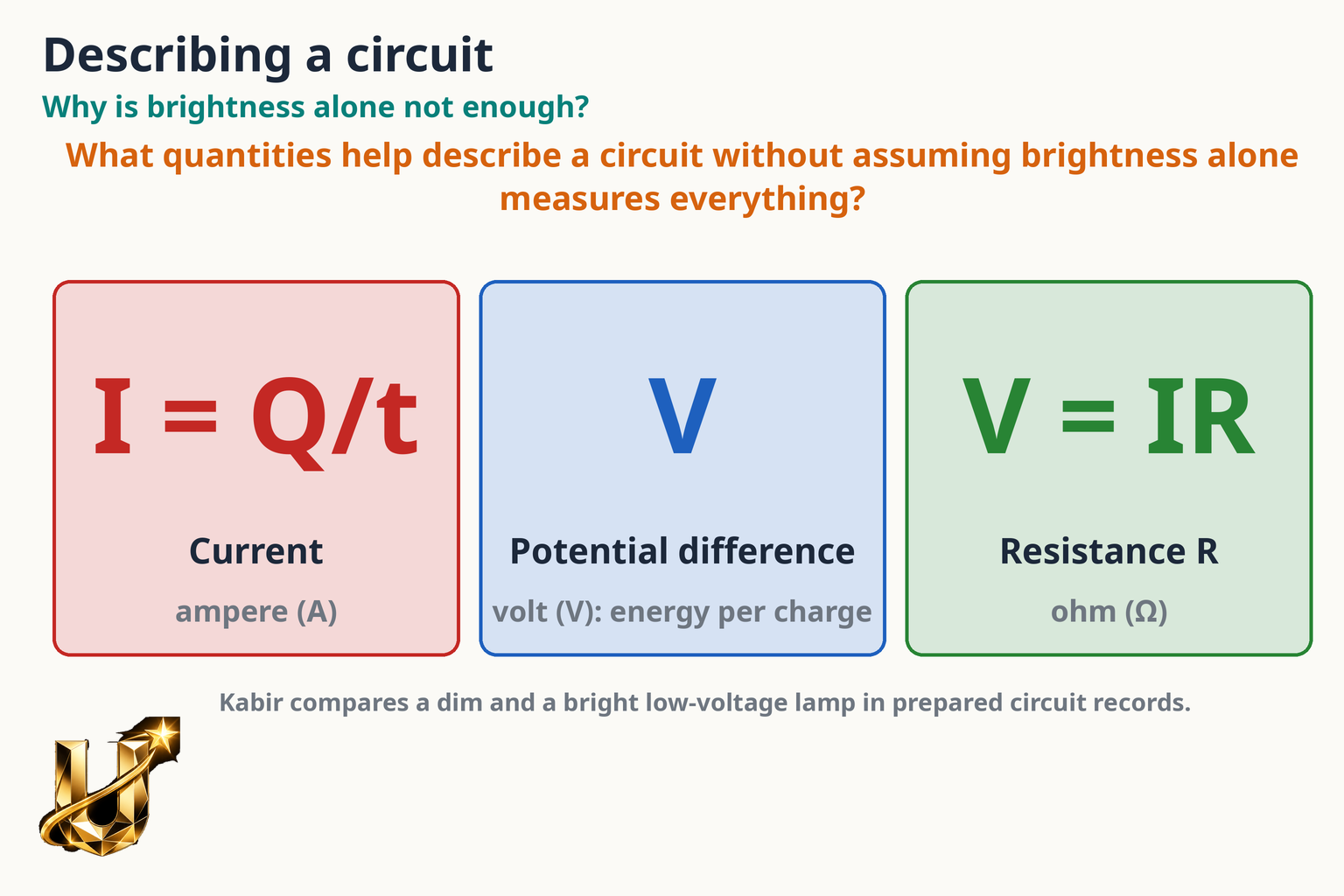
Kabir in Delhi compares a dim and bright low-voltage lamp in prepared circuit records. What quantities help describe the circuit without assuming brightness alone measures everything?
Working review group 6; official unit label pending
Kabir in Delhi compares a dim and bright low-voltage lamp in prepared circuit records. What quantities help describe the circuit without assuming brightness alone measures everything?
Energy transferred per unit electric charge between two points.
Review lesson not available yet.
Kabir in Delhi compares a dim and bright low-voltage lamp in prepared circuit records. What quantities help describe the circuit without assuming brightness alone measures everything?
Current I is charge passing per unit time: I = Q/t, measured in amperes. Potential difference V is energy transferred per unit charge, measured in volts. A source transfers energy to maintain a potential difference; it does not create electric charge.
A model conductor carries 18 C in 6 s.
What is current for 20 C in 5 s?
For an Ohmic conductor under constant relevant conditions, including temperature, V = IR. Resistance is measured in ohms. Wire resistance depends on material, length and cross-sectional area; longer comparable wire has greater resistance, while greater area reduces it.
A 12 V potential difference is applied across an Ohmic 6 Ω resistor.
What current flows at 9 V through 3 Ω?
An ammeter is connected in series with the branch being measured; a voltmeter is connected across the component. Circuit models assume ideal meters where stated. Only use teacher-prepared low-voltage kits; never connect meters or wires to mains outlets.
The same material and area are used for lengths L and 2L at the same temperature.
Interpret prepared circuit and meter-position cards. Calculate I, V or R from supplied data; no independent wiring or battery combinations.
Current is charge per time and voltage is energy per charge. Ohm's law and resistance comparisons require stated conditions and correct meter placement.
For a uniform wire under stated temperature conditions, resistance equals resistivity times length divided by cross-sectional area. Resistivity describes the material and conditions rather than the wire length alone; its SI unit is ohm metre. In an Ohmic constant-temperature graph of voltage against current, the slope is resistance. Heating can change the resistance, so a straight-line model needs suitable conditions.
A uniform wire has resistance four ohms. Its length doubles and its area stays unchanged at the same temperature.
Doubling wire area while keeping length, material and temperature fixed makes resistance: