
A question from life
Enlarge image
Enlarge image
Aarav in Mumbai studies two resistors in prepared series and parallel diagrams. Why can the same components give different total resistance?
Working review group 6; official unit label pending
Aarav in Mumbai studies two resistors in prepared series and parallel diagrams. Why can the same components give different total resistance?
Energy transferred per unit electric charge between two points.
Review lesson not available yet.
Aarav in Mumbai studies two resistors in prepared series and parallel diagrams. Why can the same components give different total resistance?
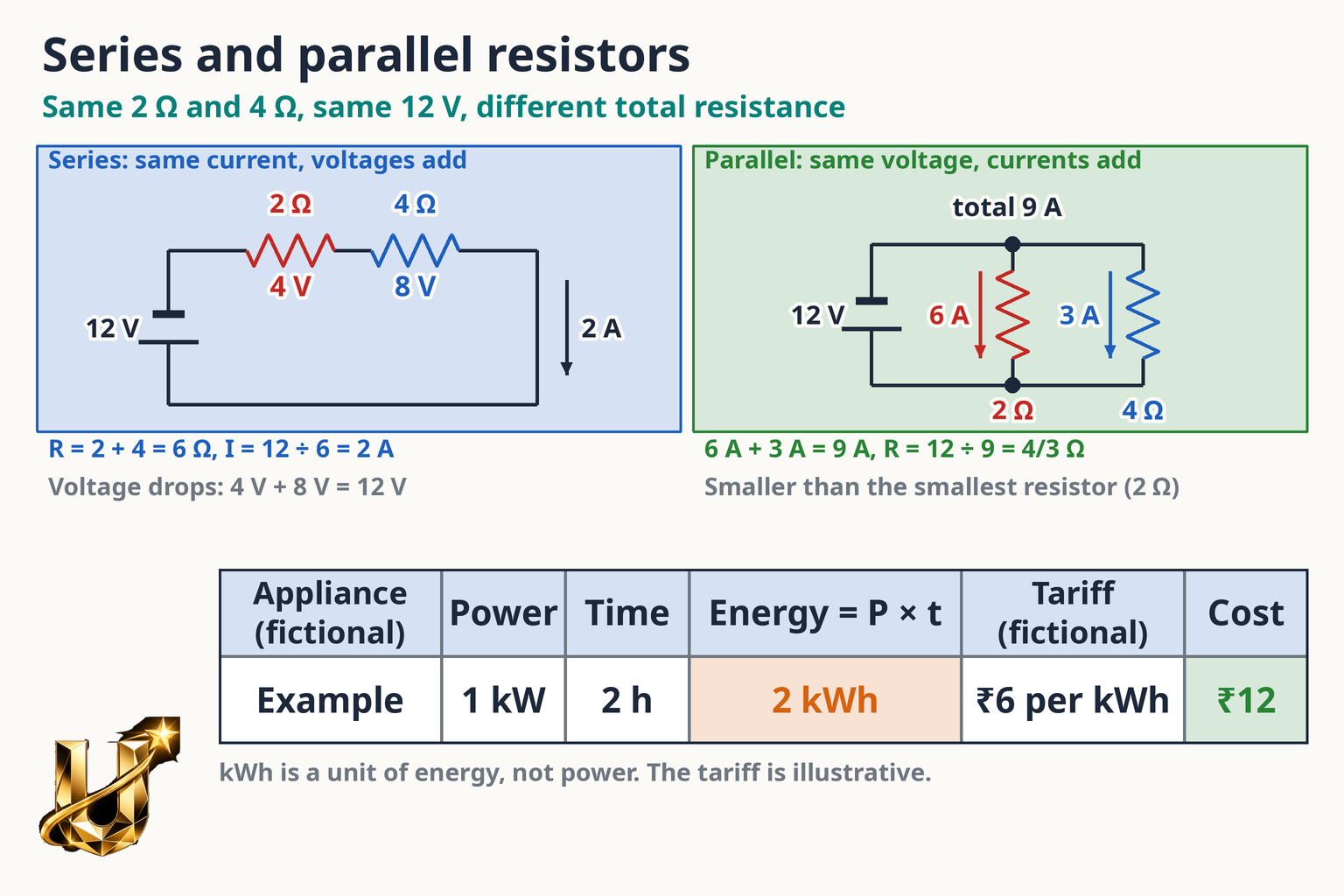
Series resistors carry the same current and their potential differences add. Equivalent resistance is R₁ + R₂ + ... . A break in the single path interrupts that path. These resistor rules are not instructions for combining arbitrary cells.
A prepared model connects 2 Ω and 4 Ω in series across 12 V.
What is series resistance of 3 Ω and 5 Ω?
Parallel branches have the same potential difference and their currents add. For two or more resistors, 1/Rₑq = 1/R₁ + 1/R₂ + ... . Equivalent resistance is smaller than the smallest positive branch resistance in the ideal model.
The same 2 Ω and 4 Ω resistors are in parallel across 12 V.
Two equal 6 Ω resistors are parallel. What is equivalent resistance?
Electrical power P = VI; for an Ohmic resistor it can also be I²R or V²/R. Energy E = Pt, and Joule heating in a resistor is I²Rt. A kilowatt-hour is energy, not power, and equals 3.6 × 10⁶ J.
A fictional 1 kW appliance runs 2 h at a fictional ₹6 per kWh.
Solve supplied resistor-network cards and a fictional appliance energy table. State whether the unit is power, energy or cost. No household circuit experiments.
Series and parallel networks obey different rules. Power measures energy-transfer rate; energy use is power times time, with kWh a unit of energy.