
A question from life
Enlarge image
Enlarge image
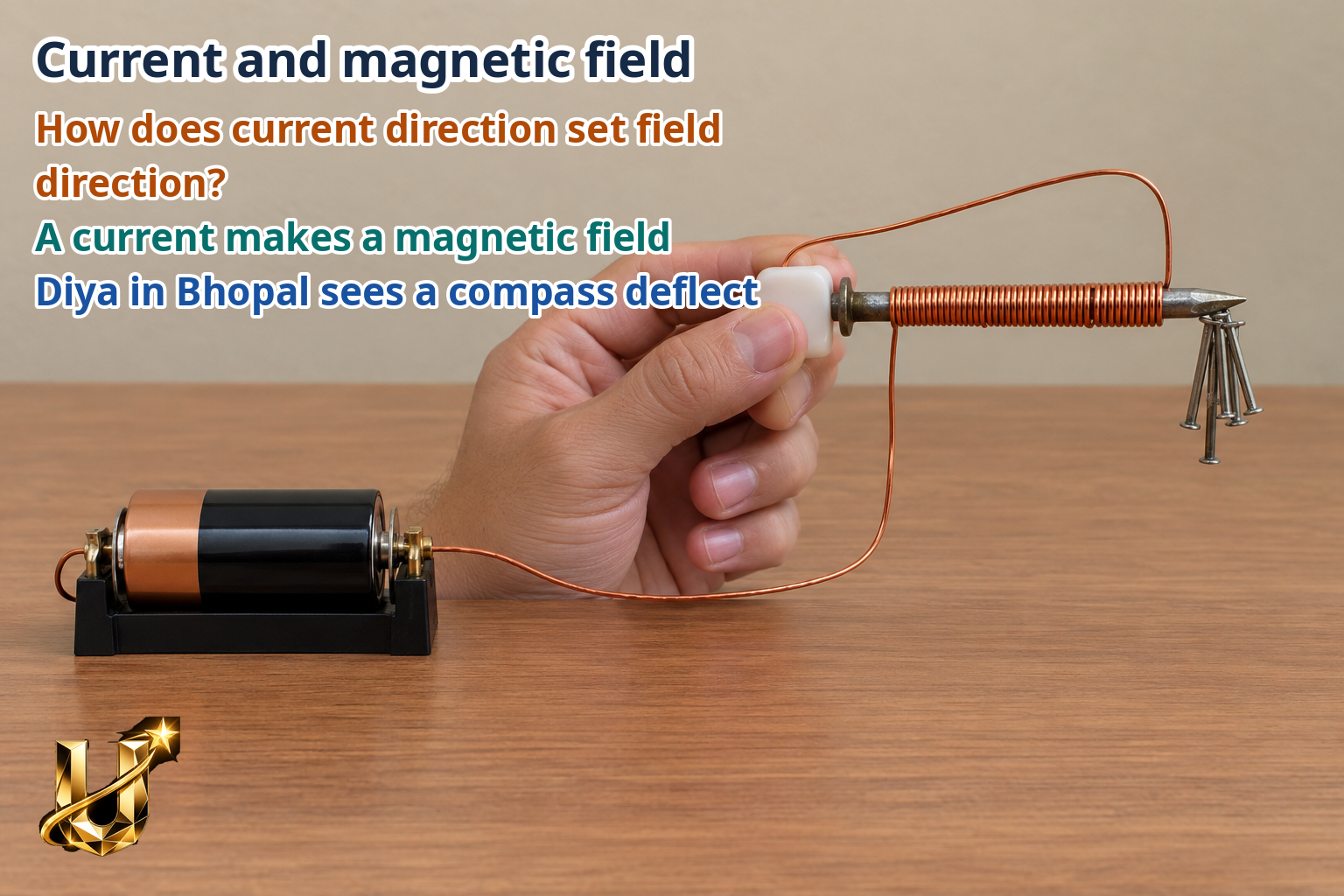
Diya in Bhopal sees a compass deflect near a teacher's low-voltage wire. How can current direction determine magnetic-field direction?
Working review group 6; official unit label pending
Diya in Bhopal sees a compass deflect near a teacher's low-voltage wire. How can current direction determine magnetic-field direction?
A field that determines magnetic effects on magnets, moving charges and currents.
Review lesson not available yet.
Diya in Bhopal sees a compass deflect near a teacher's low-voltage wire. How can current direction determine magnetic-field direction?
A compass indicates the local magnetic-field direction. Field lines represent direction and relative strength; they are not material threads. Outside a bar magnet the conventional direction is from north toward south, with the full field forming closed loops.
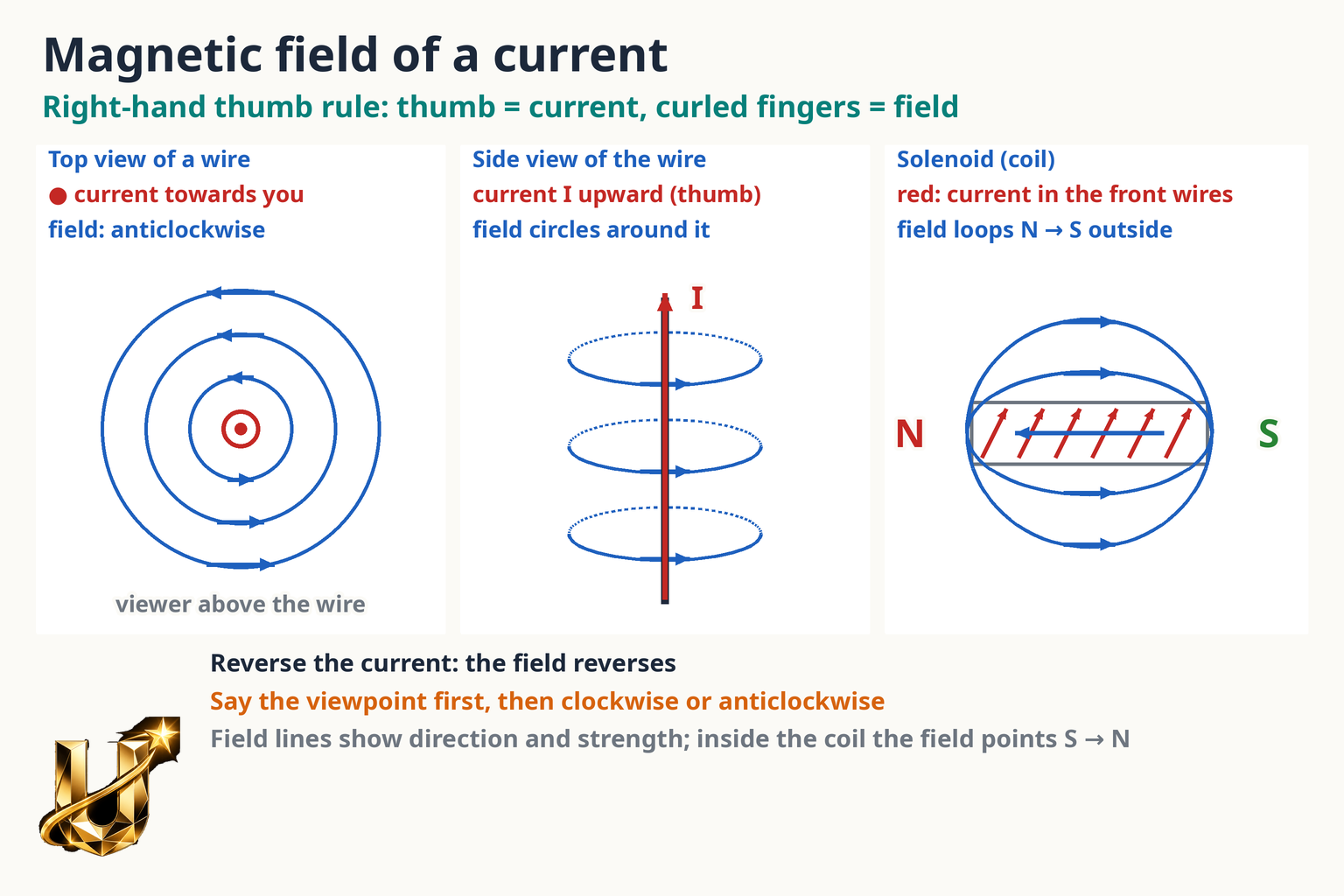
A diagram shows conventional current upward in a vertical wire.
What do magnetic-field lines represent?
A straight current-carrying wire has circular field patterns around it. In the right-hand thumb rule, the thumb points along conventional current and curled fingers give the field direction. Reversing current reverses the field. Diagrams must specify viewing direction.
The teacher reverses current in an otherwise identical prepared model.
In the right-hand thumb rule, what does the thumb show?
A solenoid combines fields from many turns and can resemble a bar magnet. Current, turns per length, core and geometry affect its field. An iron core can strengthen an electromagnet, and weak residual magnetism may remain after current stops.
At the same current and core, 20 turns lift 5 clips and 40 turns lift 8.
Use prepared right-hand-rule and solenoid cards with explicit viewpoint and current arrows. Compare controlled coil data; do not leave a real coil connected or increase cells.
Current produces magnetic fields with direction set by current and geometry. Solenoids combine fields, and electromagnet comparisons need controlled conditions.