
A question from life
Enlarge image
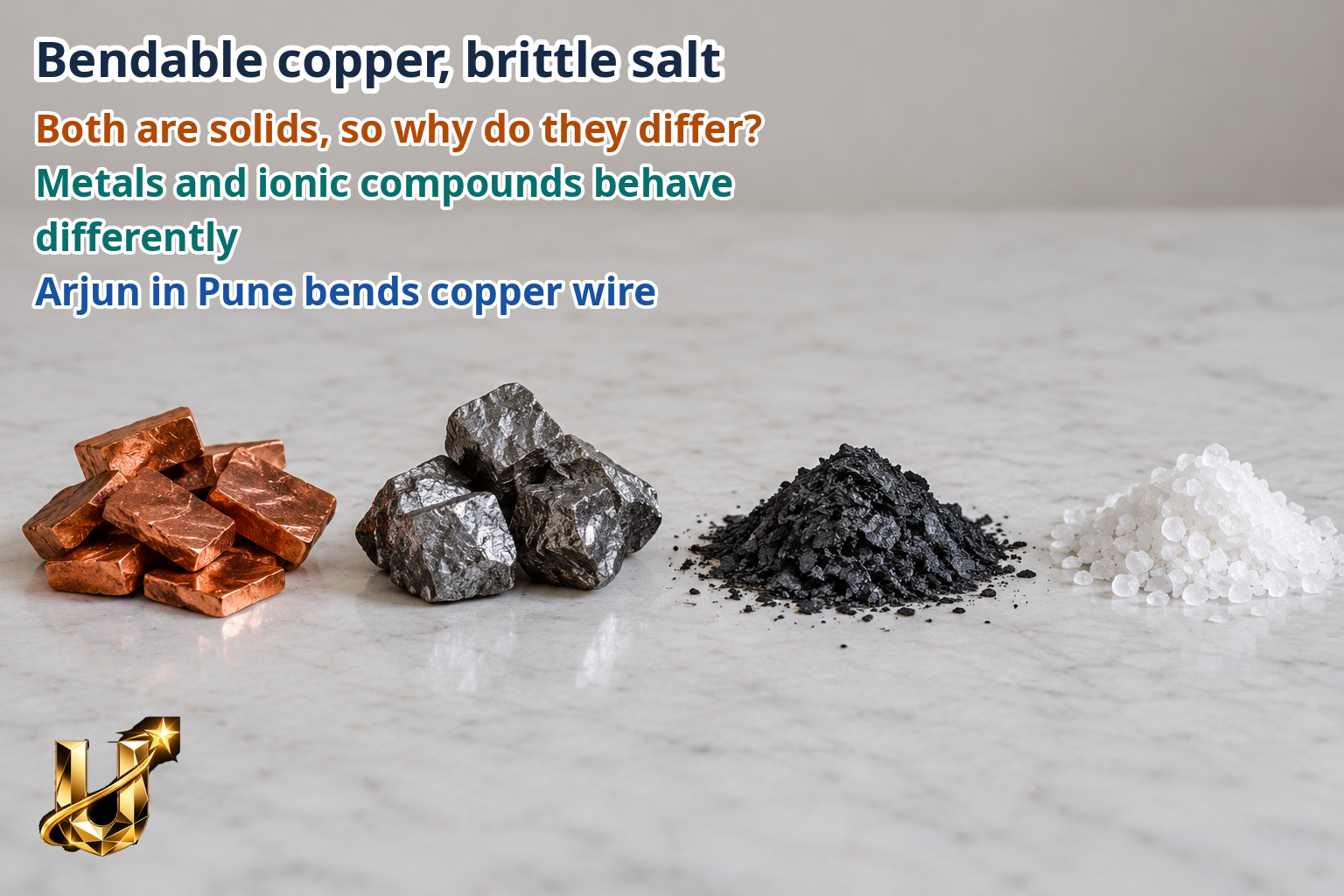
Arjun in Pune can bend copper wire, but a salt crystal breaks. Both can be solids, so why do their properties differ?
Working review group 2; official unit label pending
Arjun in Pune can bend copper wire, but a salt crystal breaks. Both can be solids, so why do their properties differ?
An ordering of metals by their relative tendency to react under stated comparison conditions.
Review lesson not available yet.
Arjun in Pune can bend copper wire, but a salt crystal breaks. Both can be solids, so why do their properties differ?
Many metals are shiny, malleable and good conductors of heat and electricity. Non-metals often differ, but properties are not universal: graphite conducts electricity and mercury is liquid near room temperature. Use several properties rather than one shortcut.
Copper is drawn into a thin wire.
What mainly carries current in solid copper?
In a metal, mobile delocalised electrons contribute to electrical conduction and bonding. In an ionic solid, oppositely charged ions form an extended structure. Solid ions are not free to move through the crystal, but molten or suitable dissolved ions can carry current.
Use Mg²⁺ and Cl⁻.
What is the neutral formula from Mg²⁺ and Cl⁻?
A simple ionic model transfers electrons from a metal atom to a non-metal atom. The resulting formula balances charges in a neutral ratio. Ionic compounds often have high melting points due to strong electrostatic attractions; their behaviour still depends on the substance.
Solid sodium chloride is compared with molten sodium chloride.
Compare prepared copper and ionic-lattice diagrams, then build neutral ion ratios from supplied charges. Do not heat salts or test unknown materials electrically.
Metallic and ionic structures explain different properties. General trends have exceptions; ionic formulas balance charges and mobile carriers determine conduction.
Formative extension: classification of elements. Döbereiner arranged some similar elements in triads; Newlands proposed an octave pattern that had important limitations. Mendeleev mainly ordered by atomic mass and chemical properties, leaving gaps and predictions. The modern table is ordered by atomic number. Across a typical main-group period metallic character generally decreases; down a typical main-group family it generally increases. These trends have conditions and exceptions. This extension is formative in the current programme.
Which ordering principle distinguishes the modern periodic table from a simple atomic-mass ordering?
Modern periodic order primarily follows: