
A question from life
Enlarge image
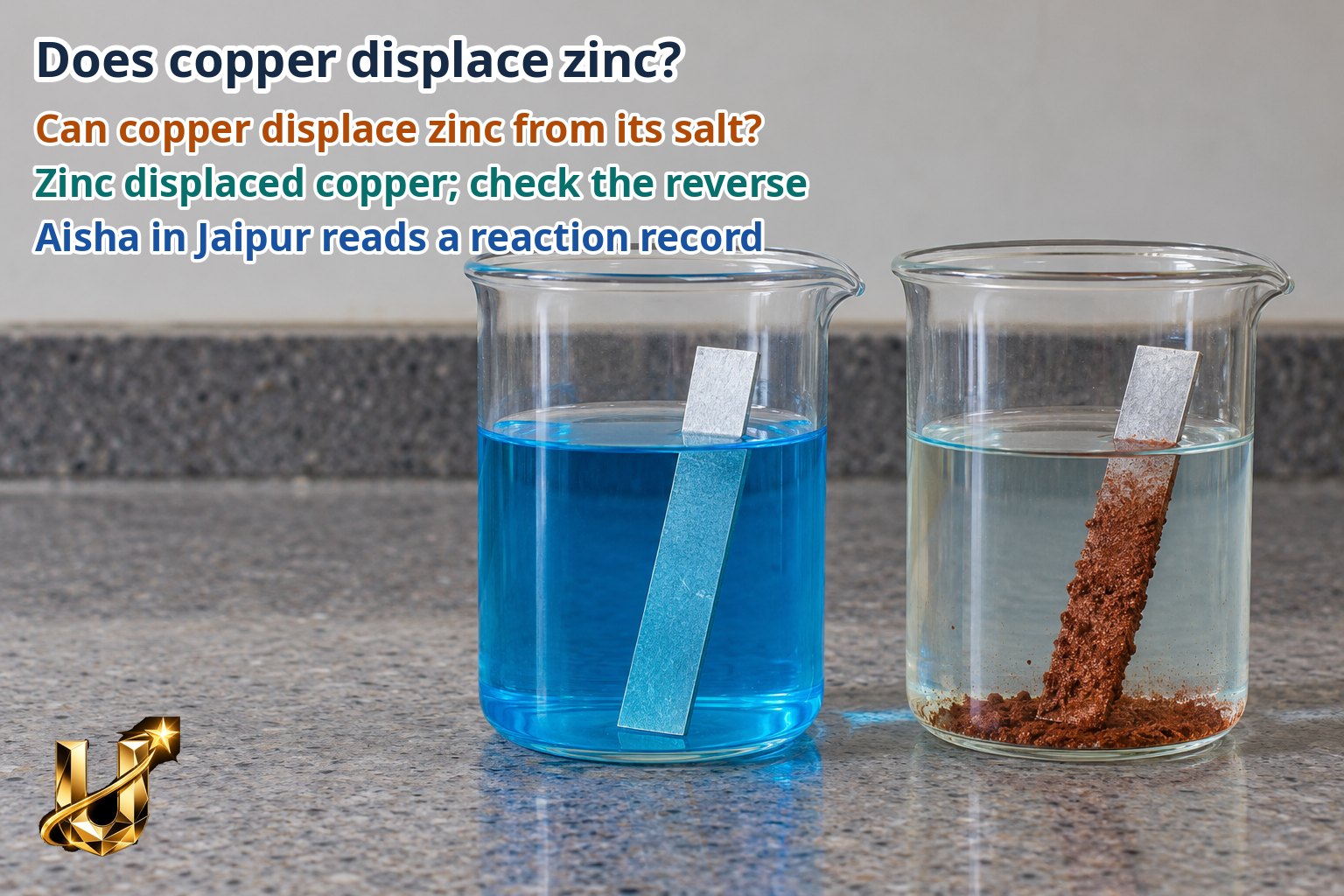
Aisha in Jaipur sees zinc displace copper in a prepared reaction record. Can copper then displace zinc from its salt solution?
Working review group 2; official unit label pending
Aisha in Jaipur sees zinc displace copper in a prepared reaction record. Can copper then displace zinc from its salt solution?
An ordering of metals by their relative tendency to react under stated comparison conditions.
Review lesson not available yet.
Aisha in Jaipur sees zinc displace copper in a prepared reaction record. Can copper then displace zinc from its salt solution?
A reactivity series compares metals under specified conditions. A more reactive metal can displace a less reactive one from suitable compounds. Metals above hydrogen can release hydrogen from suitable dilute acids, but acid type and protective layers matter; never generalise to every metal-acid pair.
A supplied series places zinc above copper.
If zinc is above copper in the given series, which is predicted?
Highly reactive metals often require electrolysis of suitable molten compounds. Less reactive metal oxides can sometimes be reduced by carbon or other reducing agents. Sulfide or carbonate ores may first be converted to oxides by suitable industrial processes. An ore is not the same as a pure metal.
A very reactive metal forms a stable ionic compound.
Why is an ore not simply a pure metal?
Iron rusting needs suitable water and oxygen exposure; salts can accelerate it. Protective coatings, galvanising and suitable alloys can reduce corrosion. A damaged coating or unsuitable environment can change performance. Different metals corrode differently.
An iron gate has an intact suitable coating.
Use supplied reactivity cards to predict suitable displacement cases and select an industrial extraction category. Interpret diagrams only; do not use acids, molten salts or reactive metals.
Reactivity helps explain displacement and extraction. Corrosion is an environmental reaction that suitable coatings and alloys can reduce.