
A question from life
Enlarge image
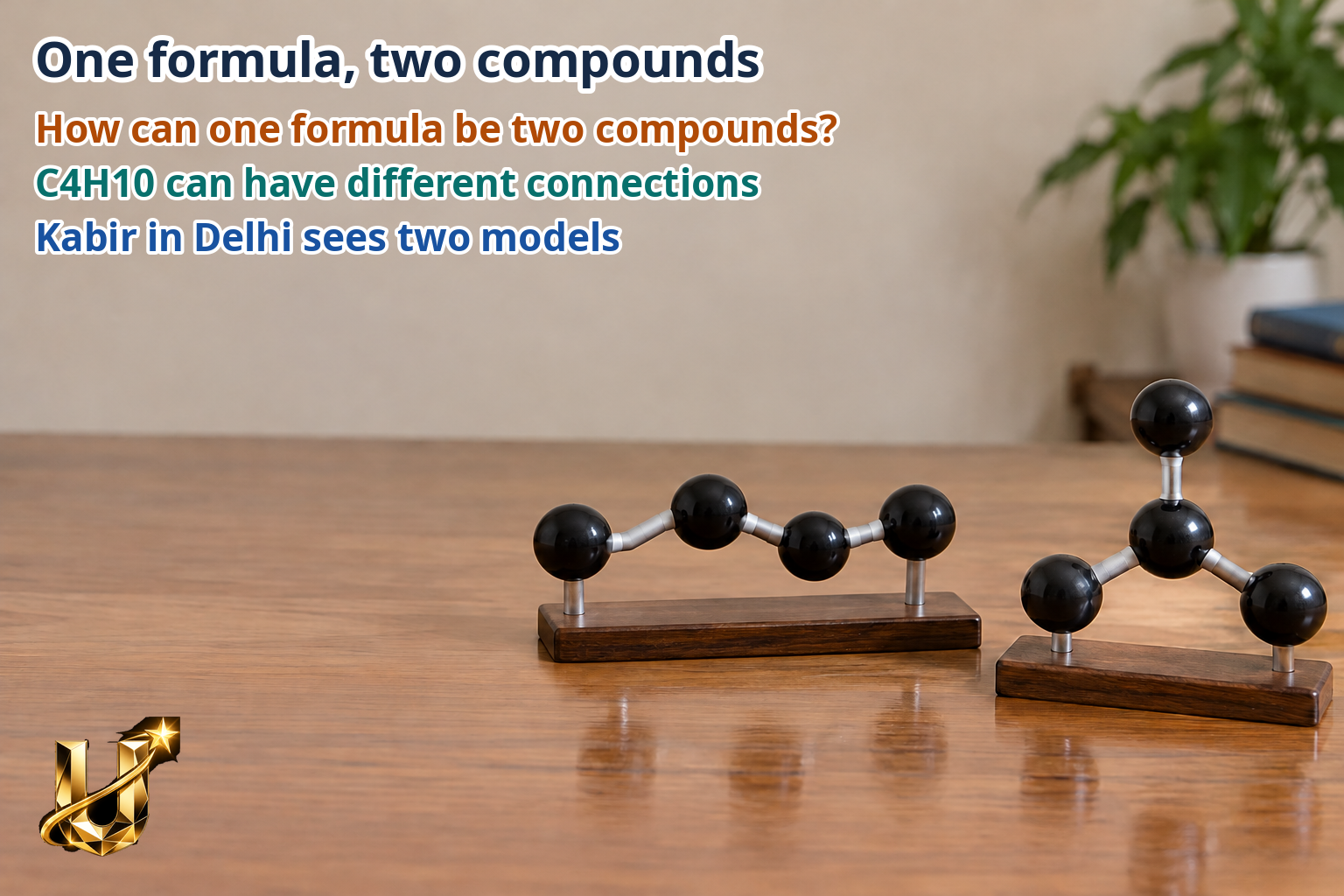
Kabir in Delhi sees two models labelled C₄H₁₀ with different connections. How can one molecular formula describe two different compounds?
Working review group 2; official unit label pending
Kabir in Delhi sees two models labelled C₄H₁₀ with different connections. How can one molecular formula describe two different compounds?
A bond represented by sharing one or more electron pairs between atoms.
Review lesson not available yet.
Kabir in Delhi sees two models labelled C₄H₁₀ with different connections. How can one molecular formula describe two different compounds?
In common neutral carbon compounds at this level, carbon forms four covalent bonds counted by bond order. It can bond to other carbon atoms in chains, branches and rings. This self-linking is called catenation and contributes to carbon's many compounds.
Compare CH₃–CH₃ and CH₂=CH₂.
What is catenation?
Hydrocarbons contain only carbon and hydrogen. Saturated hydrocarbons have only single carbon-carbon bonds; unsaturated ones contain double or triple carbon-carbon bonds. 'Saturated' here describes bonding, not the amount dissolved in a solvent.
Compare CH₃CH₂CH₂CH₃ and CH₃CH(CH₃)CH₃.
Which is an unsaturated hydrocarbon?
Structural isomers share a molecular formula but differ in atom connectivity. Simply reversing a written chain or rotating a whole model does not create a new compound. A homologous series has a common functional group and successive members typically differ by CH₂.
Compare methane CH₄, ethane C₂H₆ and propane C₃H₈.
Build chain and branched C₄H₁₀ models using prepared counters. Check atom counts and connectivity before naming an isomer. No solvents or combustion tests.
Carbon forms varied covalent structures. Bond types distinguish saturation, while connectivity distinguishes structural isomers and homologous series organise related compounds.