
A question from life
Enlarge image
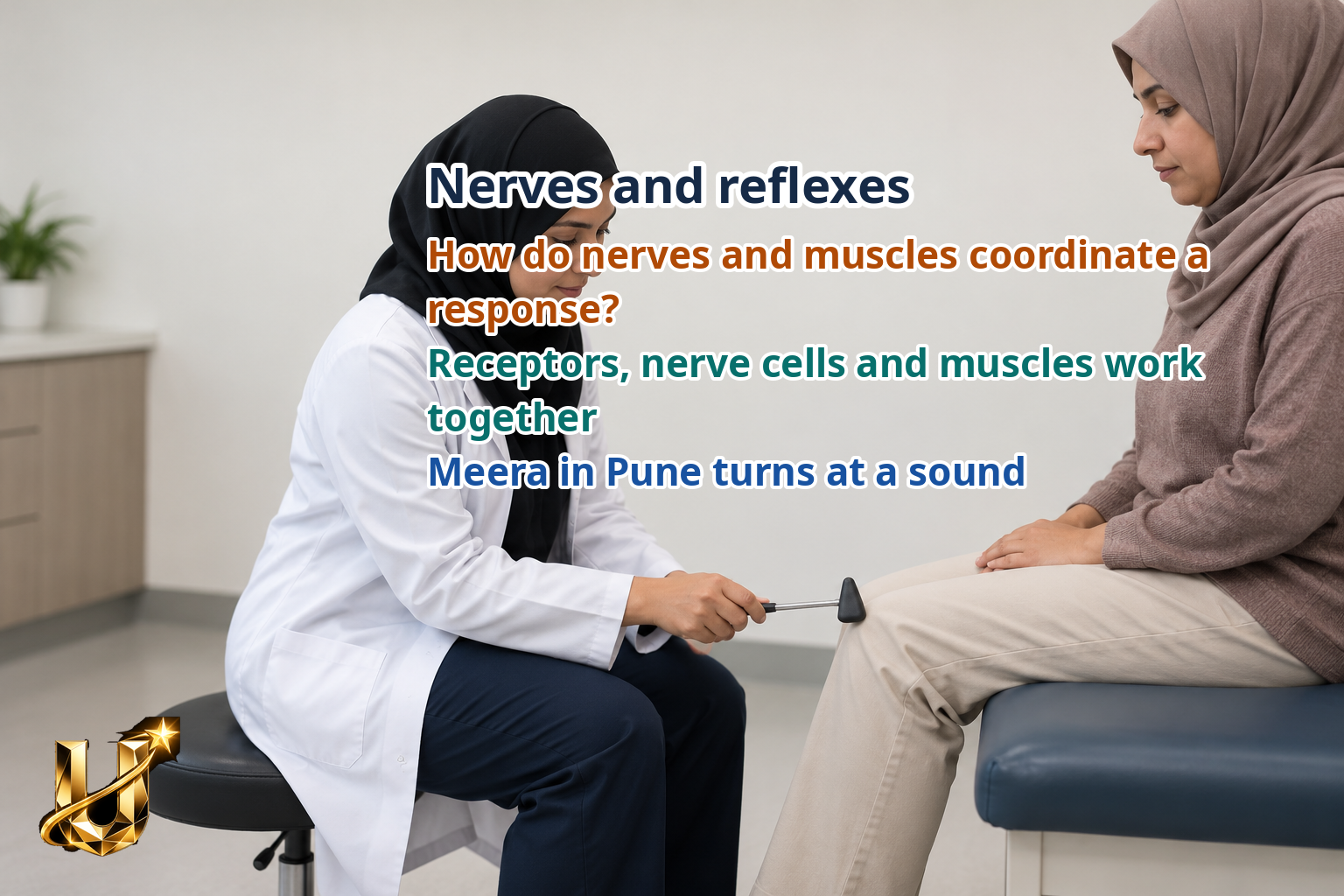
Meera in Pune hears an unexpected sound and turns her head. How can receptors, nerve cells and muscles coordinate a response?
Working review group 3; official unit label pending
Meera in Pune hears an unexpected sound and turns her head. How can receptors, nerve cells and muscles coordinate a response?
A specialised structure or molecule that detects a stimulus or signal.
Review lesson not available yet.
Meera in Pune hears an unexpected sound and turns her head. How can receptors, nerve cells and muscles coordinate a response?
A receptor detects a stimulus and information travels through sensory pathways. The brain and spinal cord form the central nervous system; peripheral nerves connect them with the body. Motor pathways can activate muscles or glands.
A prepared withdrawal model has receptor, sensory neuron, spinal interneuron, motor neuron and muscle.
What forms the central nervous system?
Dendrites and cell bodies receive inputs; an axon conducts signals away in the usual model. Many chemical synapses use neurotransmitters released at an ending to influence another cell across a small gap. Myelin speeds conduction in suitable axons.
A diagram shows vesicles releasing a chemical messenger.
What commonly crosses a chemical synaptic gap?
A reflex is a rapid automatic response through a neural circuit. Some protective withdrawal circuits are organised through the spinal cord while information also reaches the brain. Voluntary movement involves conscious control, but not every skeletal-muscle response is voluntary.
A pupil deliberately raises a hand and also has a knee reflex.
Arrange a reflex-arc card sequence and identify sensory, processing and motor stages. Use diagrams; do not test pain, hot surfaces or startling situations.
Nervous systems detect, process and respond through neurons and effectors. Reflexes can act rapidly without a prior conscious decision, while information can still reach the brain.