
A question from everyday life
Enlarge image
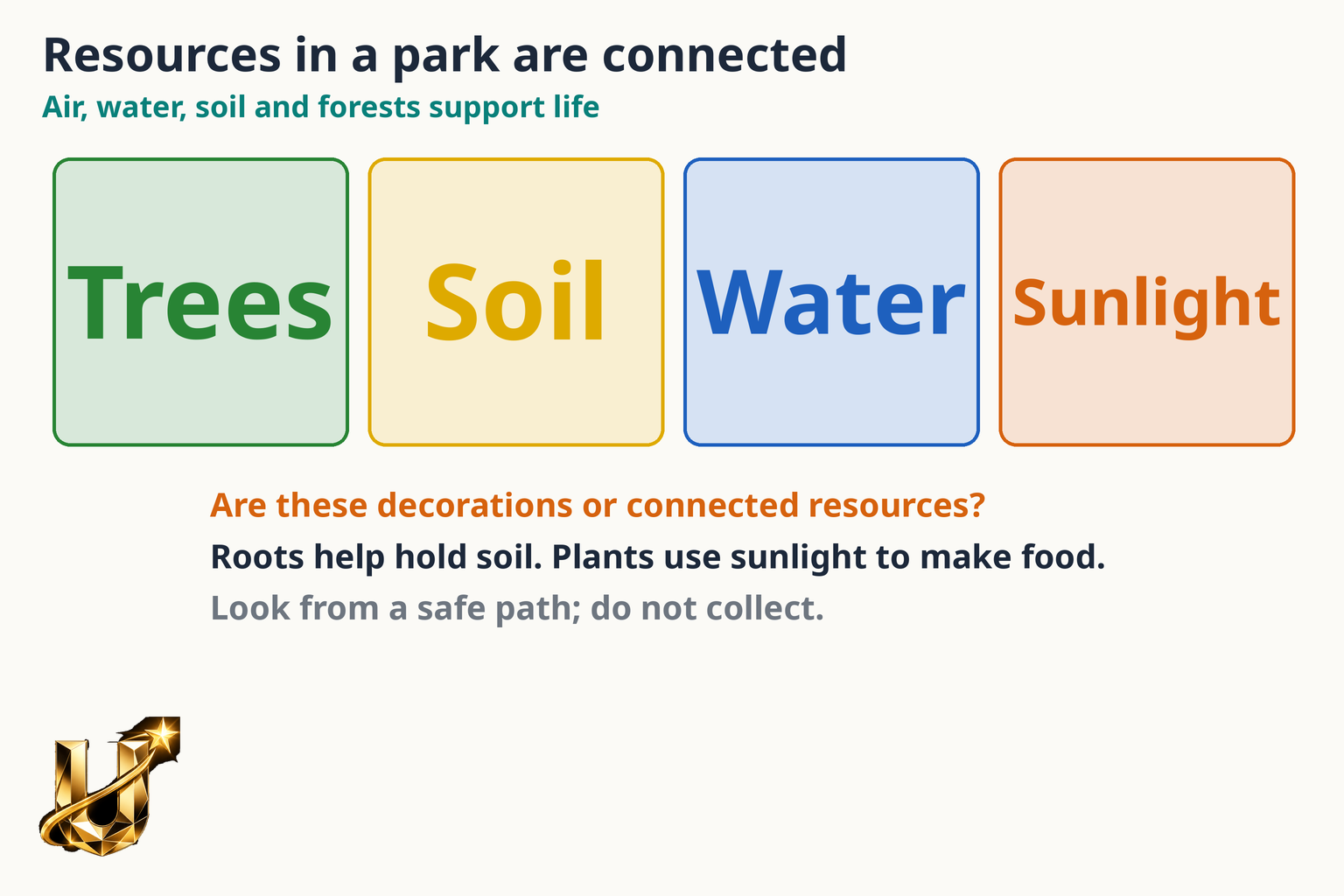
Aarav sees trees, soil, water and sunlight in a Pune park. Are these separate decorations, or connected resources that support life?
Working review group 6; official unit label pending
Aarav sees trees, soil, water and sunlight in a Pune park. Are these separate decorations, or connected resources that support life?
A resource replenished by natural processes on a relevant human timescale,subject to rate and place.
Review lesson not available yet.
Aarav sees trees, soil, water and sunlight in a Pune park. Are these separate decorations, or connected resources that support life?
Air, water, soil, rocks, minerals, forests and sunlight support life and human activity in different ways. Air is a mixture of gases. Water availability and quality differ by place and season. Soil contains mineral material, organic matter, air, water and organisms.
An adult compares sunlight with petroleum in a classroom model. Which is not replaced quickly at its use rate?
Soil can contain:
Roots can help hold soil, forests provide habitats and plants use sunlight to make food. Removing vegetation or polluting water can affect several parts of a system. A forest is more than a collection of timber.
Plants are removed from a slope. Why might soil movement change?
A fossil fuel is:
Some resources can be replenished, but local supply may still be depleted or degraded. Fossil fuels take very long periods to form and are not renewed at our consumption rate. Renewable does not mean impact-free or available everywhere at every time.
A water source is called renewable. Does that prove unlimited clean supply for every town?
Use a fictional park picture. Identify three resources and one connection, then explain why 'renewable' is not the same as 'unlimited here'.
Resources form connected systems. Protect quality and supply, and distinguish renewal from unlimited availability.