
A question from everyday life
Enlarge image
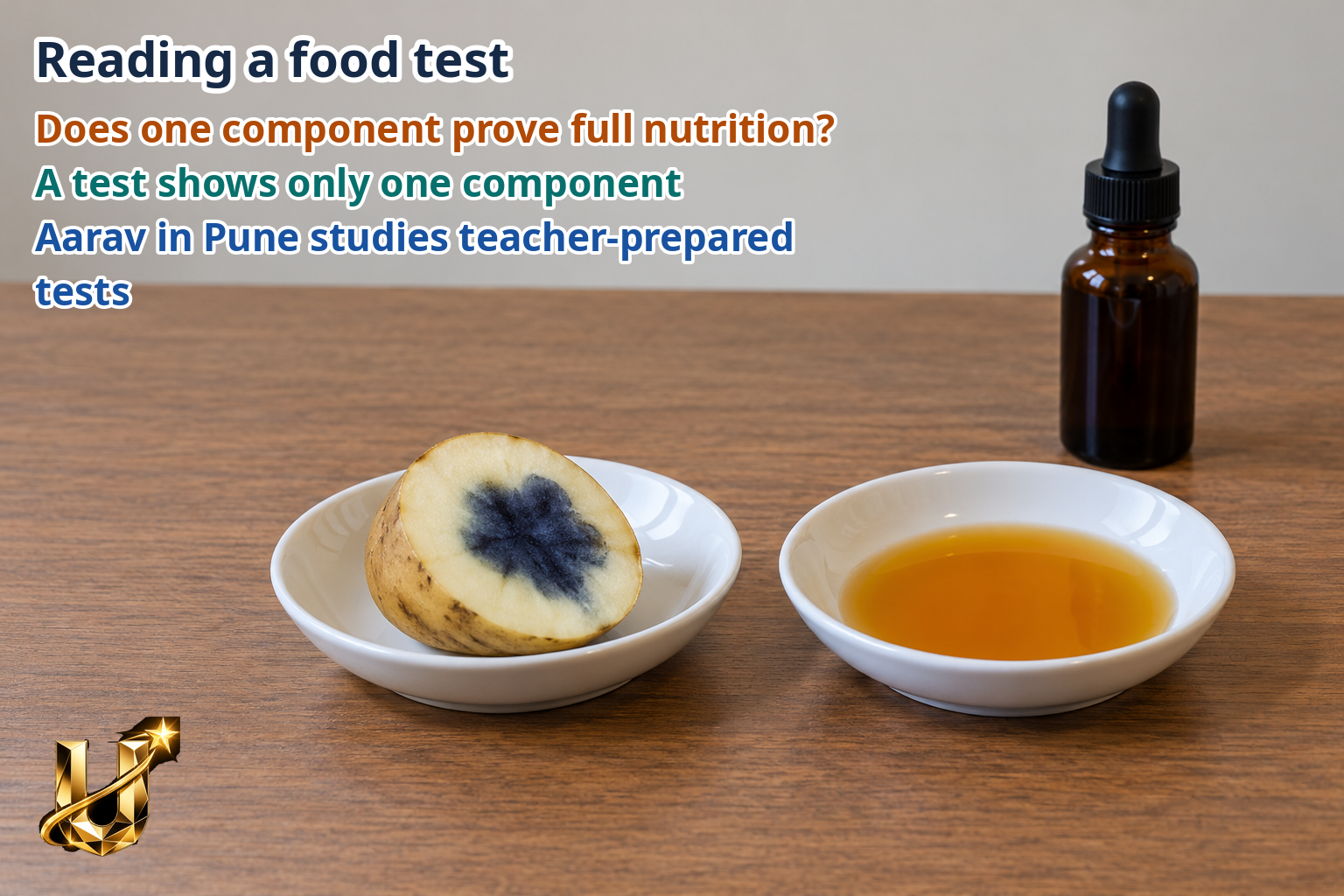
Aarav studies teacher-prepared food-test results in Pune. If a sample shows one component, does that prove its full nutritional value?
Working review group 2; official unit label pending
Aarav studies teacher-prepared food-test results in Pune. If a sample shows one component, does that prove its full nutritional value?
The food and drink a person usually consumes.
Review lesson not available yet.
Aarav studies teacher-prepared food-test results in Pune. If a sample shows one component, does that prove its full nutritional value?
In a standard classroom test, iodine turning blue-black supports starch being present. A translucent grease spot on paper can suggest fat. Teacher-prepared protein-test results can also be interpreted. These tests do not measure a complete diet or prove food safe to eat.
A prepared sample turns blue-black after the teacher's iodine test. What is supported?
Blue-black colour in the standard iodine test supports:
Millets are a group of cereal crops used in varied foods. They can contribute useful nutrients as part of a suitable diet. No one grain is a magic replacement for all other foods. Preparation, access and individual needs still matter.
A sample does not show the recorded starch colour. Does that prove it has no nutrients?
A food-test sample should:
Food miles describe distance travelled by food from production toward the consumer. Longer distance is one consideration, but it alone does not establish nutrition, safety or total environmental impact. Growing, storage and transport methods also matter.
Two foods travel different distances. Is the shorter distance alone enough to prove lower total impact?
Read fictional teacher-prepared positive and negative starch-test cards. State one supported conclusion and one thing the test cannot show.
Food tests answer limited questions. Millets can add variety, and food miles are one factor rather than a complete judgement.