
A question from everyday life
Enlarge image
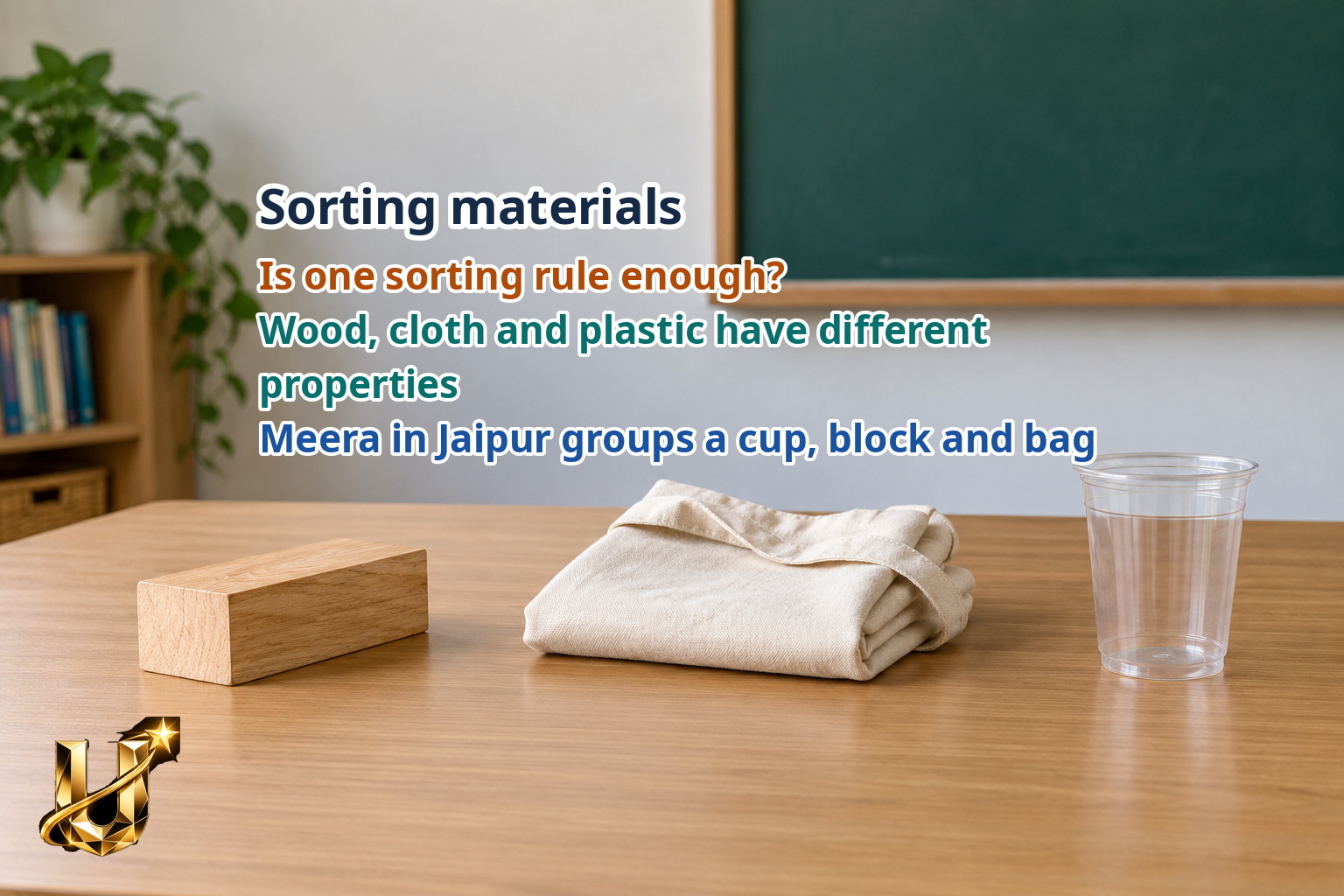
Meera in Jaipur groups a glass-like clear plastic cup, a wooden block and a cloth bag. Is one sorting rule enough to describe every property?
Working review group 3; official unit label pending
Meera in Jaipur groups a glass-like clear plastic cup, a wooden block and a cloth bag. Is one sorting rule enough to describe every property?
Anything with mass that occupies space.
Review lesson not available yet.
Meera in Jaipur groups a glass-like clear plastic cup, a wooden block and a cloth bag. Is one sorting rule enough to describe every property?
An object is a thing; a material is what it is made from. One object may combine materials. Different objects may use the same material, while objects with the same use may use different materials.
In 'wooden spoon', which is object and which is material?
In 'wooden spoon', the material is:
Hardness, flexibility, lustre, transparency and solubility describe different features. Transparent materials let us see clearly through; translucent materials pass some light without a clear view; opaque materials do not let visible light pass through the sample in the stated classroom test. Do not infer every property from appearance.
A cloth bag folds and cannot be seen through. Can it fit two groups?
A material that lets us see clearly through it is:
State the chosen property before grouping. A cloth can be both flexible and opaque. Classifications for different purposes can overlap. Use safe approved objects or data rather than scratching, breaking or tasting unknown materials.
A shiny object is not attracted to a classroom magnet. Is shine enough to prove magnetic behaviour?
Sort approved object cards by transparency, then flexibility. Explain how one object can belong to different groups under different rules.
Objects use materials with multiple properties. State the rule and use evidence suited to the property being studied.