
A question from everyday life
Enlarge image
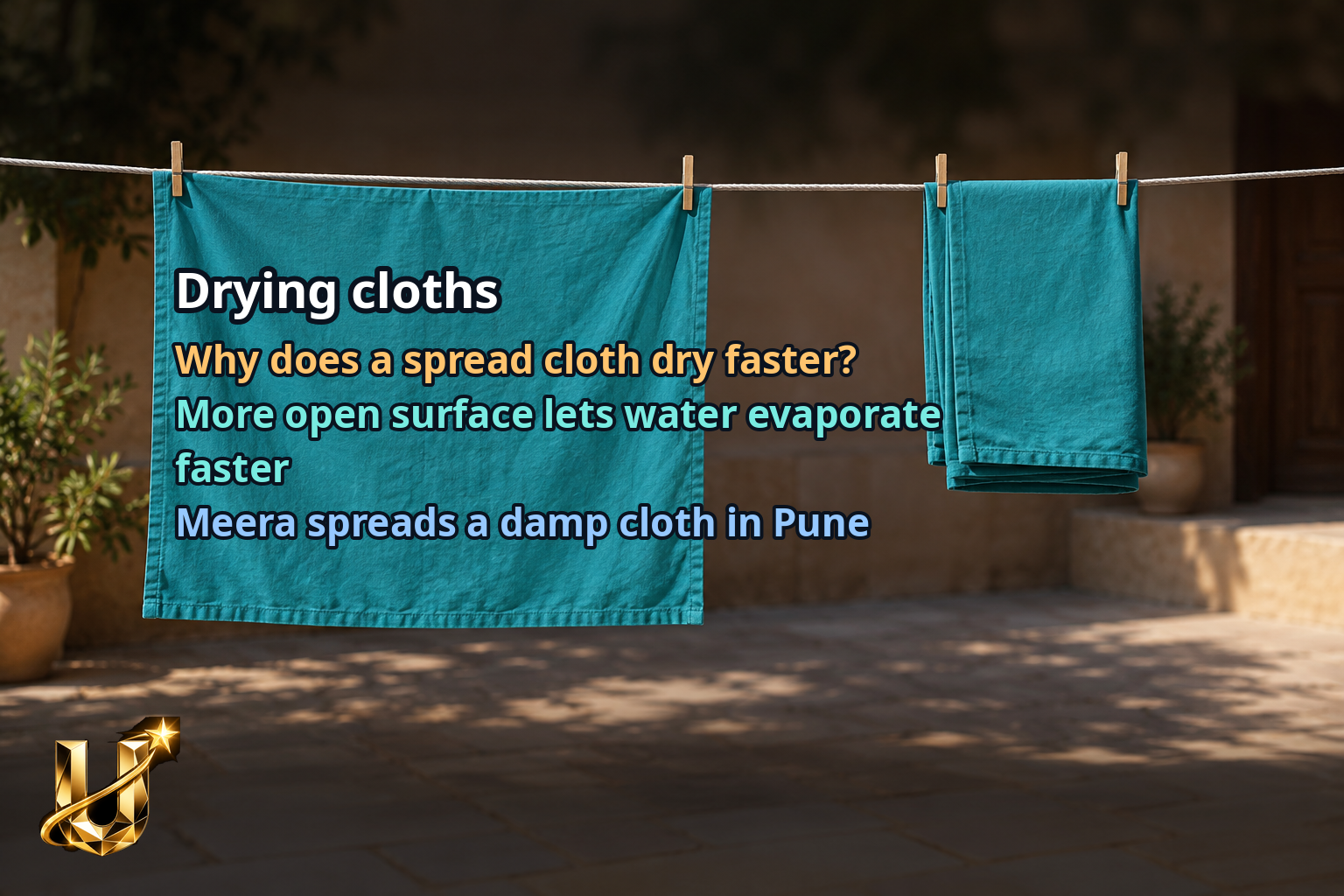
Meera spreads a damp cloth in Pune instead of leaving it folded. Why might the spread cloth dry faster under otherwise similar conditions?
Working review group 4; official unit label pending
Meera spreads a damp cloth in Pune instead of leaving it folded. Why might the spread cloth dry faster under otherwise similar conditions?
Change from liquid water to water vapour.
Review lesson not available yet.
Meera spreads a damp cloth in Pune instead of leaving it folded. Why might the spread cloth dry faster under otherwise similar conditions?
During evaporation, molecules can leave a liquid's surface into the air without the whole liquid boiling. Temperature, exposed surface, airflow and surrounding humidity affect the rate. More than one factor may change outdoors.
Two equally damp similar cloths are kept together, one spread and one folded. What factor is intended to differ?
Evaporation:
Evaporation uses energy, which can be transferred from the liquid and surroundings. This can produce cooling. The effect depends on conditions and does not guarantee a fixed temperature change.
One cloth is in warm windy sun and another in cool still shade. Can area alone explain the result?
A fair surface-area comparison keeps:
To compare surface area, keep initial water amount, material, temperature, airflow and observation time as similar as possible. Use safe water and adult-approved samples or prepared data. Never block essential drinking or hygiene to perform a test.
An approved animation shows evaporation taking energy from surroundings. Does it prove every liquid cools by the same amount?
Compare fictional drying records with stated conditions. Name the changed factor and one condition to keep similar. No heat or unknown liquids.
Evaporation differs from boiling, depends on several conditions and can cause cooling. Fair tests isolate a chosen factor.
Humidity describes water vapour in air. Relative humidity compares the amount present with the amount corresponding to saturation at the same temperature. At the same temperature, more humid air generally allows slower evaporation from an exposed water surface when other conditions are similar. Water vapour is invisible; visible mist consists of tiny liquid droplets.
Two identical wet cloths face similar airflow and temperature. The surrounding air is more humid for one. Which is expected to dry more slowly?
With other conditions similar, higher humidity generally makes drying: