
A question from life
Enlarge image
Enlarge image
Aisha in Hyderabad sees small rectangles in a prepared onion-skin slide. Does the picture alone prove what every plant cell looks like?
Working review group 1; official unit label pending
Aisha in Hyderabad sees small rectangles in a prepared onion-skin slide. Does the picture alone prove what every plant cell looks like?
A factor that can change or be measured in an investigation.
Review lesson not available yet.
Aisha in Hyderabad sees small rectangles in a prepared onion-skin slide. Does the picture alone prove what every plant cell looks like?
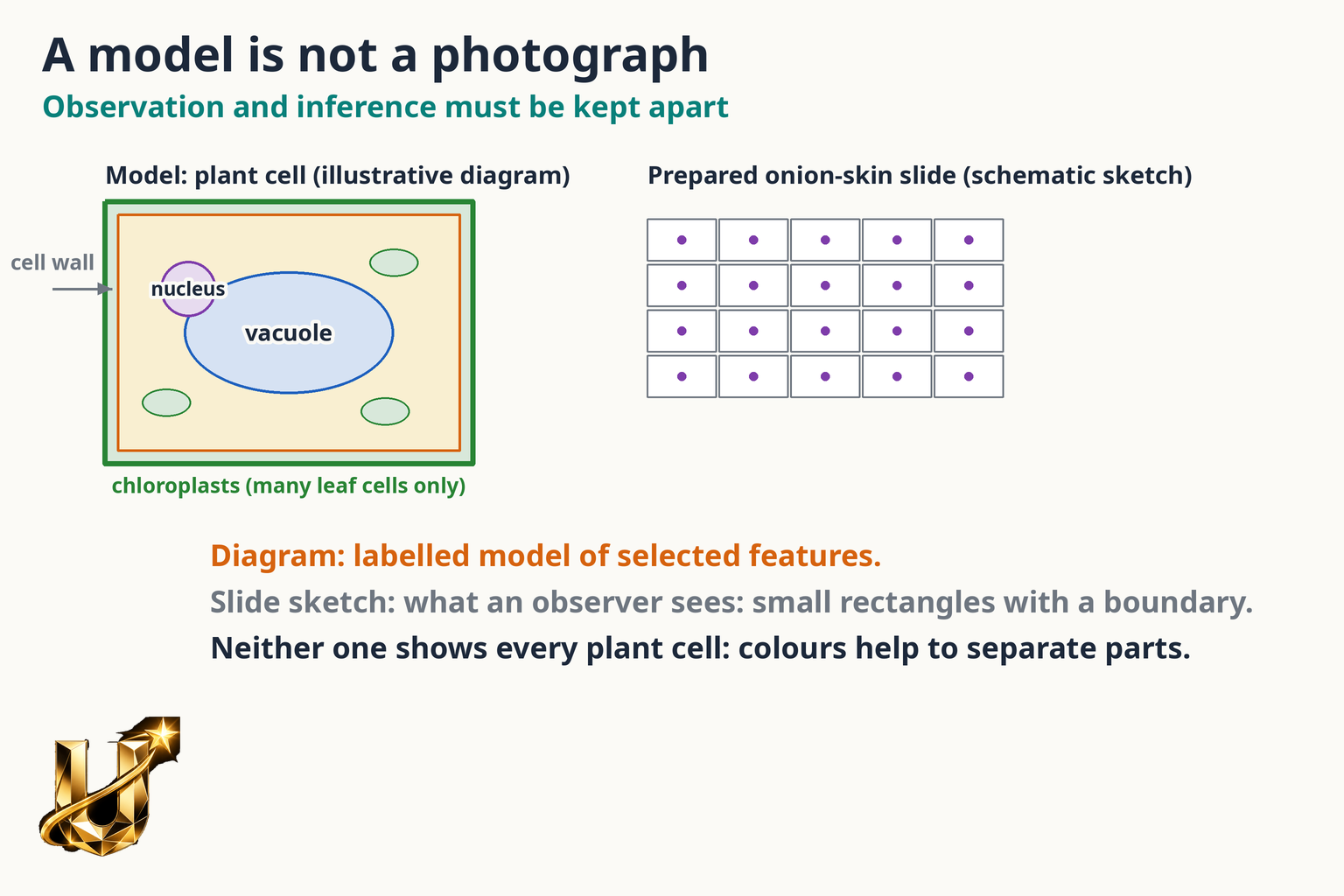
An observation records what an instrument or our senses detect. An inference explains the observation using knowledge. Seeing a boundary is an observation; identifying it as a cell wall uses an interpretation.
A prepared image shows a green body inside a leaf cell.
Which statement is an observation?
A model represents selected features of something. A flat cell drawing can show relative positions of parts, but it does not show every structure, natural colour or changing process. Magnification makes an image larger, not necessarily more detailed.
A cell diagram colours the nucleus purple.
Why is a textbook diagram coloured?
Compare several observations before making a broad claim. Many leaf cells contain chloroplasts, while onion bulb epidermal cells usually do not. New evidence can refine an explanation without making earlier observations useless.
One leaf sample has chloroplasts; an onion bulb sample does not.
Compare a prepared microscope image and a simplified cell drawing with your teacher. Say one useful feature and one omitted feature of the model. Never collect or culture unknown microbes.
Observations describe evidence; inferences interpret it. Models simplify, and scientific explanations can improve when reliable evidence changes.