
A question from life
Enlarge image
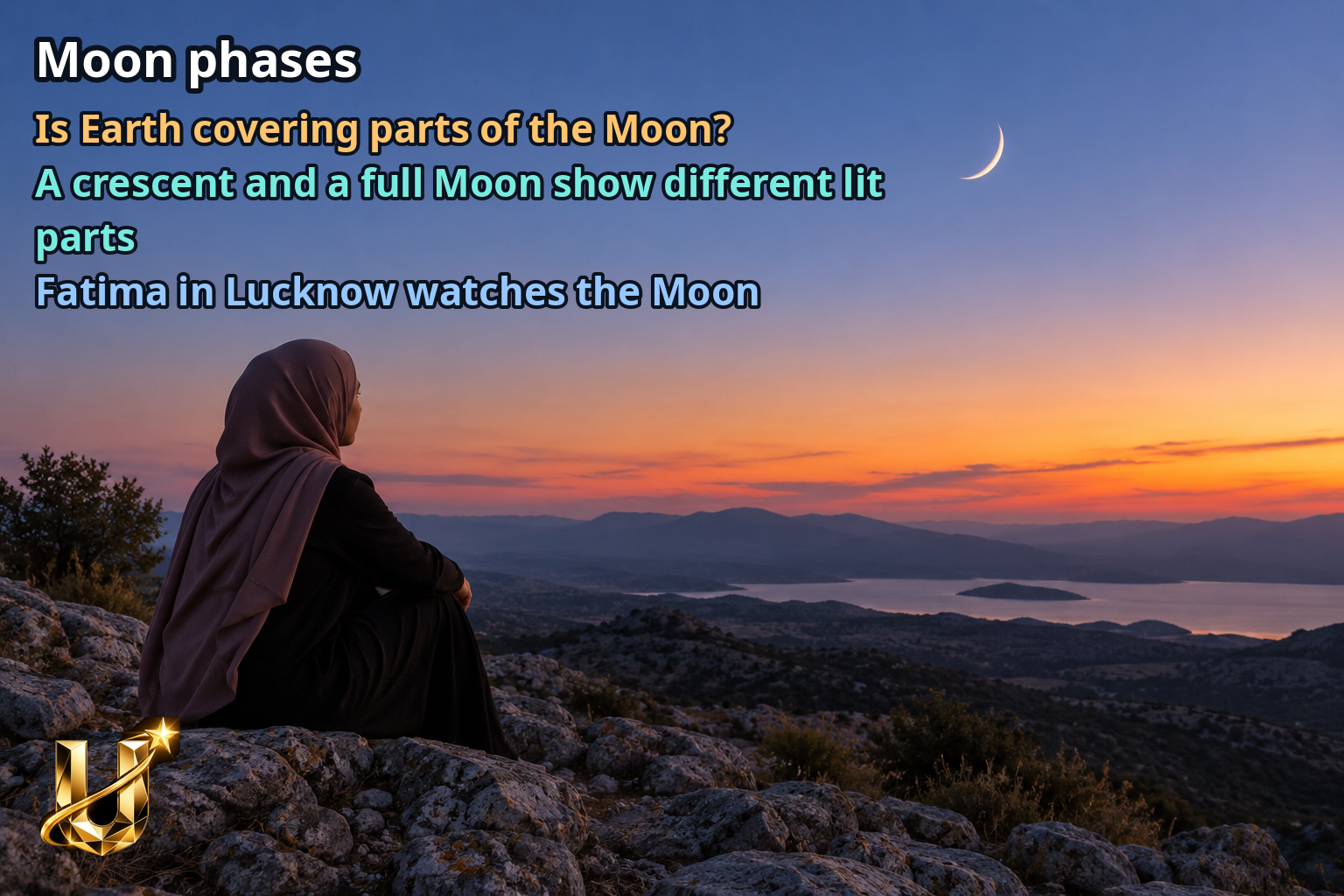
Fatima in Lucknow notices a crescent Moon and later a full Moon. Is Earth covering different parts of the Moon every night?
Working review group 6; official unit label pending
Fatima in Lucknow notices a crescent Moon and later a full Moon. Is Earth covering different parts of the Moon every night?
Turning of a body about its own axis.
Review lesson not available yet.
Fatima in Lucknow notices a crescent Moon and later a full Moon. Is Earth covering different parts of the Moon every night?
Sunlight illuminates roughly half of the Moon at a time. As the Moon orbits Earth, we see different fractions of that illuminated half. These changing appearances are phases; the Moon does not make its own visible light.
A picture shows half the Moon's visible disc illuminated at first quarter.
What causes ordinary Moon phases?
The sequence includes new Moon, waxing crescent, first quarter, waxing gibbous, full Moon and waning phases. A full phase cycle takes about 29½ days. A quarter Moon looks half lit because 'quarter' refers to progress around the cycle.
Use 29½ days as an approximate phase-cycle length.
About how long is a full phase cycle?
Day, month and year are linked to different astronomical cycles, which do not fit into exact whole-number multiples. Calendars use rules to organise them. Eclipses require a special alignment; they do not occur at every new or full Moon because the lunar orbit is tilted.
A full Moon occurs without a lunar eclipse.
Arrange prepared Moon phase images in order and explain first quarter. Use a cool lamp and balls for a teacher-led model; never observe the Sun directly or through optical devices.
Phases come from changing views of the Moon's illuminated half. The cycle is about 29½ days; calendars approximate linked cycles, while eclipses require special alignment.
A solar calendar follows the year linked to Earth’s orbit. A lunar calendar follows lunar phase months. A lunisolar calendar combines lunar months with adjustments that keep the calendar aligned with the solar seasons. These cycles do not fit exact whole-number multiples. Artificial satellites serve communication, navigation and scientific observation; not every moving light in a night-sky image is a satellite.
A calendar uses lunar months and occasionally adds an extra month to stay aligned with seasons. What kind is this?
A calendar combining lunar months and solar-season adjustment is: