
A question from life
Enlarge image
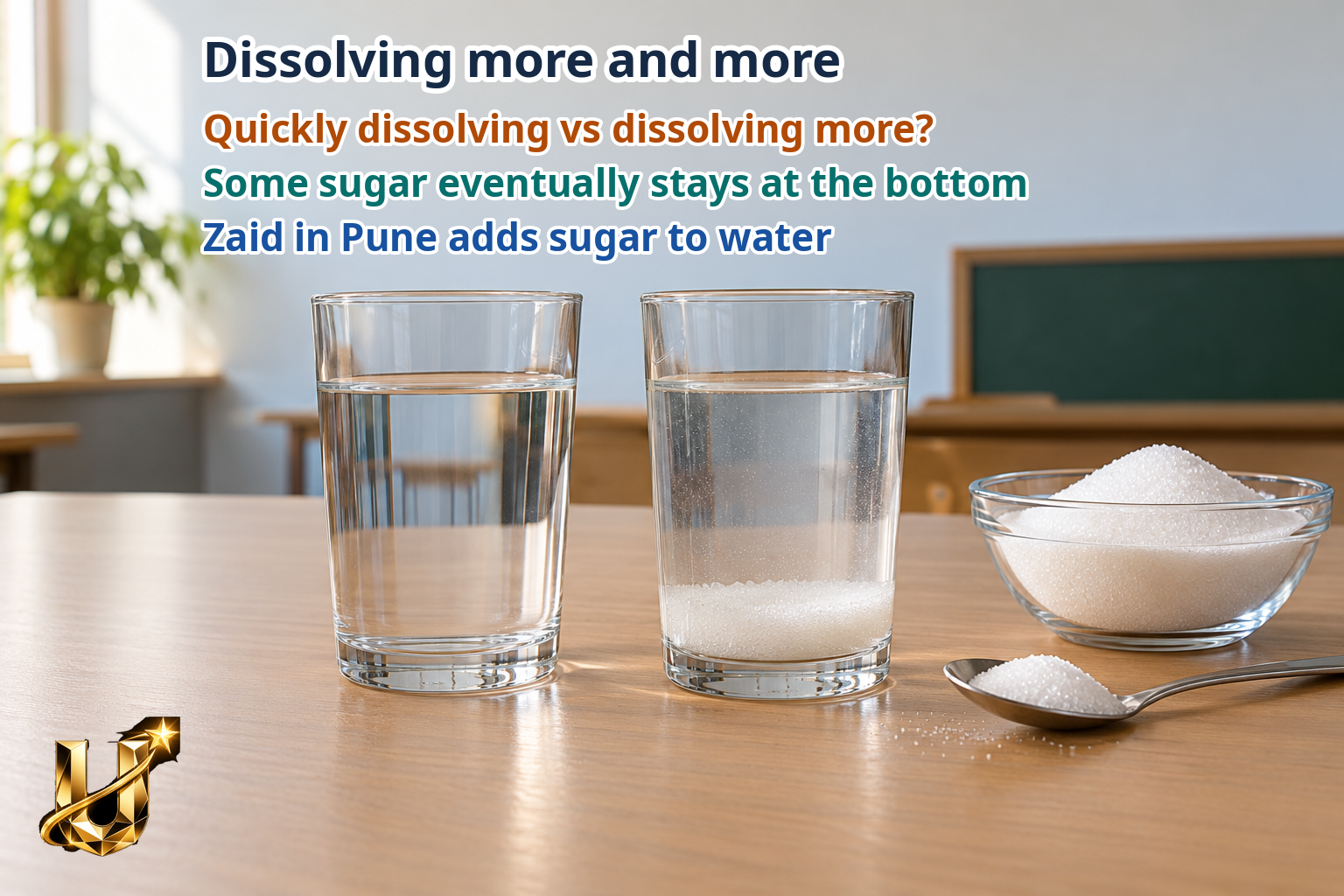
Zaid in Pune adds small amounts of sugar to water. Eventually some remains at the bottom. What distinguishes dissolving quickly from being able to dissolve more?
Working review group 5; official unit label pending
Zaid in Pune adds small amounts of sugar to water. Eventually some remains at the bottom. What distinguishes dissolving quickly from being able to dissolve more?
A homogeneous mixture in which a solute is dispersed in a solvent at the molecular or ionic scale.
Review lesson not available yet.
Zaid in Pune adds small amounts of sugar to water. Eventually some remains at the bottom. What distinguishes dissolving quickly from being able to dissolve more?
For the same solute and solvent, concentration describes how much solute is present relative to an amount of solution or solvent. State the comparison basis clearly. More solute in the same final solution volume means greater concentration.
A contains 5 g salt per 100 mL solution; B contains 10 g per 100 mL solution.
Which solution is more concentrated at equal final volume?
At a given temperature, a saturated solution contains as much dissolved solute as can dissolve under those conditions. Extra solid may remain undissolved. Solubility depends on the solute, solvent and temperature; it does not increase with temperature for every substance.
At a fixed temperature a prepared sample retains excess sugar after enough stirring and time.
What does stirring usually change most directly?
Stirring and using smaller particles can increase the rate of dissolving without necessarily changing how much dissolves at equilibrium. Temperature can affect both rate and solubility. Test one factor at a time and distinguish time-to-dissolve from maximum dissolved amount.
Crushed sugar dissolves sooner than an equal mass of large crystals in a fair test.
Compare prepared concentration cards with equal final volumes. Then sort investigation questions into rate or maximum dissolved amount. No heating, tasting or unknown solvents.
Concentration uses a stated comparison basis. Saturation and solubility depend on conditions. Dissolving rate and final dissolving capacity are different questions.
Density is mass divided by volume. An object with average density lower than a liquid can float in the simple model; an object denser than the liquid tends to sink when surface-tension and support effects are negligible. For a solid that does not dissolve or react, immersion in a measuring cylinder can give volume from the rise in liquid level; read the meniscus at eye level and check scale divisions. Gas solubility in liquids depends on temperature and pressure: many gases dissolve less in warmer water and more under higher gas pressure, at otherwise comparable conditions.
A non-absorbing model object has mass twenty grams and displaces twenty-five millilitres of water. Calculate its average density.
Mass 30 grams and volume 10 millilitres give density: