
A question from life
Enlarge image
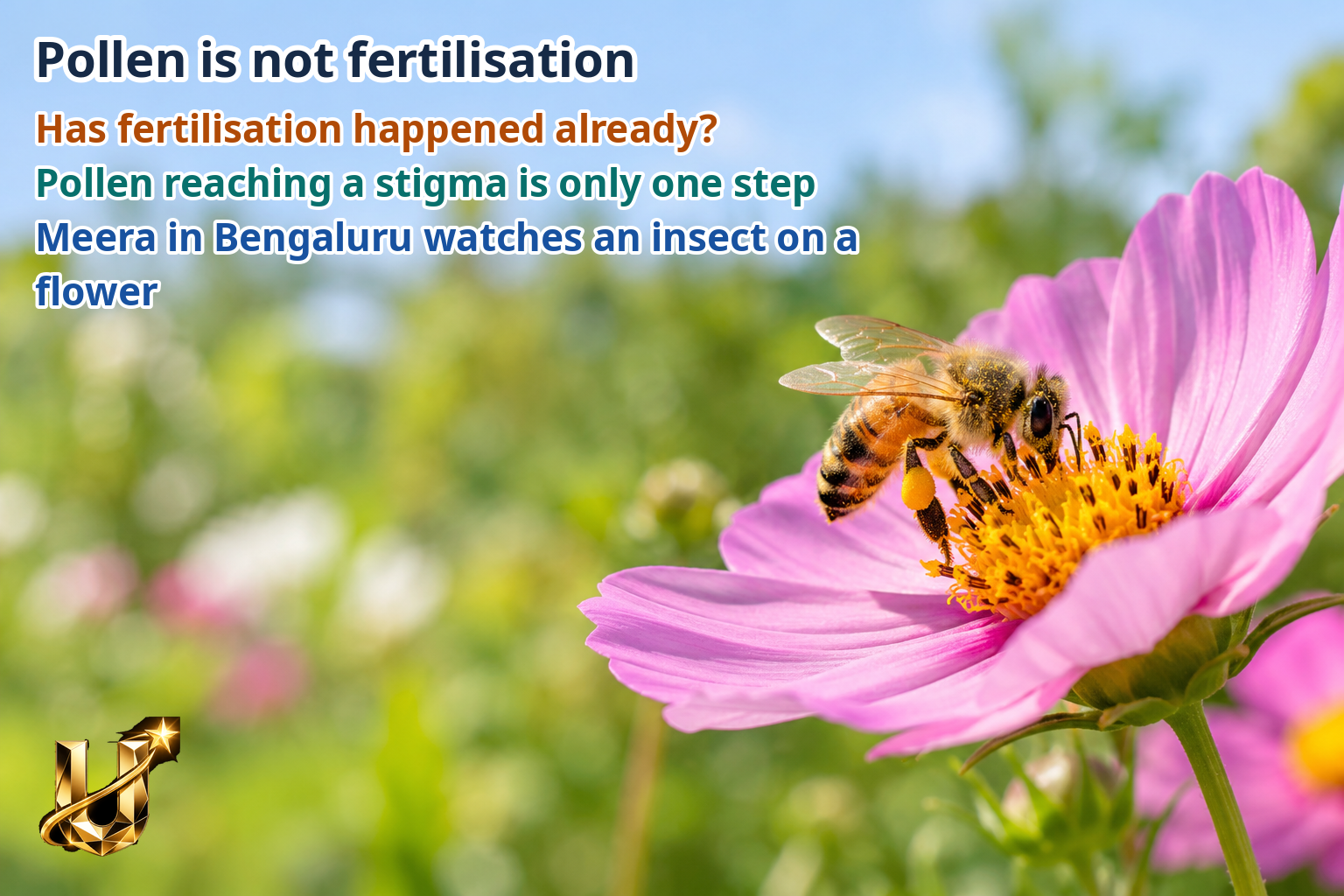
Meera in Bengaluru watches an insect visit a flower. Has fertilisation already happened just because pollen has reached a stigma?
Working review group 6; official unit label pending
Meera in Bengaluru watches an insect visit a flower. Has fertilisation already happened just because pollen has reached a stigma?
A reproductive cell that can fuse with another during sexual reproduction.
Review lesson not available yet.
Meera in Bengaluru watches an insect visit a flower. Has fertilisation already happened just because pollen has reached a stigma?
Sexual reproduction involves fusion of gametes. Meiosis helps reduce chromosome number in the usual sexual life-cycle model; fertilisation restores the paired condition. It can create genetic combinations, but not every trait follows one simple dominant-recessive rule.
Pollen lands on a flower's stigma.
What is pollination?
In flowering plants, anthers produce pollen grains, and the stigma receives pollen. Pollination is pollen transfer to a stigma; it is not gamete fusion. Suitable pollen can grow a tube that enables male gametes to reach the ovule.
A model species has body cells with 12 chromosomes.
What forms directly from gamete fusion?
Fusion of a male and female gamete forms a zygote, which develops by division and differentiation. In the usual flowering-plant model the ovule develops into a seed and the ovary into a fruit. Some plants self-pollinate, so separate parent individuals are not always required.
A fertilised flowering plant develops fruit and seeds.
Arrange prepared cards from pollen transfer through gamete fusion to seed/fruit development. Use supplied chromosome counts for a model species; no personal body information is requested.
Sexual reproduction combines gametes. Pollination transfers pollen; fertilisation fuses gametes. Seeds and fruits form through later development.
In humans, testes produce sperm; ovaries produce egg cells. Sperm travel through ducts and the urethra, while eggs pass into oviducts. Fertilisation usually occurs in an oviduct; the early embryo can implant in the uterine lining. The uterus supports development,with exchange through the placenta; maternal and fetal blood do not normally mix directly. The cervix joins uterus to vagina. Menstruation involves shedding of uterine lining when the cycle does not lead to maintained pregnancy. Cycles vary; these diagrams do not diagnose an individual. Contraceptive methods include barriers,hormonal methods,intrauterine devices and sterilisation,which act differently. Condoms also reduce transmission risk for many sexually transmitted infections; no method should be described as universally perfect. Personal advice belongs to qualified care.
A labelled diagram shows fertilisation in the oviduct and later implantation in the uterus. Are these the same event?
Usual human fertilisation occurs in the: