
A question from life
Enlarge image
Enlarge image
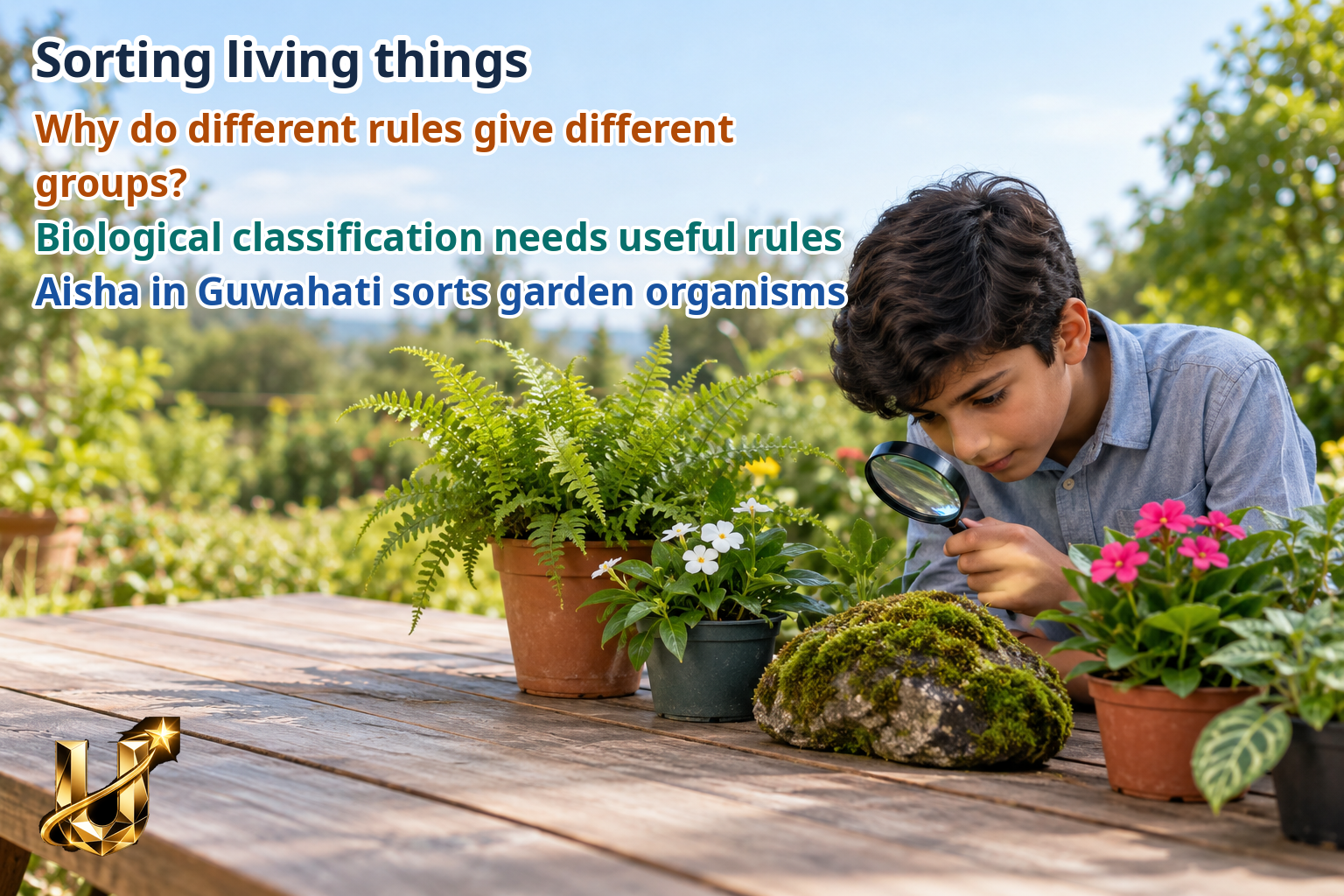
Aisha in Guwahati sorts garden organisms by colour, then by feeding role. Why can different sorting rules give different groups, and which rules help biological classification?
Working review group 6; official unit label pending
Aisha in Guwahati sorts garden organisms by colour, then by feeding role. Why can different sorting rules give different groups, and which rules help biological classification?
Grouping organisms using specified shared features and evidence of relationships.
Review lesson not available yet.
Aisha in Guwahati sorts garden organisms by colour, then by feeding role. Why can different sorting rules give different groups, and which rules help biological classification?
We can classify organisms by ecological role, visible features or evolutionary relationships. Producer/consumer categories describe ecological roles, not formal taxonomic ranks. Colour alone is often an unreliable guide to relatedness.
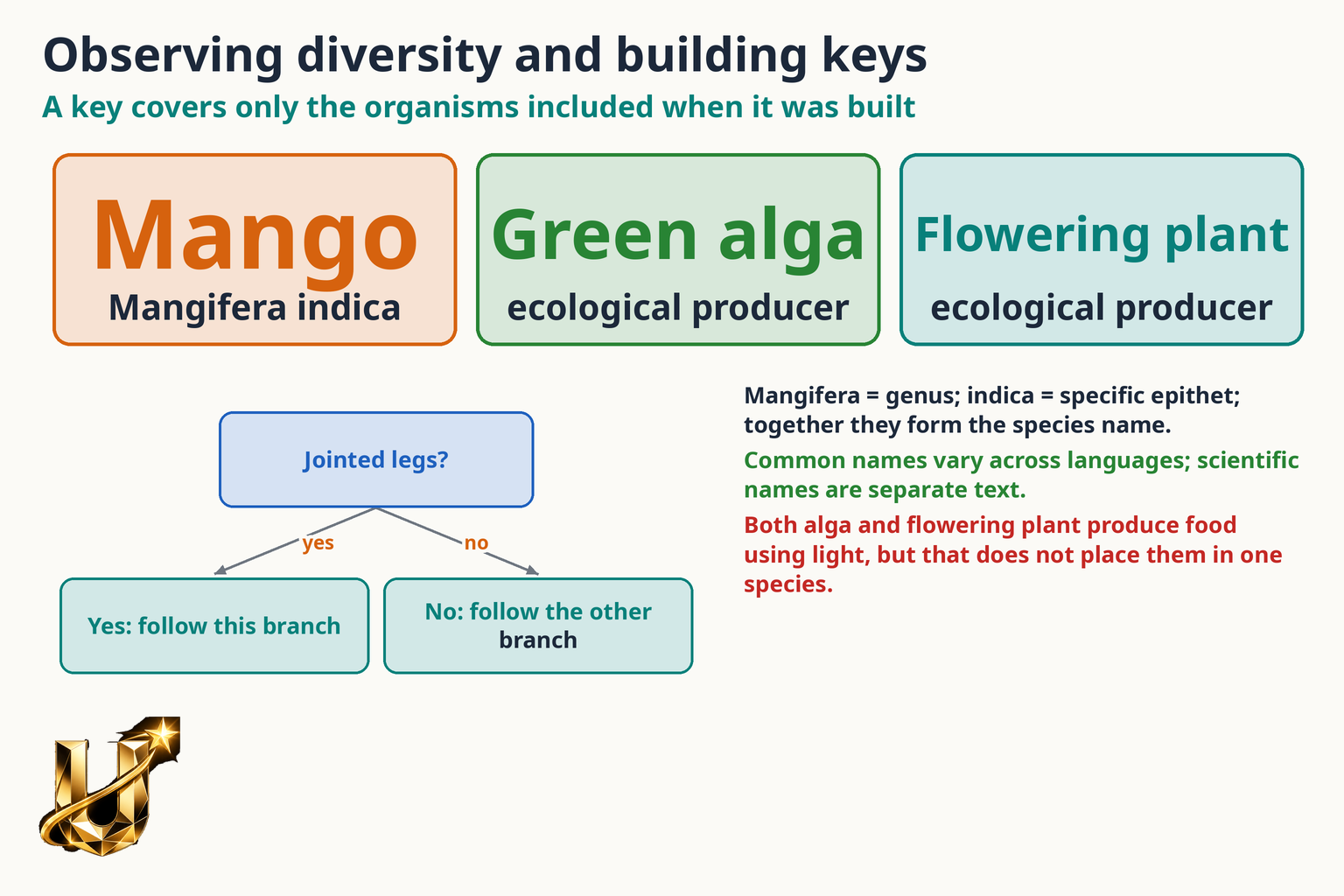
A green alga and a green flowering plant can both produce food using light.
What must a classification state first?
Biological classification compares multiple inherited features and evidence of relationships. Broad school groups can consider cell type, cell number, nutrition and organisation. Similar appearance may arise in unrelated organisms, so one feature is rarely enough.
A prepared key first asks whether an organism has jointed legs.
Why is 'producer' not a species name?
Taxonomic groups are nested: species belongs within a genus and broader groups. A scientific species name commonly uses two words, with genus capitalised and the specific epithet lowercase. A simple identification key separates alternatives using observable features; a key identifies within its listed set rather than proving every relationship.
A card uses Mangifera indica for mango.
Build a two-step key for four teacher-provided organism cards using visible, unambiguous features. State which organisms the key covers and one limitation.
Classifications need clear purposes and multiple features. Ecological roles differ from taxonomy; scientific names and keys support precise communication.