
A question from life
Enlarge image
Kabir in Kolkata sees a mushroom beside a leafy plant. Both stay in one place, but should a mushroom be classified as a plant?
Working review group 6; official unit label pending
Kabir in Kolkata sees a mushroom beside a leafy plant. Both stay in one place, but should a mushroom be classified as a plant?
Grouping organisms using specified shared features and evidence of relationships.
Review lesson not available yet.
Kabir in Kolkata sees a mushroom beside a leafy plant. Both stay in one place, but should a mushroom be classified as a plant?
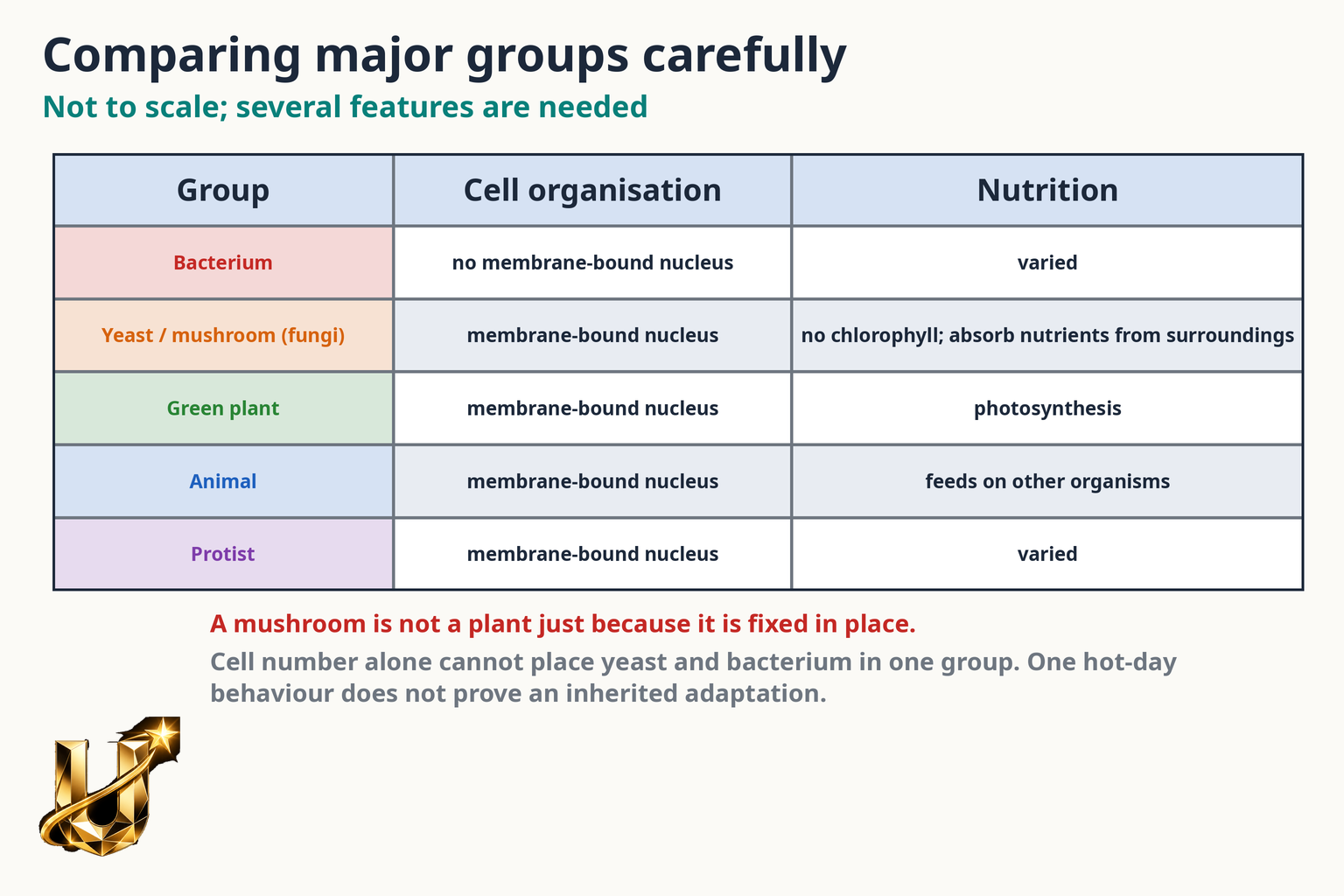
Bacteria lack a membrane-bound nucleus. Plants, animals, fungi and organisms commonly grouped as protists are eukaryotic, with membrane-bound nuclei. 'Protists' is a useful broad school grouping here, not one simple complete account of evolutionary relationships.
A mushroom lacks chlorophyll and absorbs nutrients from its surroundings.
Which lacks a membrane-bound nucleus?
Plants commonly make food by photosynthesis, while fungi absorb nutrients after external digestion. Animals ingest food in the usual comparison. Fungi and plants can both have cell walls, but their composition and ways of obtaining food differ. Not every organism fits a one-feature shortcut.
A prepared bacterial cell has no membrane-bound nucleus; a yeast cell does.
How do fungi commonly obtain nutrients?
Inherited characteristics can support survival and reproduction in particular environments over generations. An individual's short-term response is not automatically an evolutionary adaptation. Diversity includes differences within species as well as between species and ecosystems.
A pupil sees one animal behave differently on a hot day.
Compare supplied organism cards using cell type, cell number and nutrition. For each choice state two supporting features and avoid relying on colour or movement alone.
Major-group comparisons use cell organisation, nutrition and structure. Broad school categories simplify diversity; inherited adaptation differs from a short-term response.
The five-kingdom school model uses Monera,Protista,Fungi,Plantae and Animalia. Monera groups prokaryotes; the other groups are eukaryotic. Molecular evidence distinguishes three domains: Bacteria,Archaea and Eukarya. This newer domain framework does not map one-to-one onto the older five-kingdom model. Major school plant groups include bryophytes,pteridophytes,gymnosperms and angiosperms; vertebrates include fishes,amphibians,reptiles,birds and mammals. Viruses are acellular and do not fit the cell-based kingdoms in the same way.
A bacterium and a yeast are both unicellular. Must they belong to the same kingdom?
Yeast belongs to which school kingdom?