
A question from life
Enlarge image
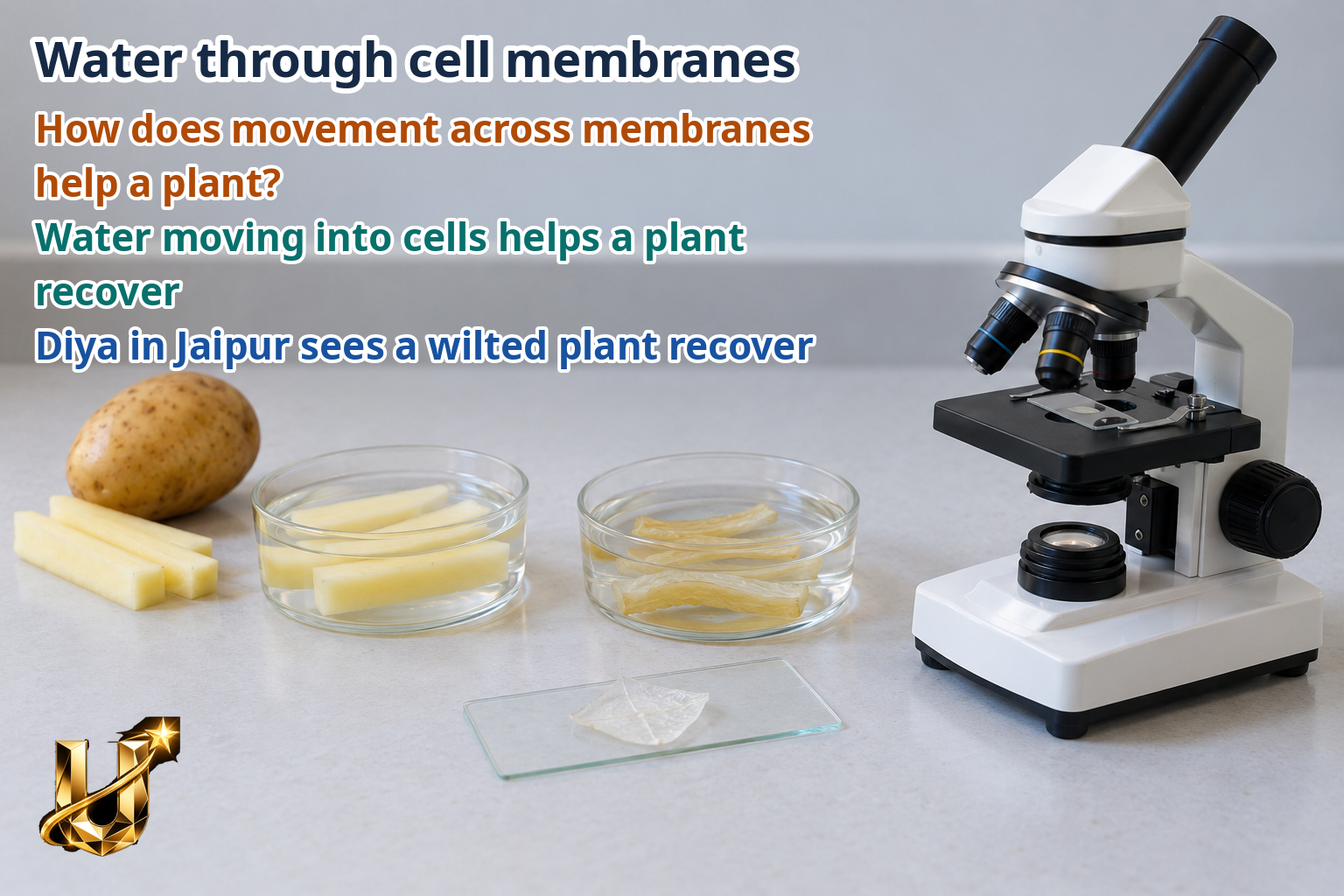
Diya in Jaipur sees a wilted plant recover after suitable watering. How can movement across cell membranes affect a whole plant?
Working review group 1; official unit label pending
Diya in Jaipur sees a wilted plant recover after suitable watering. How can movement across cell membranes affect a whole plant?
A boundary that permits some substances to cross more readily than others.
Review lesson not available yet.
Diya in Jaipur sees a wilted plant recover after suitable watering. How can movement across cell membranes affect a whole plant?
The cell membrane regulates exchange with surroundings. Cytoplasm contains cell components; in eukaryotic cells a membrane-bound nucleus contains most genetic material. Mitochondria support energy transfer through respiration, and ribosomes make proteins. Plant cells also have a cell wall and a large vacuole in the usual mature-cell model.
A membrane-permeable substance has equal concentrations on both sides.
Which structure regulates cell exchange?
Diffusion is net movement down a concentration gradient due to random particle motion. At equilibrium particles still move, but there is no net movement caused by the concentration difference. Membrane proteins can assist passive transport; using a protein does not by itself make transport active.
A model membrane passes water but not salt; one side is more salty.
What happens to particle motion at diffusion equilibrium?
Osmosis is net water movement across a selectively permeable membrane. In a simple model permeable to water but not salt, water moves toward the more concentrated salt solution. Active transport uses cellular energy to move substances, often against a concentration gradient.
A root cell uses energy to move ions from lower to higher concentration.
Interpret teacher-provided membrane diagrams and label the direction of net transfer. Compare a usual plant-cell model with an animal-cell model; remember structures vary by cell type.
Cell structures have specialised roles. Membranes regulate exchange; diffusion and osmosis are passive, while active transport uses cellular energy.
Rough endoplasmic reticulum bears ribosomes and participates in making and processing proteins. Smooth endoplasmic reticulum supports lipid-related processes. Chloroplasts capture light for photosynthesis in suitable plant cells. In typical eukaryotic cells the nucleus contains most DNA; specialised mature cells can lose it. Bacteria lack a membrane-bound nucleus but still contain DNA.
A diagram labels ribosomes on a membrane network. Which organelle is shown?
A ribosome-bearing membrane network is: