
A question from life
Enlarge image
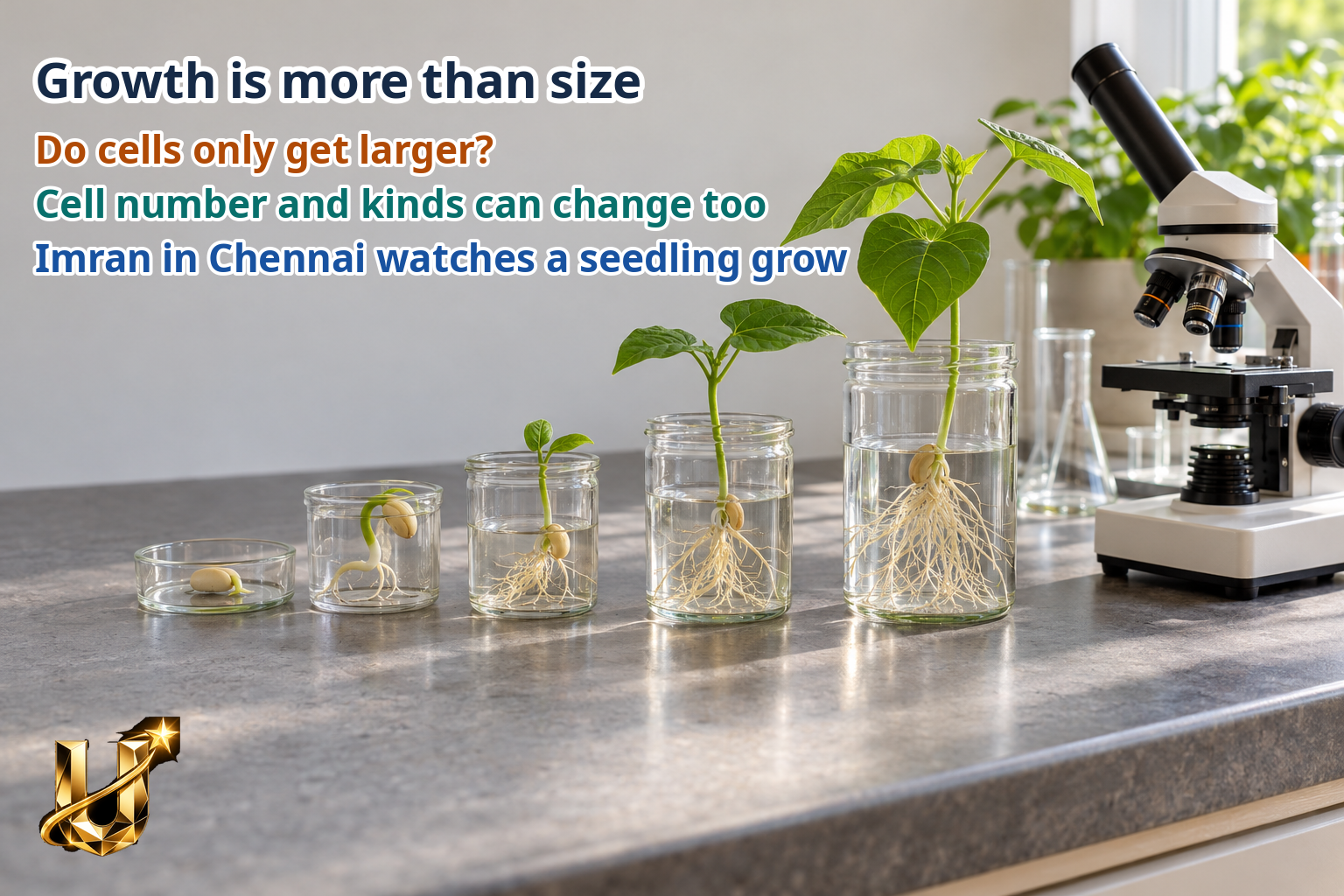
Imran in Chennai watches a seedling grow. Does growth mean every original cell only gets larger, or can the number and kinds of cells change?
Working review group 1; official unit label pending
Imran in Chennai watches a seedling grow. Does growth mean every original cell only gets larger, or can the number and kinds of cells change?
A boundary that permits some substances to cross more readily than others.
Review lesson not available yet.
Imran in Chennai watches a seedling grow. Does growth mean every original cell only gets larger, or can the number and kinds of cells change?
Cells grow and carry out activities during interphase. DNA is copied before ordinary mitosis. Interphase is not a period when all activity stops. Some specialised cells divide rarely or leave the active cycle.
A model cell with 8 chromosomes completes normal mitosis and cytokinesis.
When is DNA copied before ordinary mitosis?
Mitosis distributes copied genetic material into two nuclei. Cytokinesis divides the cell contents, producing two cells in the usual model. Successful mitosis preserves chromosome number in each daughter nucleus; copying DNA is not the same as permanently doubling that number.
Two model cells each divide once, then all resulting cells divide once again.
What does successful mitosis usually preserve?
Division is regulated, and cells can specialise by using different sets of genetic instructions. Specialised structure supports function. Growth and repair involve coordination between cell division, enlargement, differentiation and controlled removal of cells.
A nerve cell has long processes, while a muscle cell is adapted for contraction.
Arrange prepared cards for growth, DNA copying, nuclear division and cytokinesis. Use counters to model cell counts and state the assumptions.
Cells copy DNA before mitosis, preserve chromosome number through successful division, and can specialise for different functions under regulated growth.