
A question from life
Enlarge image
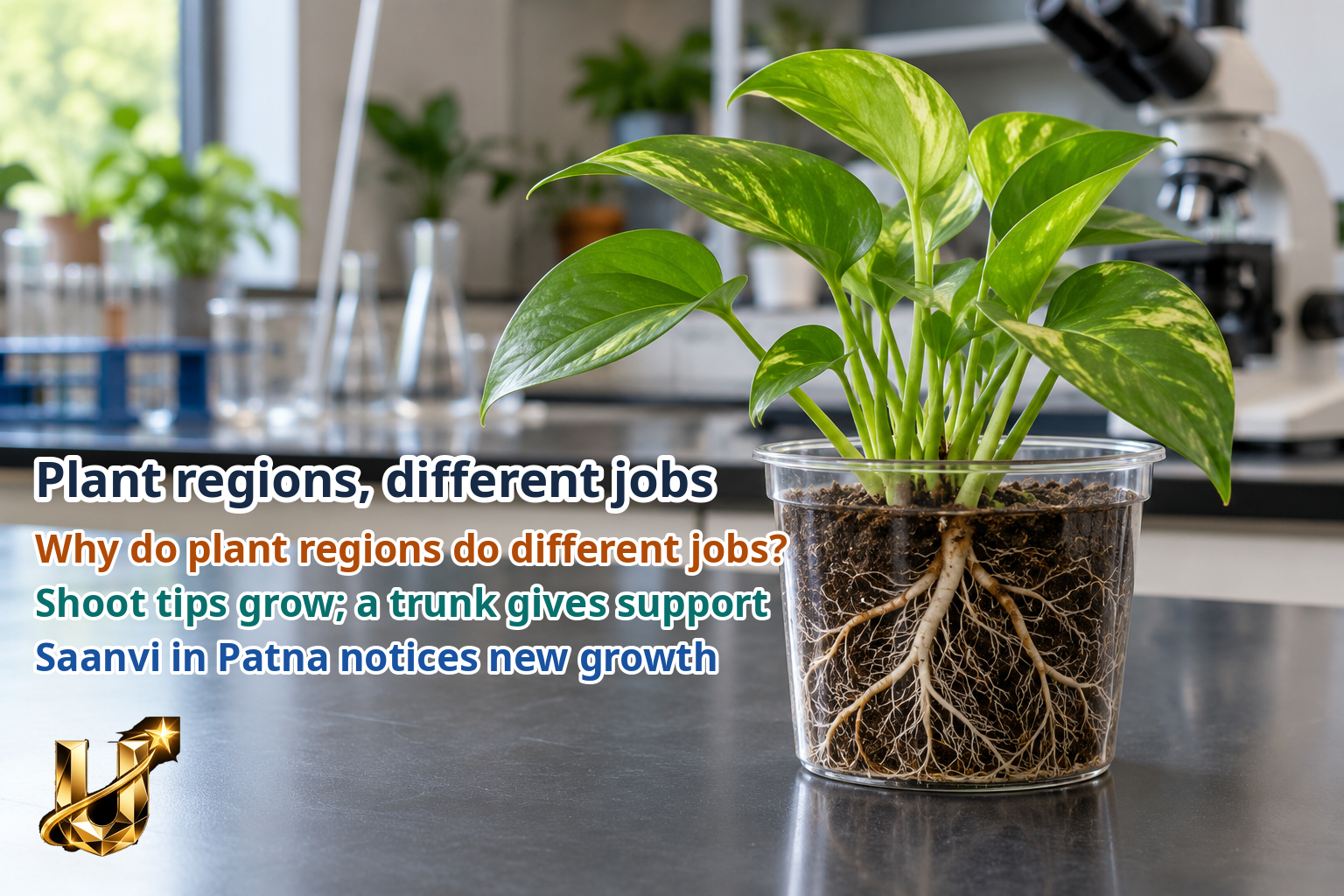
Saanvi in Patna notices that new growth appears near shoot tips while a tree trunk provides support. Why do different plant regions do different jobs?
Working review group 2; official unit label pending
Saanvi in Patna notices that new growth appears near shoot tips while a tree trunk provides support. Why do different plant regions do different jobs?
The development of specialised cell structures and functions.
Review lesson not available yet.
Saanvi in Patna notices that new growth appears near shoot tips while a tree trunk provides support. Why do different plant regions do different jobs?
A tissue is an organised group of cells working together for a function. Plant tissues show division of labour: some regions produce new cells, some make or store food, some support and others transport materials.
A prepared root-tip diagram has a region of many dividing cells.
What is a tissue?
Meristematic tissue contains actively dividing cells, for example at root and shoot tips. Cells derived from these regions can enlarge and differentiate into permanent tissues. Parenchyma commonly supports storage and metabolism; collenchyma provides flexible support; sclerenchyma typically provides strong support with thickened walls.
A young leaf stalk bends while remaining supported.
Where is meristematic tissue commonly found?
Xylem transports water and mineral ions and also supports the plant. Phloem transports sugars and other organic substances between sources and sinks. Transport through phloem is not always simply downward; direction depends on the source and destination.
A plant needs water in leaves and sugar in a growing root.
Match prepared plant-region cards with growth, storage, flexible support and transport. Use existing sections or diagrams; do not cut live plants or handle blades.
Plant tissues divide labour among growth, support, storage and transport. Xylem and phloem have distinct roles, and cells can differentiate after division.