
A question from life
Enlarge image
Aarav in Hyderabad asks how skin, blood, muscle and nerves can all be built from cells yet perform such different functions.
Working review group 2; official unit label pending
Aarav in Hyderabad asks how skin, blood, muscle and nerves can all be built from cells yet perform such different functions.
The development of specialised cell structures and functions.
Review lesson not available yet.
Aarav in Hyderabad asks how skin, blood, muscle and nerves can all be built from cells yet perform such different functions.
Epithelial tissue covers surfaces and lines cavities, with cells arranged to protect, absorb or secrete depending on the site. Connective tissues support and link structures; their cells are distributed in a surrounding matrix. Blood is a specialised connective tissue with a fluid matrix.
An intestinal lining is adapted for absorption.
Which tissue commonly covers or lines surfaces?
Muscle cells can contract. Skeletal muscle supports voluntary body movements, smooth muscle acts in many internal organs, and cardiac muscle forms the heart's muscular wall. Their structures and control differ; one label does not describe every muscle cell.
Blood contains cells suspended in plasma.
Why is blood considered a connective tissue?
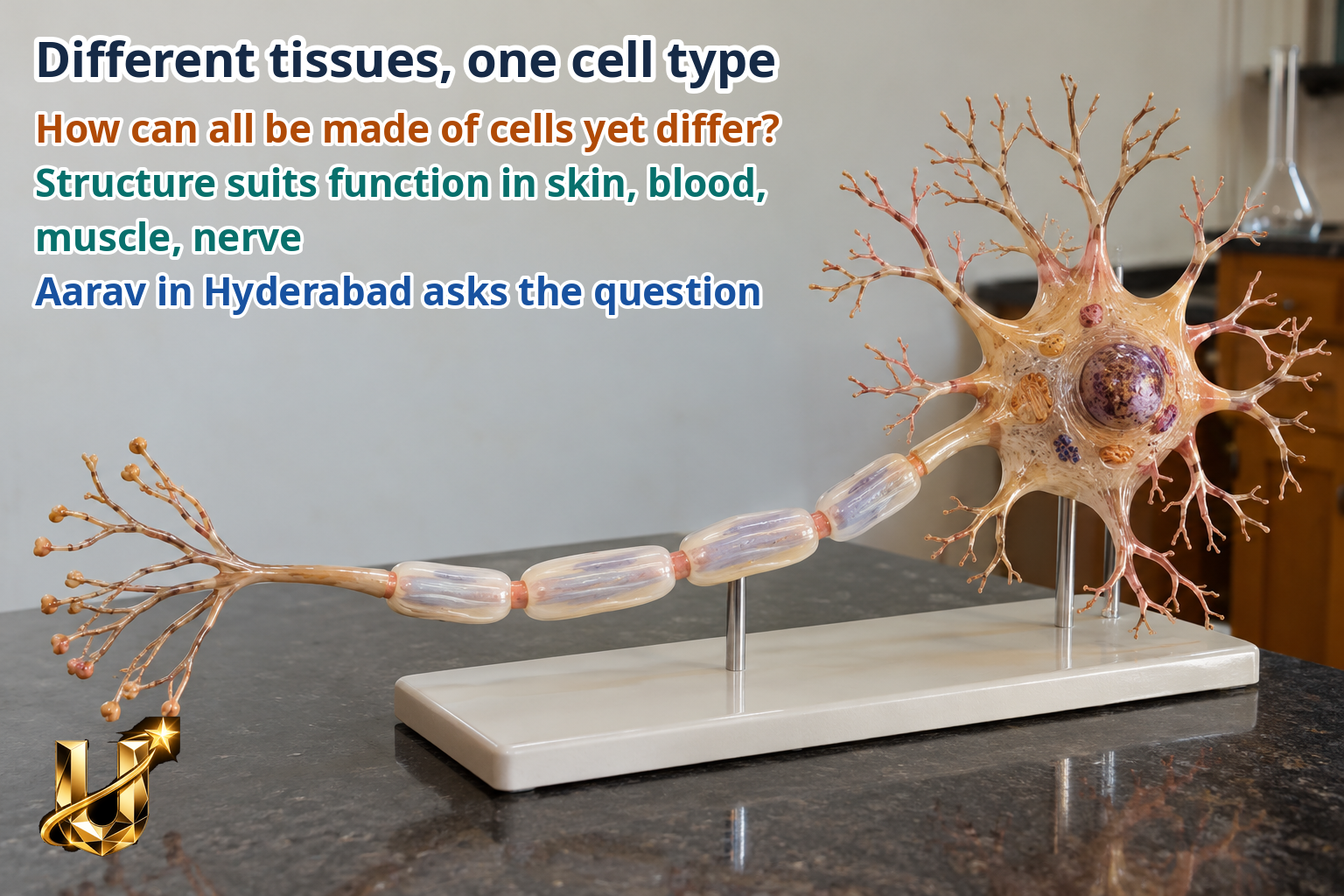
Neurons receive and transmit signals through specialised structures such as dendrites and axons. Supporting glial cells have important maintenance and regulatory roles. Some axons have a myelin sheath that speeds signal conduction; not every axon is myelinated.
A model shows branched receiving regions and a long axon.
Sort teacher-provided tissue images by covering, support/transport, contraction and signalling. Explain one visible feature cautiously; a simplified image cannot reveal every function.
Animal tissues specialise for covering, connection, movement and coordination. Cell structure and surrounding matrix support each tissue's role.