
A question from life
Enlarge image
Enlarge image
Kabir in Delhi has a fictional mixture of sand, salt and water. Should he choose one separation method before deciding which component he wants to recover?
Working review group 3; official unit label pending
Kabir in Delhi has a fictional mixture of sand, salt and water. Should he choose one separation method before deciding which component he wants to recover?
The equilibrium amount of a solute that can dissolve in a specified amount of solvent under stated conditions.
Review lesson not available yet.
Kabir in Delhi has a fictional mixture of sand, salt and water. Should he choose one separation method before deciding which component he wants to recover?
Separation methods exploit differences such as particle size, solubility, density or volatility. First identify the components, the desired product and relevant properties. A method suitable for one component may not recover another. Crystallisation can purify a suitable dissolved solid by forming crystals from a concentrated solution, often on cooling when that solute is more soluble hot than cold. Many soluble impurities remain in the mother liquor. It differs from simply evaporating every drop to dryness and is not guaranteed to remove every impurity.
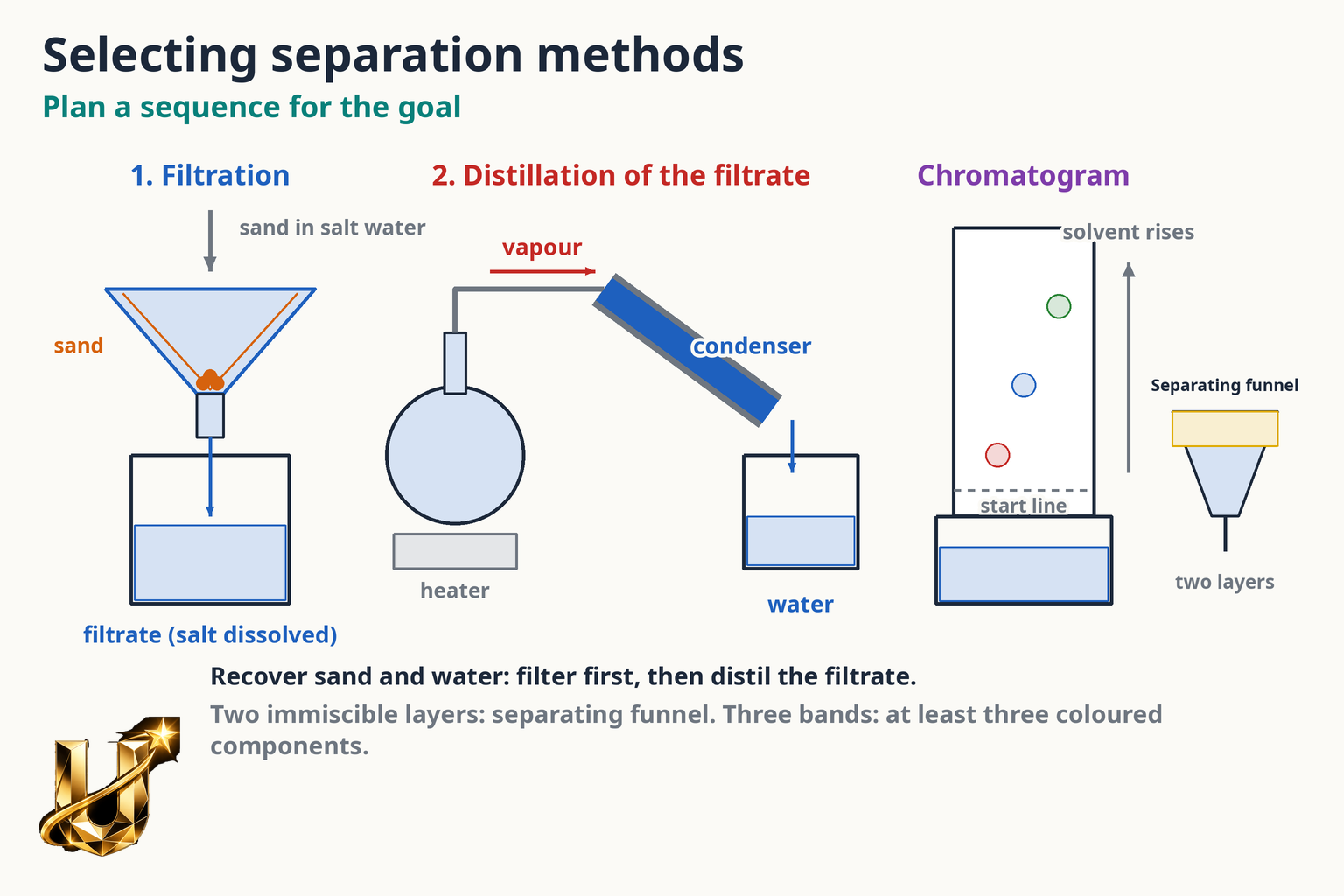
The goal is to recover sand and water from sand in salt water.
Which property supports filtering sand from water?
Filtration can collect an insoluble solid. Evaporation can leave a dissolved solid behind. Distillation adds vapour condensation and collection to recover a volatile component. Boiling point depends on pressure, and mixtures may need more elaborate distillation than a simple model. Centrifugation speeds the separation of components with different sedimentation behaviour by rotating a prepared mixture; denser suspended particles can collect farther from the rotation axis under suitable conditions. The liquid supernatant can then be separated. It does not remove ordinary dissolved salt from water. Use diagrams or supplied results, not improvised high-speed devices.
A prepared diagram shows two immiscible liquid layers.
Which method collects a volatile solvent after evaporation?
A separating funnel can separate suitable immiscible liquid layers by density after settling. Chromatography separates components because they move differently between a moving phase and a stationary material. A colour band is evidence of a component, not by itself proof of its full chemical identity. Coagulation destabilises suitable colloidal particles so they can aggregate into larger flocs, which may then settle and be filtered. It is a distinct stage from disinfection and does not by itself make drinking water safe. Only prepared teacher-managed treatment records are considered here; no household mixing instructions are given.
Prepared process records show (A) crystals growing as a suitable concentrated solution cools, (B) a suspension spun to collect particles, and (C) colloidal particles forming flocs before settling. Identify each process and its limit.
Select a separation sequence from property cards and desired-product cards. Interpret a prepared chromatography image. Use diagrams only; do not heat solvents or operate glass apparatus independently.
Choose separation methods from component properties and the desired product. Filtration, evaporation, distillation, layer separation and chromatography solve different tasks.