
A question from life
Enlarge image
A bus in Bengaluru brakes, and an unrestrained object keeps moving forward relative to the bus. Was there a new forward force on the object?
Working review group 3; official unit label pending
A bus in Bengaluru brakes, and an unrestrained object keeps moving forward relative to the bus. Was there a new forward force on the object?
The vector sum of all external forces acting on the chosen object.
Review lesson not available yet.
A bus in Bengaluru brakes, and an unrestrained object keeps moving forward relative to the bus. Was there a new forward force on the object?
An object tends to maintain its velocity unless a nonzero resultant external force changes it. This is Newton's first law in an inertial reference model. Greater mass means greater inertia; inertia is not a separate forward push.
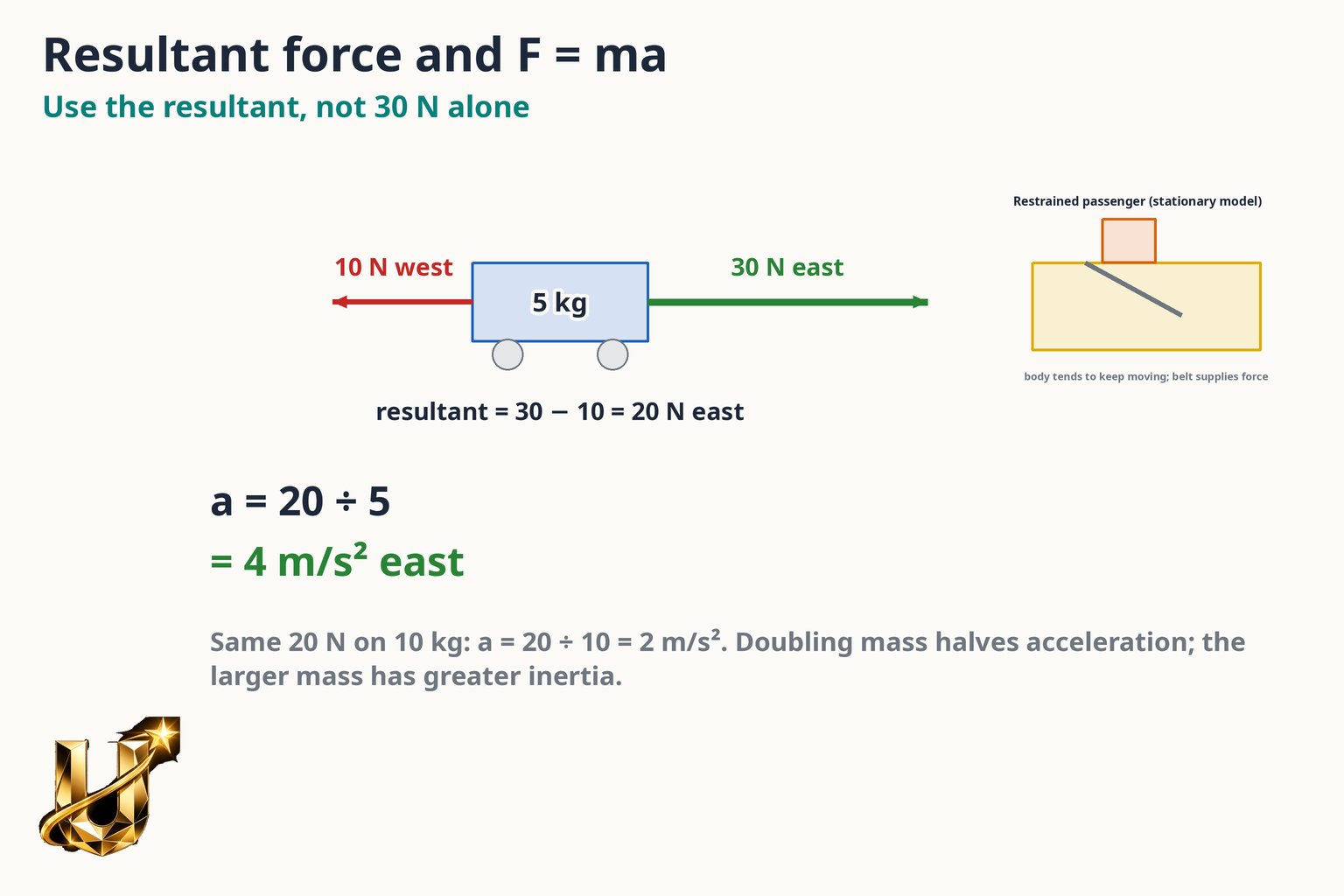
A trolley has 30 N east and 10 N west.
What is inertia?
Several forces may act on an object. Add forces with their directions to find the resultant. Equal opposing forces on the same object can balance. Zero resultant allows rest or straight-line constant velocity.
The trolley mass is 5 kg.
A 24 N resultant acts on 6 kg. What is acceleration?
For constant mass, resultant force equals mass multiplied by acceleration. Acceleration has the direction of the resultant, not necessarily the direction of existing velocity. Use kilograms, m/s² and newtons consistently.
The same 20 N resultant acts on 10 kg instead of 5 kg.
Read prepared force diagrams and calculate the resultant before acceleration. Discuss a fictional braking scene without testing sudden motion on people.
Inertia maintains motion unless a resultant force changes it. Add forces first, then use F = ma with consistent units.