
A question from life
Enlarge image
Aisha in Mumbai pushes a wall and feels it push her hand. If these forces are equal and opposite, why do interaction pairs not cancel each other on one object?
Working review group 3; official unit label pending
Aisha in Mumbai pushes a wall and feels it push her hand. If these forces are equal and opposite, why do interaction pairs not cancel each other on one object?
The vector sum of all external forces acting on the chosen object.
Review lesson not available yet.
Aisha in Mumbai pushes a wall and feels it push her hand. If these forces are equal and opposite, why do interaction pairs not cancel each other on one object?
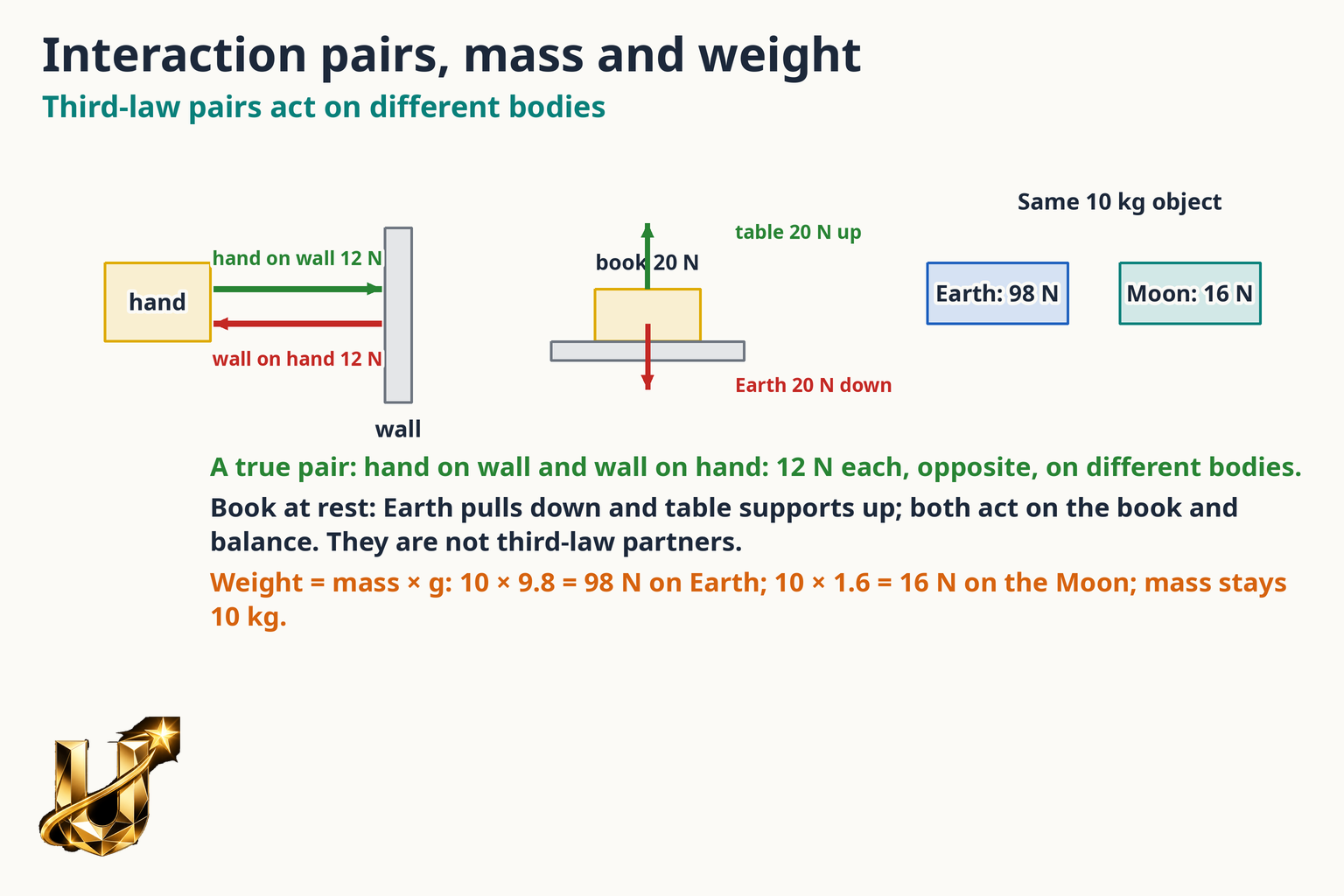
If object A exerts a force on B, B exerts an equal and opposite force on A. These forces act on different objects. They do not cancel when finding the resultant on just one of the objects.
A hand pushes a wall with 12 N.
Where do a third-law force pair act?
Two interacting objects can have equal force magnitudes but different accelerations because their masses differ and other forces may act. Draw a separate force diagram for each object. A rocket can accelerate by pushing exhaust backward; it does not need air to push against.
A book rests on a table with weight 20 N.
What unit measures weight?
Mass is measured in kilograms and describes inertia. Weight is gravitational force, W = mg, measured in newtons. Moving an ordinary object between Earth and Moon changes its weight because g differs, while its mass is approximately unchanged.
A 10 kg object's g values are 9.8 m/s² on Earth and 1.6 m/s² on the Moon.
Use cards naming both force source and receiver. Match interaction pairs, then separately group all forces on one object. No pushing classmates or jumping from boats.
Third-law pairs act on different objects. Equal forces need not give equal accelerations. Mass and weight are distinct quantities with different units.