
A question from life
Enlarge image
Priya in Chandigarh asks how an atom can contain charged particles while an ordinary atom is electrically neutral.
Working review group 4; official unit label pending
Priya in Chandigarh asks how an atom can contain charged particles while an ordinary atom is electrically neutral.
The number of protons in one atomic nucleus.
Review lesson not available yet.
Priya in Chandigarh asks how an atom can contain charged particles while an ordinary atom is electrically neutral.
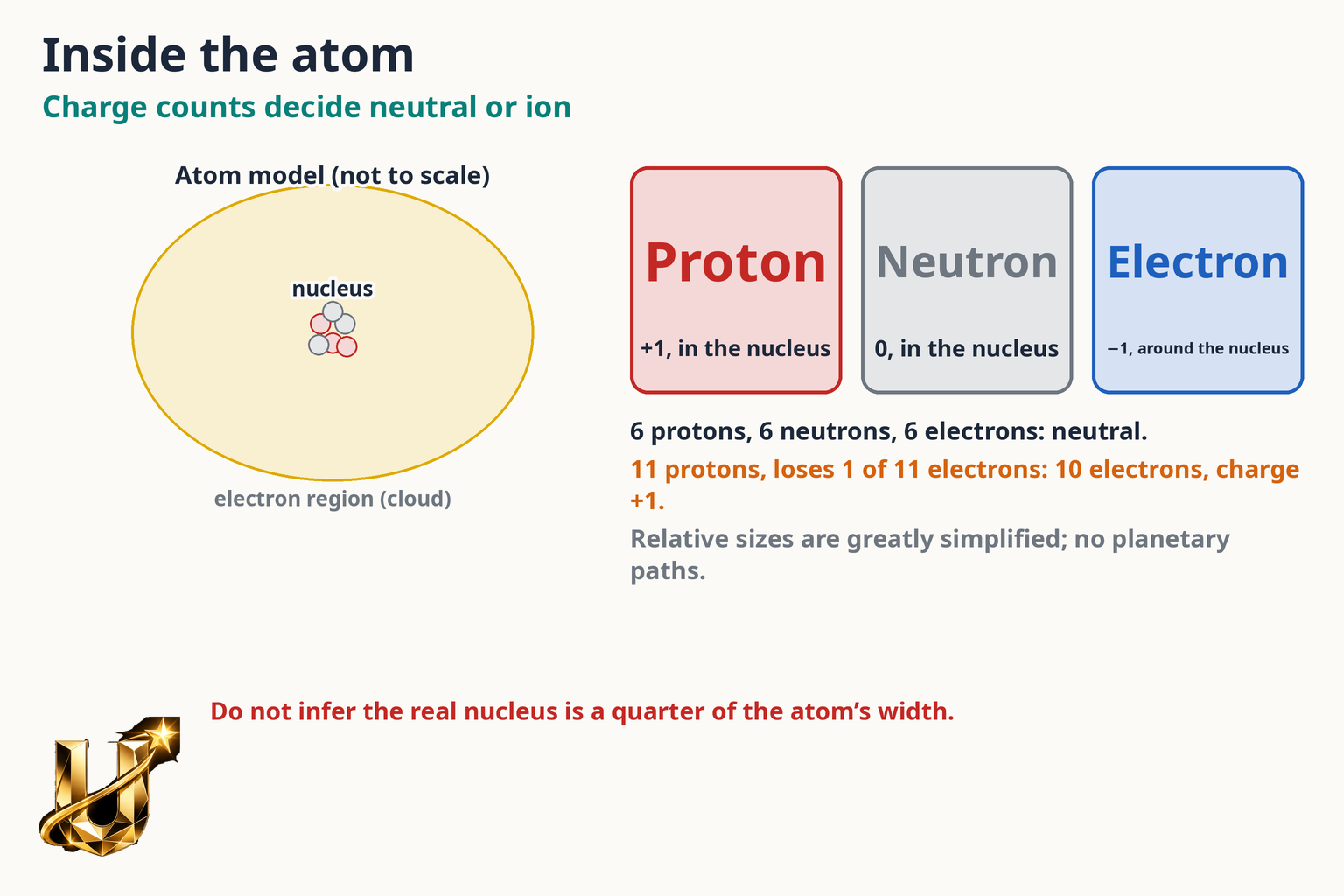
Protons have positive charge, electrons negative charge and neutrons no net charge. Protons and neutrons are in the nucleus; electrons occupy the surrounding atomic region. Electron diagrams are models, not photographs of little planets on fixed tracks.
A model atom has 6 protons, 6 neutrons and 6 electrons.
Which particle has negative charge?
A neutral atom has equal numbers of protons and electrons. Neutrons affect mass but not net electric charge. If an atom loses electrons it becomes a positive ion; gaining electrons makes a negative ion. Ordinary ion formation does not change the proton number.
An atom with 11 protons loses one of its 11 electrons.
What makes an atom neutral?
Most atomic mass is concentrated in a tiny nucleus while the atom's overall volume is much larger. Evidence from scattering helped establish the nuclear model. Common diagrams enlarge the nucleus so it can be seen; they are not to scale.
An atom drawing shows a nucleus one quarter as wide as the atom.
Use particle cards to build neutral atoms and simple ions. Keep proton number fixed while moving electron cards, and explain the resulting charge.
Atoms contain positive protons, neutral neutrons and negative electrons. Charge depends on proton-electron balance; the nucleus is tiny and contains most mass.