
A question from life
Enlarge image
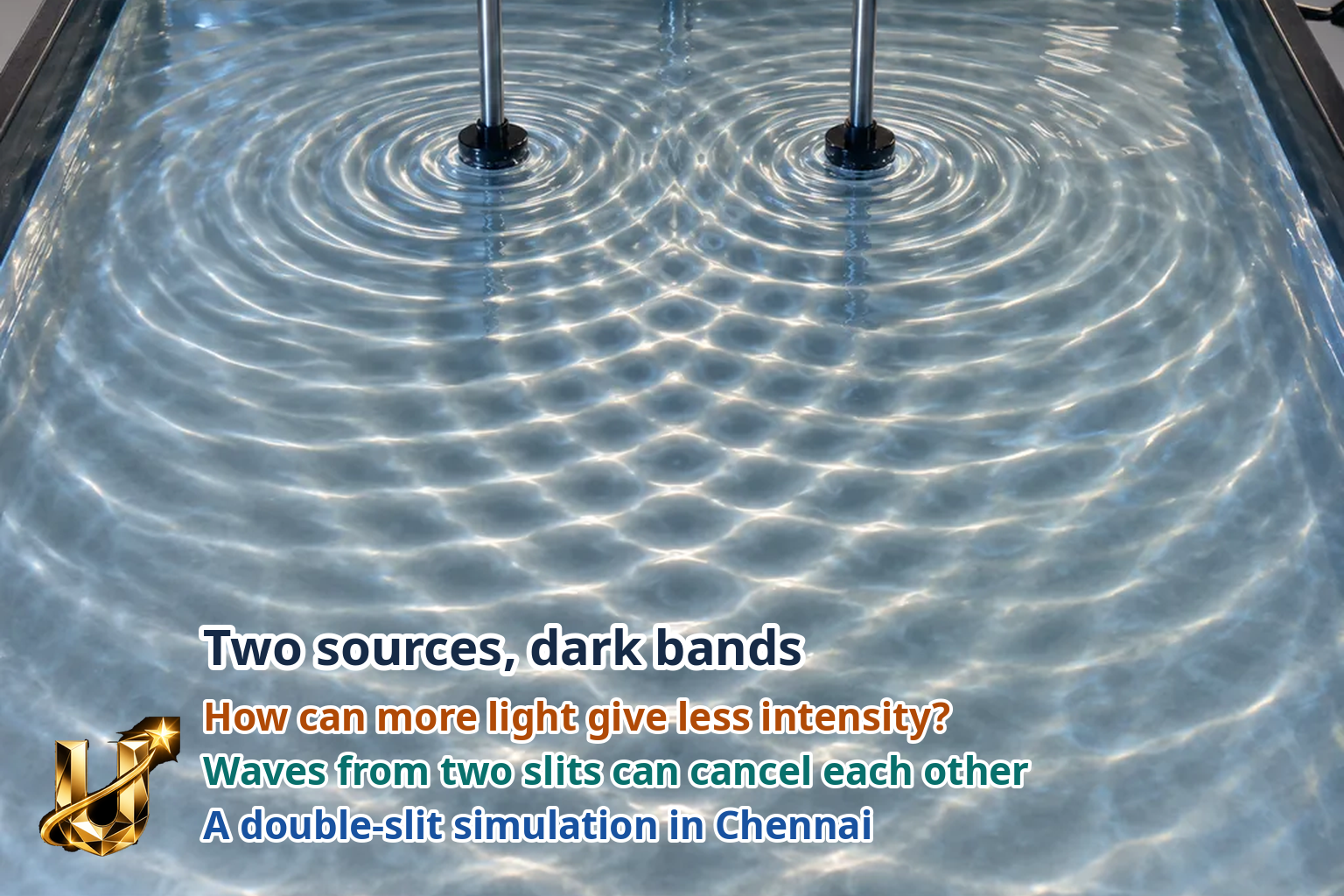
In a Chennai double-slit simulation, two illuminated slits produce dark bands where light from each slit can reach. How can adding light reduce intensity there?
Working review group 5; official unit label pending
In a Chennai double-slit simulation, two illuminated slits produce dark bands where light from each slit can reach. How can adding light reduce intensity there?
A stable relative phase relationship that supports sustained interference.
Review lesson not available yet.
In a Chennai double-slit simulation, two illuminated slits produce dark bands where light from each slit can reach. How can adding light reduce intensity there?
A wavefront joins points of equal phase. Rays are normal to wavefronts in an isotropic medium. Huygens' principle treats each point as a source of secondary wavelets; their forward envelope is the next wavefront. It explains reflection and refraction geometrically, with sin i/sin r=v1/v2=n2/n1.
Two equal-amplitude, in-phase sources reach a point with path differenceλ.
Coherence requires what?
At a point, the electric-field disturbances add. Stable interference needs sources of the same frequency and a constant relative phase; equal frequency alone does not guarantee a fixed phase relation. For equal-polarisation coherent waves, I=I1+I2+2√(I1I2)cosδ. Dark minima reach zero only when amplitudes match and phases oppose.
λ=500nm, D=1.0m, d=0.20mm.
For in-phase slits, path differenceλ/2 gives?
For coherent in-phase slits separated byd, a distant screen atD and small angles give path difference≈dy/D. Bright positions satisfyΔ=mλ; dark positionsΔ=(m+½)λ. Fringe spacingβ=λD/d. UseD≫d and smally/D; a finite slit width also gives a diffraction envelope. Energy redistributes across the pattern rather than being destroyed.
Use that same arrangement and locate them=2 bright fringe.
Superpose two paper sine-wave strips in phase and half a cycle apart. Compare equal and unequal amplitudes, then predict how the double-slit pattern changes whenλ, D ord changes. Use prepared simulation images without lasers.
Wavefronts describe phase geometry. Coherence supports stable interference, and Young's fringe spacing isλD/d under stated approximations. Cancellation redistributes energy.