
A question from everyday life
Enlarge image
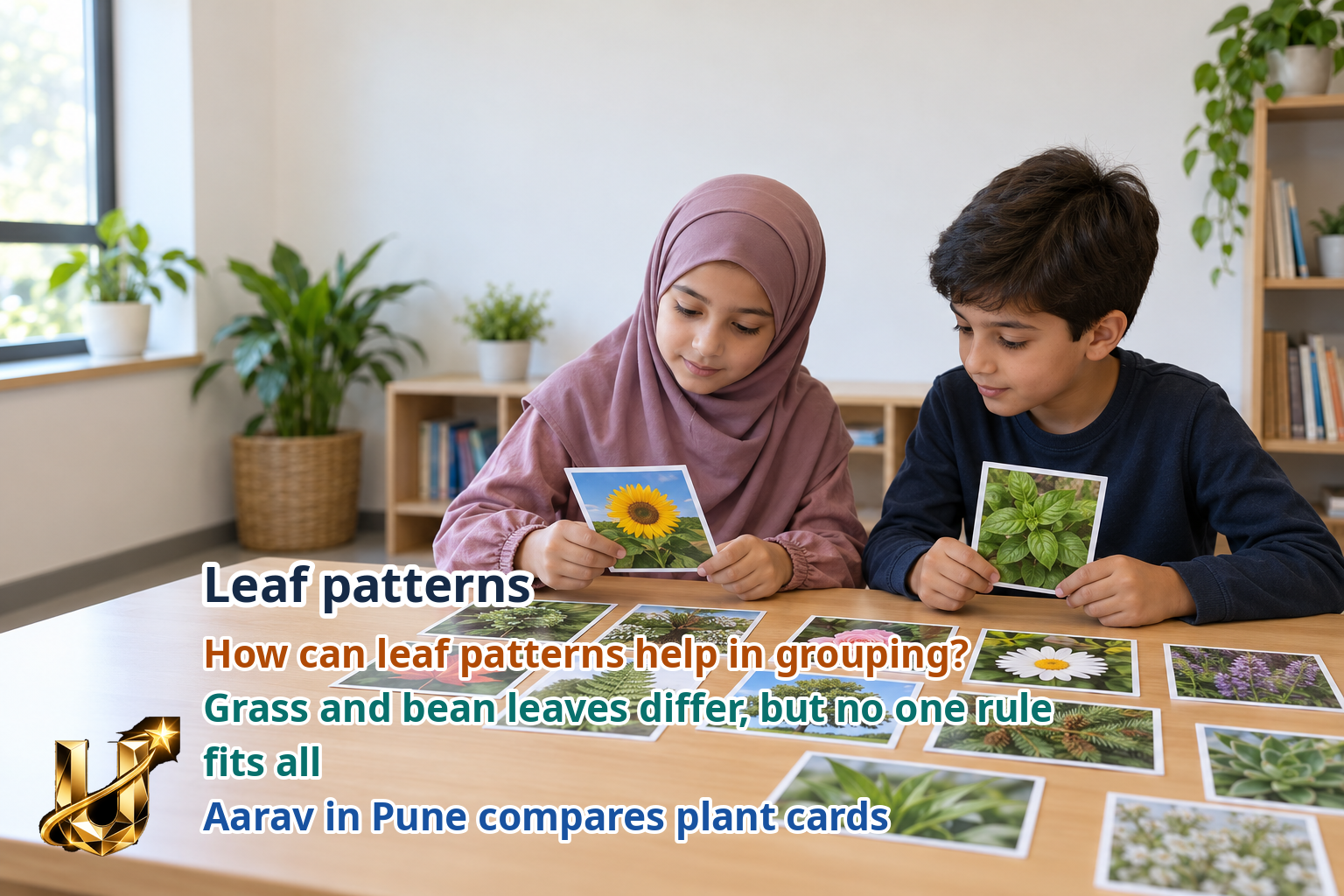
Aarav compares a grass leaf with a bean leaf in Pune. How can leaf patterns help him form a careful grouping without claiming every plant follows one rule?
Working review group 1; official unit label pending
Aarav compares a grass leaf with a bean leaf in Pune. How can leaf patterns help him form a careful grouping without claiming every plant follows one rule?
Organising living things by relevant evidence and stated features.
Review lesson not available yet.
Aarav compares a grass leaf with a bean leaf in Pune. How can leaf patterns help him form a careful grouping without claiming every plant follows one rule?
Veins can form a net-like pattern, called reticulate venation, or run mostly alongside one another, called parallel venation. Observe safe leaves or pictures without plucking or tasting unknown plants.
A leaf image shows veins forming a network. Which venation is shown?
Net-like leaf veins are called:
Taproot systems have a prominent main root; fibrous systems have many similarly sized roots. In familiar examples, many plants with two seed leaves have net-like veins and taproots, while many with one seed leaf have parallel veins and fibrous roots. These are common patterns, not exception-free rules.
One diagram has a thick main root; another has many similar roots. Which is taproot?
A root system with a prominent main root is:
Water, temperature and other conditions affect living things. Features and behaviours may help organisms survive particular surroundings. Do not assume every desert plant has the same roots or every animal responds identically.
A familiar grass example has parallel veins and fibrous roots. Does it prove every plant with one observed feature fits all others?
Compare approved leaf and root diagrams. Identify a vein pattern and root form, then state that a diagram does not prove unseen features of every plant.
Leaf and root patterns support grouping, but common associations have exceptions. Compare specific evidence and surroundings carefully.