
A question from life
Enlarge image
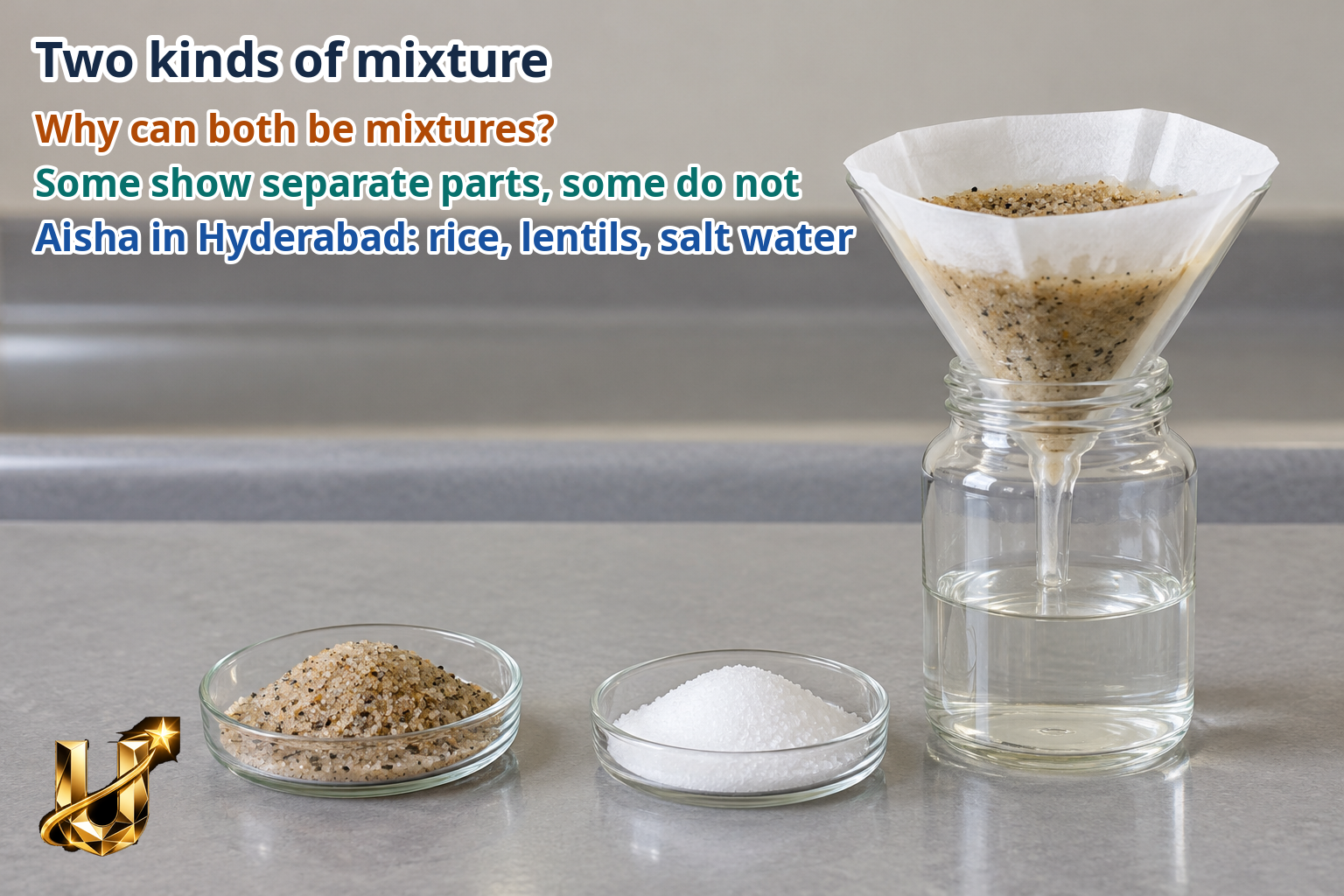
Aisha in Hyderabad sees rice mixed with lentils and salt dissolved in water. Why can both be mixtures even though only one shows separate parts?
Working review group 4; official unit label pending
Aisha in Hyderabad sees rice mixed with lentils and salt dissolved in water. Why can both be mixtures even though only one shows separate parts?
The smallest unit of an element that retains its chemical identity.
Review lesson not available yet.
Aisha in Hyderabad sees rice mixed with lentils and salt dissolved in water. Why can both be mixtures even though only one shows separate parts?
A mixture combines substances without requiring a fixed chemical ratio. Salt water can contain different amounts of salt. A compound has a fixed chemical composition. Mixture components may be separated using differences in physical properties.
A clear salt solution has no visible crystals.
Which is normally a mixture?
A homogeneous mixture is uniform at the scale considered, such as a well-mixed salt solution. A heterogeneous mixture has distinguishable regions, such as sand in water. Air is normally a mixture of gases, not a single element.
A teacher's prepared sequence separates dry sand mixed with salt.
What does ordinary filtration remove from sand-and-salt water?
A sieve uses particle-size differences; filtration removes suitable insoluble solids from liquids. Evaporation can recover a dissolved solid; distillation collects and condenses a volatile component. Ordinary filtration does not remove dissolved salt.
The task is to collect water from salt water.
Choose methods for picture-card mixtures: sand and gravel, sand in water, salt solution. State both the relevant property and the product wanted. Use prepared results rather than heating or tasting samples.
Mixtures may be uniform or non-uniform and can have variable composition. Physical separation depends on component properties and the product to recover.